
If you're trying to figure out how to transition into GRC from another field, the good news is you're probably closer than you think. Governance, risk, and compliance draws heavily on skills that already exist in accounting, IT, legal, business analysis, and operations roles — the trick is learning to translate what you already do into the language this field uses.
You're Probably More Qualified Than You Think
A career change into GRC rarely means starting from absolute zero. If you've ever documented a process, flagged a risk to a manager, followed a regulation, reviewed a vendor contract, or built a checklist to catch errors before they happened, you've already done GRC-adjacent work — you just didn't call it that at the time.
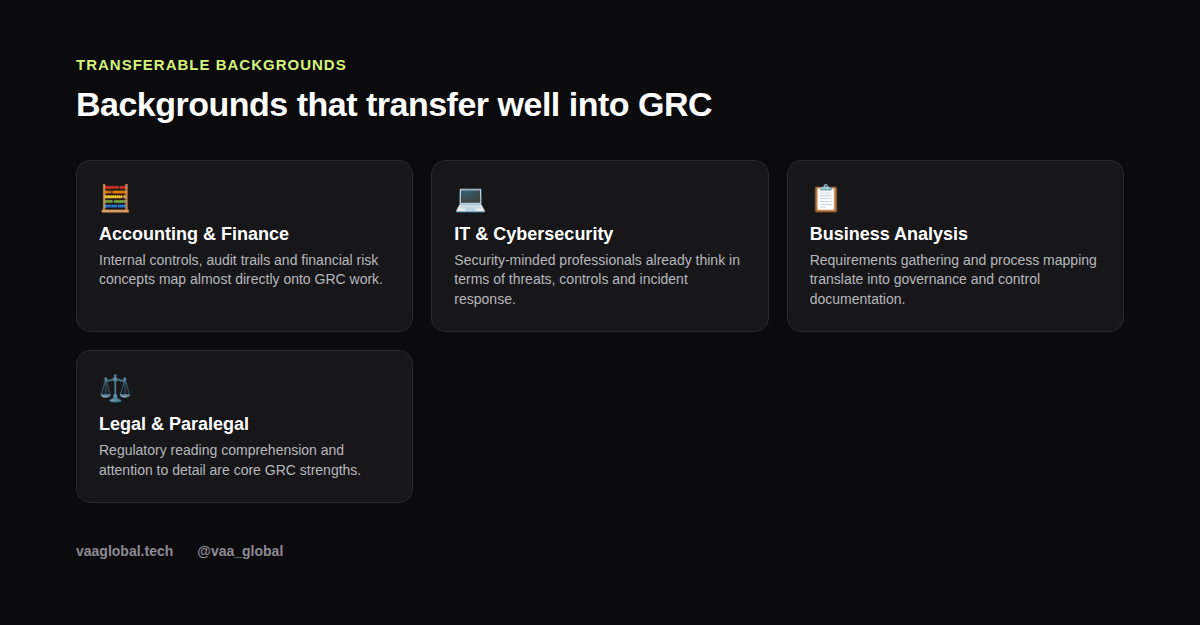
What Skills Transfer Into GRC From Accounting and Finance
Accounting and finance backgrounds transfer unusually well. Internal controls, segregation of duties, audit trails, and financial risk assessment are core accounting concepts that map almost one-to-one onto GRC work. If this is your background, lean into it heavily rather than downplaying it as 'just finance.'
What Skills Transfer Into GRC From IT and Cybersecurity
IT and cybersecurity professionals already think in terms of threats, vulnerabilities, and controls, which is most of the risk half of GRC. Our articles on entry-level cybersecurity jobs that don't require a degree and common cybersecurity tools beginners should learn cover the technical foundation that often sits underneath a GRC risk specialist's work.
What Skills Transfer Into GRC From Business Analysis
Business analysts spend their careers mapping processes, gathering requirements, and documenting how things actually work versus how they're supposed to work — which is essentially governance and control-documentation work by another name. If this is you, our business analyst interview questions and answers piece shows how closely the interview expectations already overlap.
What Skills Transfer Into GRC From Legal and Paralegal Work
Legal and paralegal backgrounds transfer well too, particularly for the compliance side of GRC. Reading dense regulatory text carefully, tracking deadlines, and documenting exactly how a requirement was met are core legal skills that map directly onto regulatory compliance work. If this is your background, emphasize your comfort reading and interpreting formal rules; it's a genuinely scarce skill many GRC teams need.
Rewriting Your CV Around GRC Language
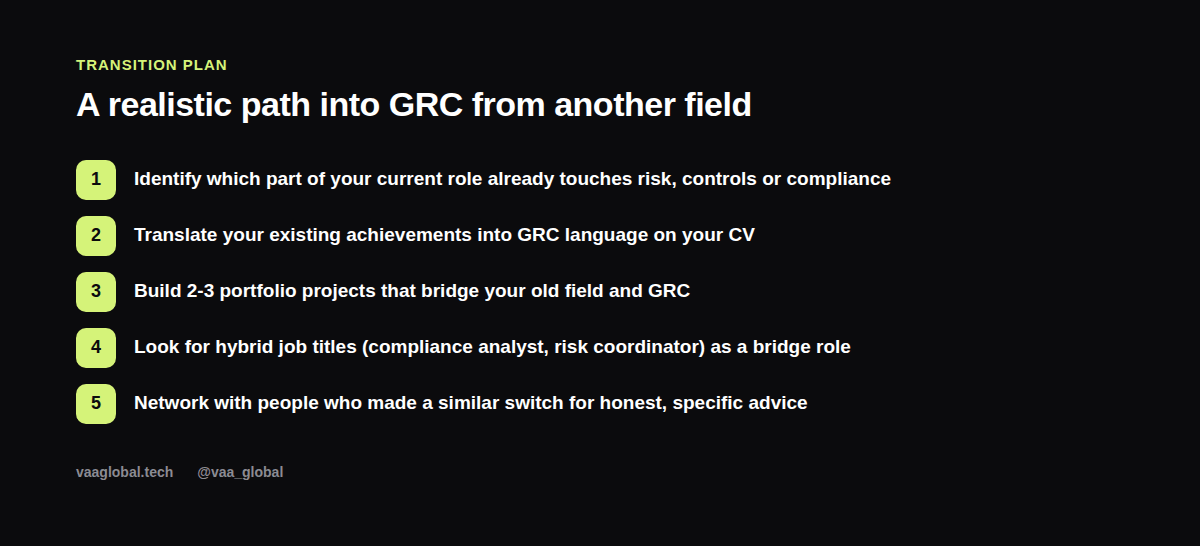
Once you know which parts of your background apply, rewrite your CV's achievements using GRC vocabulary without exaggerating what you did. 'Flagged recurring billing errors and proposed a process fix' becomes language about identifying a control weakness and recommending a remediation. This isn't spin — it's accurately describing work you already did, in terms the next hiring manager will recognize.
Can I Switch Careers Into GRC With No Certification?
Can I switch careers into GRC with no certification at all? Yes, especially for hybrid or junior roles. Most ISACA and ISC2 certifications require experience you likely don't have yet anyway, so a career-change story backed by relevant transferable skills and a small portfolio (see our guide to building a GRC portfolio with no experience) often matters more at this stage than a certification would.
Target Bridge Roles, Not the Top of the Ladder
Is it hard to move into compliance from another career if you aim straight for a senior title? Usually, yes. It's far more realistic to target bridge roles — compliance analyst, risk coordinator, junior audit support — that value your existing background plus a demonstrated interest in GRC, rather than expecting to land a senior GRC manager role on day one of your pivot.
How Long Does It Take to Switch Into GRC?
How long does it take to switch into GRC realistically depends on how closely your current role already overlaps with it. Someone coming from internal audit or security might make the jump within months; someone coming from an unrelated field might need six months to a year of deliberate upskilling, networking, and portfolio-building first. Either way, treat it as a project with milestones, not a single leap. Setting a rough target date, even a loose one, tends to help more than an open-ended 'someday' plan, because it forces you to actually schedule the CV rewrite, the portfolio projects, and the networking conversations instead of letting them slide indefinitely.
Build a Foundation If You're Coming From Somewhere Unrelated
If your current field has little obvious overlap, consider building some structured foundational knowledge first. VAA Global's Business Analysis course covers requirements elicitation and process improvement skills that translate directly into governance documentation work, while the Cybersecurity course builds the risk-and-controls mindset from the security side. Either way, pairing structured learning with real-world context from the certifying bodies themselves helps: ISACA's own career resources are a useful next stop once you've mapped your transferable skills, since they outline the broader governance, risk, and audit career paths you might be aiming toward.
The Bottom Line
You don't need to abandon everything you've built to transition into GRC from another field — you need to translate it. Identify the risk, control, and compliance threads already running through your current work, build a small portfolio that makes the connection explicit, and target bridge roles that reward your combined background rather than waiting for a perfect GRC job to appear.