
Even if you've never set foot in the EU, learning GDPR compliance basics for GRC beginners is worth your time, because GDPR has quietly become the reference point other privacy laws around the world get compared against. This guide covers the core ideas without drowning you in legal language.
What GDPR Actually Is
GDPR is EU legislation that governs the processing of personal data belonging to people in the EU. It replaced a patchwork of earlier national laws with one unified regulation, and because it applies based on whose data is involved rather than where the company is headquartered, it reaches far outside European borders in practice. For the authoritative legal text and official guidance, gdpr.eu is a good starting point.
The Core Data Protection Principles
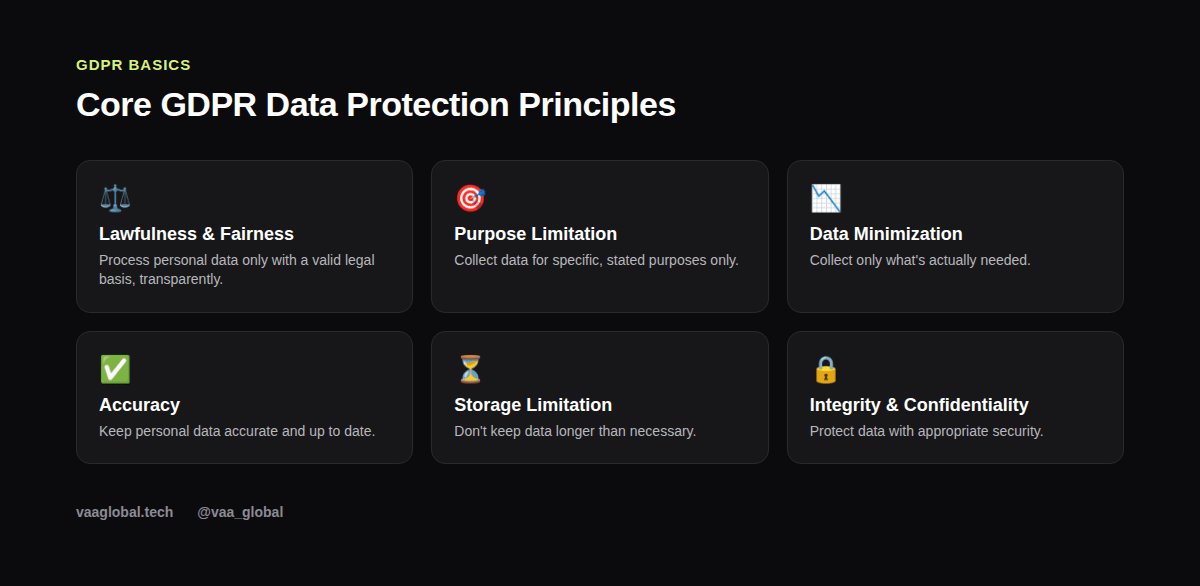
GDPR is built around a handful of core principles, shown in the graphic above: lawfulness and fairness, purpose limitation, data minimization, accuracy, storage limitation, and integrity and confidentiality. Together, these principles push organizations toward collecting less personal data, being transparent about why they're collecting it, and protecting whatever they do hold with appropriate security.
Personal Data: Broader Than You Might Think
Personal data under GDPR covers any information relating to an identifiable person — not just obvious things like names and ID numbers, but also things like IP addresses, location data, and online identifiers in many contexts. This broad definition is one reason GDPR compliance work touches nearly every department in a company, not just legal or IT.
Data Subject Rights
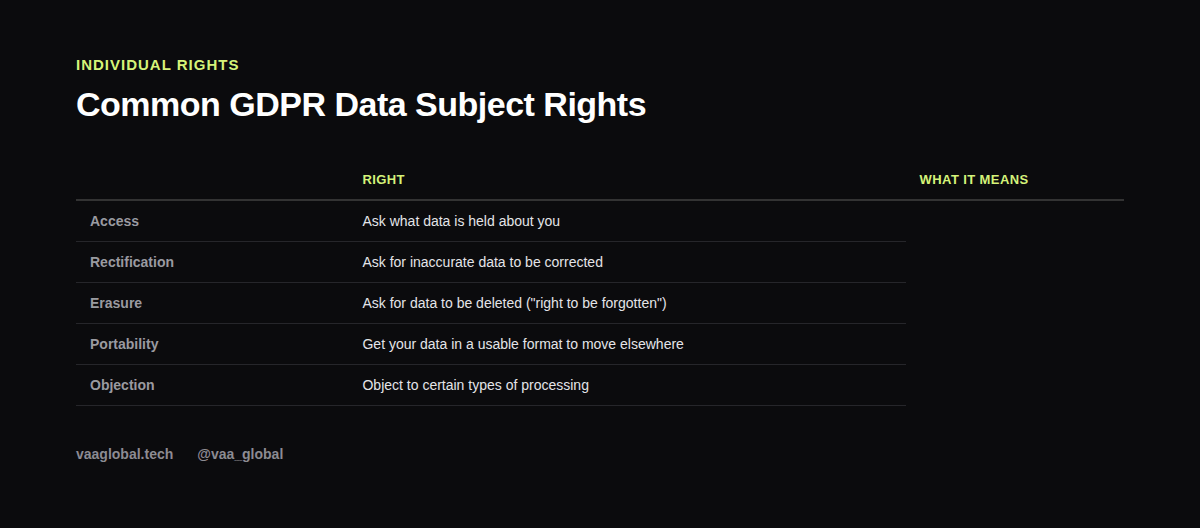
Individuals (called data subjects under GDPR) have specific rights over their own data, summarized in the table below. The right to access lets someone ask what data a company holds about them. The right to rectification lets them correct inaccurate data. The right to erasure, often called the 'right to be forgotten,' lets them request deletion under certain conditions. The right to portability lets them get their data in a usable format to move elsewhere. And the right to object lets them push back on certain types of processing, like direct marketing.
Controllers vs. Processors
GDPR distinguishes between a data controller (the organization that decides why and how personal data is processed) and a data processor (an organization processing data on the controller's behalf, like a cloud vendor). This distinction matters a lot in contracts, because it determines who holds which legal responsibilities, and it's a concept that comes up constantly once you start reading real GDPR-related agreements.
Does GDPR Apply Outside the EU?
Yes, often. GDPR can apply to organizations outside the EU if they process the personal data of people located in the EU, for example by offering goods or services to EU residents or monitoring their behavior. This is exactly why companies in Nigeria, the US, and elsewhere still need to think about GDPR if any of their customers are based in Europe — it's not purely a 'European problem.'
A Simple Example
Say a Nigeria-based e-commerce company starts selling to customers across Europe. Under GDPR, they'd need a lawful basis for processing those customers' personal data, clear privacy notices explaining what they collect and why, and a process for responding to access or erasure requests within a defined timeframe. Getting this wrong isn't just a technical slip — it's the kind of gap a third-party vendor risk management review or a client's own due diligence process would likely catch.
Common Questions Beginners Ask
People often ask what is GDPR in simple terms — a European law giving people rights over their own personal data and requiring organizations to handle that data responsibly. On does GDPR apply outside the EU, as covered above, yes, whenever EU residents' data is involved. People also ask what counts as personal data under GDPR, which is broader than most beginners expect, covering identifiers beyond just names. And what happens if a company violates GDPR — enforcement authorities can investigate and take action, though specific penalties vary by case and should be confirmed through official regulatory guidance rather than a secondhand estimate.
Consent, Breach Notification, and Privacy by Design
Three more concepts round out the GDPR basics every beginner should recognize. Consent is one lawful basis for processing data, but it has to be freely given, specific, and easy to withdraw; a pre-checked box buried in fine print doesn't meet that bar. A data breach, meaning unauthorized access to or loss of personal data, triggers notification obligations that organizations need to plan for well before an incident actually happens, not scramble to figure out afterward. And privacy by design means building data protection into a product or process from the start, rather than bolting it on as an afterthought once something has already gone live. Together, these three ideas show up constantly in real compliance work, often well before anyone talks about GDPR by name.
Building Toward a GRC Career
GDPR knowledge pairs naturally with broader data protection and compliance skills. If you're researching how data privacy concepts compare across regulations, our guide on HIPAA vs. GDPR, what's the difference is a natural next read, and if you want to build technical security skills alongside this regulatory knowledge, VAA Global's Cybersecurity course covers foundational practices that support data protection work in general. It also helps to understand related topics like what is a control in GRC and third-party vendor risk management basics, since vendors handling EU customer data are exactly where GDPR obligations often get tested in practice.
The Bottom Line
GDPR compliance basics for GRC beginners boil down to a simple idea: collect less, be transparent, protect what you hold, and respect the rights of the people whose data you're handling. Learn these fundamentals well, and you'll have a head start on nearly every other privacy regulation you'll encounter later in your career.