People weighing GRC vs compliance officer as career directions are often surprised to learn the two overlap heavily but aren't actually the same thing. Compliance is one piece of the broader GRC puzzle, and understanding exactly where the line sits will help you pick a more accurate job title to search for and a clearer story to tell in interviews.
Is a Compliance Officer the Same as GRC?
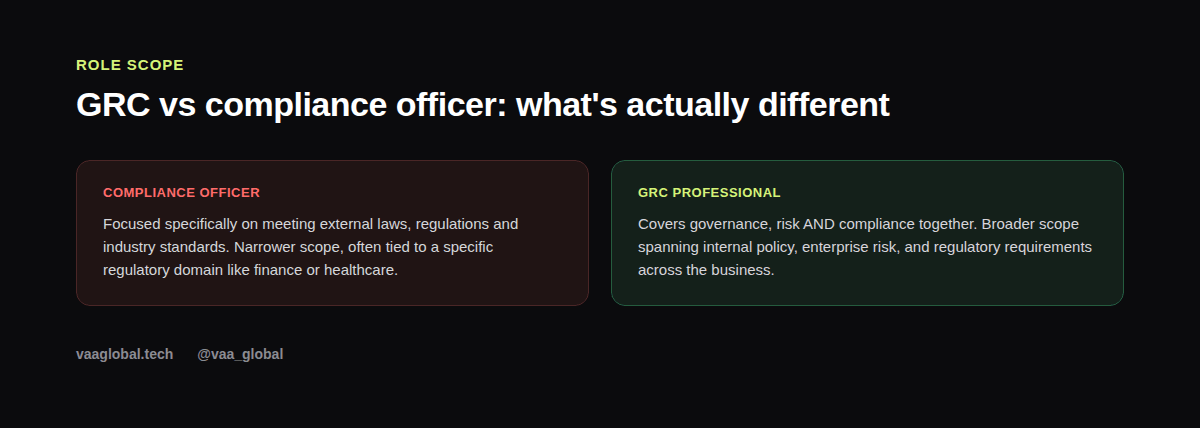
Is a compliance officer the same as GRC, strictly speaking? No. A compliance officer role sits inside the 'C' of GRC. Their job is to make sure the organization follows applicable laws, regulations, and industry standards — think data protection rules, financial reporting requirements, or industry-specific regulations like healthcare privacy laws. GRC is the umbrella term covering that work plus governance and risk management as well.
What a Compliance Officer Actually Does Day to Day
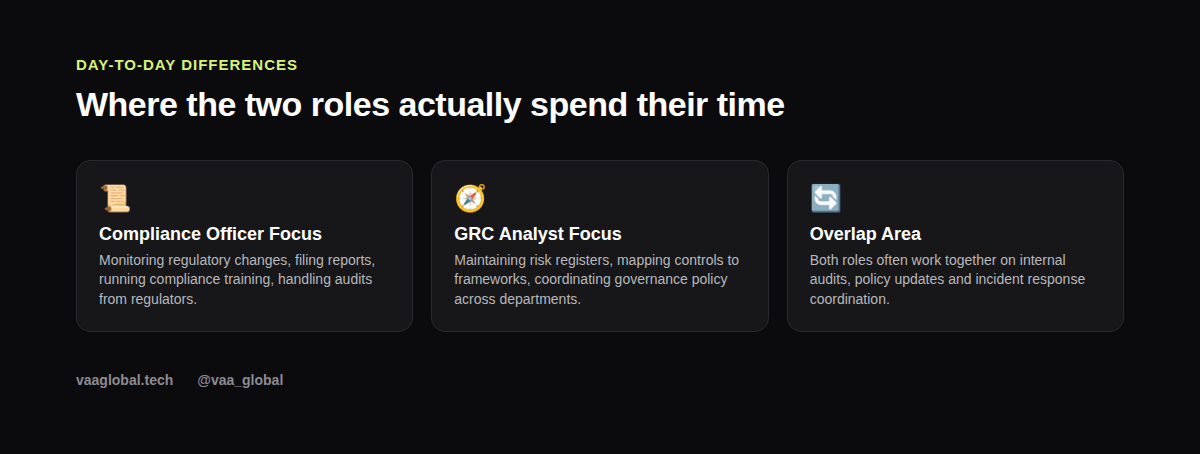
A compliance officer typically monitors regulatory changes relevant to their industry, updates internal policies to reflect new requirements, runs or coordinates compliance training for staff, prepares for and manages regulator audits, and investigates potential violations. The work tends to be deeply tied to the specific laws governing their sector.
What a GRC Analyst Actually Does Day to Day
A GRC analyst role, by contrast, often spans multiple areas: maintaining the organization's risk register, mapping internal controls to recognized frameworks, supporting internal audits, and coordinating governance policy across departments — which might include compliance requirements, but also broader operational and strategic risk that has nothing to do with external regulation.
Where the Two Roles Genuinely Overlap
In smaller organizations especially, these roles blur together constantly. A single person might hold a 'compliance and risk' title and do both jobs. Internal audits, incident response coordination, and policy updates are common meeting points where compliance officers and GRC analysts work side by side or even occupy the same desk. In fact, in a lot of small-to-mid-sized Nigerian companies and startups, you'll see one person wearing both hats out of necessity rather than design, which is worth knowing if you're evaluating a job description that mixes language from both roles.
How to Tell Which One a Job Posting Actually Is
Job titles in this space are notoriously inconsistent, so read the actual listed responsibilities rather than the title alone. If the posting talks almost exclusively about a specific law or regulatory filing, it's leaning compliance officer. If it talks about risk registers, control frameworks, and cross-departmental governance policy, it's leaning GRC analyst. Many postings genuinely blend both, which simply reflects how blurred these roles are in practice, especially at smaller organizations that can't afford to split the function into two dedicated hires.
Do I Need Different Skills for Compliance vs GRC?
Do I need different skills for compliance vs GRC specifically? Compliance work rewards deep regulatory knowledge in a specific domain and careful, detail-oriented reading comprehension. GRC work rewards that same attention to detail plus broader systems thinking — the ability to see how governance, risk, and compliance connect across an entire organization rather than within one regulatory lane. Neither skill set replaces the other; they layer.
Which Career Path Fits You Better
If you're drawn to becoming a true specialist in one regulatory area — say, data privacy or financial services regulation — a dedicated compliance officer path might suit you better long-term. If you'd rather work across governance, risk, and compliance broadly and don't want to be boxed into one regulatory domain, governance risk and compliance careers as a generalist GRC analyst are the better fit. Our piece on specializing versus staying a generalist covers this broader career decision in more depth.
Which Pays More, GRC or Compliance?
Which pays more GRC or compliance is genuinely hard to answer in general terms, because pay depends heavily on industry, seniority, location, and whether the role requires a specific high-demand regulatory specialty (financial services and healthcare compliance roles, for instance, often command a premium). Rather than relying on a single generic number, research current postings for the specific regulatory compliance jobs or GRC roles in your target industry and region, the same way you would for any operations or management career path where pay varies by sector.
How Certifications Map to Each Path
If you're leaning compliance-specific, industry certifications tied to your sector matter more. If you're leaning GRC-broad, credentials like CISA or CRISC from ISACA (covered in our best GRC certifications for beginners guide) carry more direct weight, since they're built around the broader governance and risk discipline rather than one specific regulation.
The Bottom Line
The GRC vs compliance officer question ultimately comes down to scope: compliance is one important piece inside the larger GRC picture, not a separate competing field. Decide based on whether you want deep specialization in one regulatory area or broader exposure across governance, risk, and compliance together, and let that decision guide which job titles and certifications you pursue next. If you're still unsure, it's perfectly reasonable to apply to both kinds of roles early in your search and let the actual day-to-day work at each company tell you which direction fits better, rather than trying to decide everything from a job title alone.