If you've just landed a GRC role, learning how to handle vendor questionnaires properly will save you hours every single week, because these requests show up constantly once your company starts selling to bigger customers. A vendor security questionnaire is a standard way for a prospective customer, or their security team, to evaluate whether your company's data handling and security practices meet their bar before they'll sign a contract.
What Is a Vendor Security Questionnaire?
What is a vendor security questionnaire, exactly? It's a standardized (or sometimes custom) list of questions a prospective customer sends to assess your company's security and compliance posture before doing business with you. Questions typically cover data encryption, access controls, incident response, employee security training, and sometimes subcontractor or sub-vendor management. Some companies use industry-standard templates, like the Standardized Information Gathering (SIG) questionnaire, while others write their own custom version, which usually takes longer to answer.
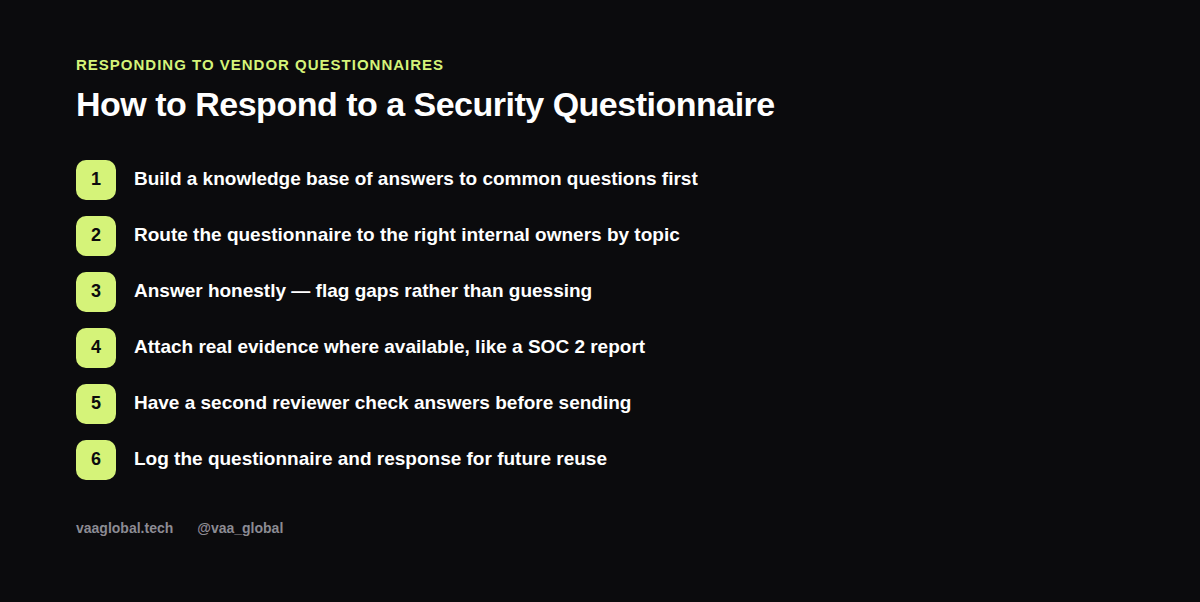
Step 1: Build a Knowledge Base First
The single biggest time-saver is building a knowledge base of answers to the most common questions before you need them. Most security questionnaires cover the same core topics — encryption, access control, incident response, data retention — over and over, worded slightly differently each time. A searchable repository of pre-approved answers turns a two-day questionnaire into a two-hour one, since most of the work becomes matching existing answers to new phrasing rather than writing from scratch each time.
Step 2: Route Questions to the Right Owners
Who answers security questionnaires at a company varies by size, but it's almost never one person alone doing all of it well. A GRC analyst or sales engineer often coordinates the response, but technical questions about encryption or infrastructure should go to engineering, HR-related questions about background checks go to HR, and legal questions about data processing agreements go to legal. Routing the right question to the right owner, rather than guessing centrally, is what keeps answers accurate.
Step 3: Answer Honestly — Including Gaps
This is the step beginners get wrong most often: when the honest answer is "no" or "partially," say so, and explain the compensating control or planned timeline if there is one. Overstating your security posture on a questionnaire is a real liability — if a gap you claimed didn't exist later causes an incident, that false answer becomes a serious problem in any resulting dispute. Customers generally respect a precise, honest "not yet, but here's our plan" far more than a confident answer that later turns out to be wrong.
Step 4: Attach Real Evidence
What evidence goes with a security questionnaire depends on the question, but common attachments include a current SOC 2 report, a penetration test summary, your written incident response plan, or a security awareness training completion record. Attaching real evidence, rather than just a written claim, speeds up the buyer's own review and builds trust — it signals you have the documentation discipline to back up what you're saying.
Step 5: Second-Review Before Sending
A second set of eyes catches mistakes the first writer missed — an outdated fact, an answer that contradicts another answer elsewhere in the same questionnaire, or a claim that isn't actually backed by current evidence. This review step matters more as the stakes go up; a questionnaire tied to a major enterprise deal deserves more scrutiny than a routine renewal from an existing customer.
Step 6: Log Everything for Reuse
Every completed questionnaire should get logged — the questions asked, the answers given, and the evidence attached — in your knowledge base. This isn't just about saving time on the next one; it also creates an audit trail showing what you represented to each customer, which matters if a dispute or audit ever asks you to explain a past answer.
A Worked Example: Answering a Real Question
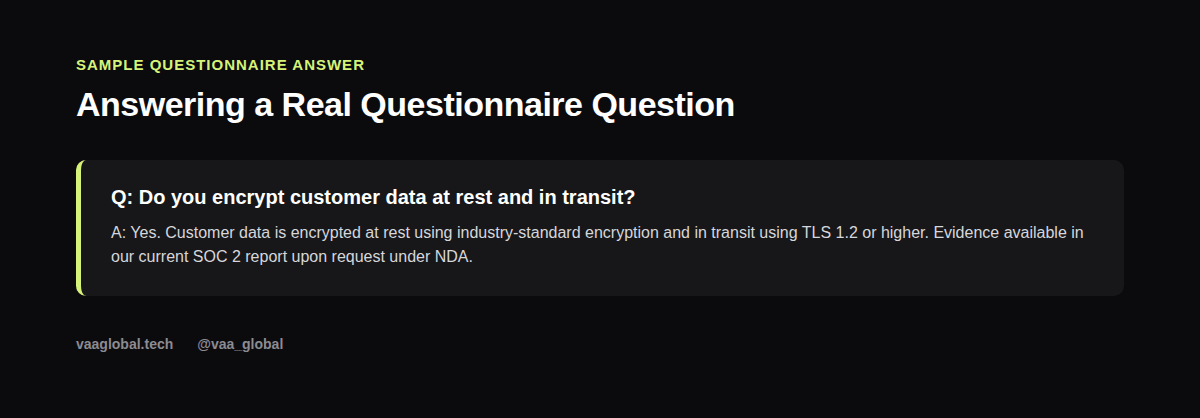
Take a common question: "Do you encrypt customer data at rest and in transit?" A weak answer just says "yes." A strong answer is specific: "Yes. Customer data is encrypted at rest using industry-standard encryption and in transit using TLS 1.2 or higher. Evidence available in our current SOC 2 report upon request under NDA." The specific version gives the reviewer something concrete to check, and it points to real evidence instead of asking them to just trust the claim.
How Long Does a Security Questionnaire Take?
How long does it take to answer a security questionnaire depends heavily on whether you have a knowledge base ready. A well-prepared team can turn around a standard questionnaire in a day or two. A team starting from scratch, writing every answer fresh and chasing down evidence as they go, can easily spend a week or more on a single lengthy custom questionnaire.
Why This Skill Matters for GRC Careers
Handling vendor security questionnaires is one of the most common day-to-day responsibilities for a GRC analyst, especially at B2B companies, and it connects directly to how to prepare for a SOC 2 audit, since the same evidence often gets reused across both. If you're building GRC skills from a security background, VAA Global's Cybersecurity course covers the foundational security concepts — encryption, vulnerability management, incident response — that these questionnaires constantly ask about. It also pairs well with the structured communication skills covered in business analyst interview questions and answers, since clear, precise writing matters just as much here. The AICPA is a useful reference for understanding what a SOC 2 report actually attests to, which helps when you're deciding what evidence to cite in a questionnaire response. For readers comparing adjacent remote career paths, top remote jobs for Nigerians in 2026 is worth a look too.
The Bottom Line
Getting good at responding to vendor security questionnaires is mostly about preparation and honesty: build your knowledge base early, route questions to real owners, never overstate your security posture, and always back up claims with real evidence. Companies that treat this as a routine, well-organized process close deals faster than companies scrambling to answer every questionnaire from a blank page.