If you have an interview coming up, business analyst interview questions and answers are probably the first thing you are searching for right now, and that is a smart place to start. Interviewers for business analyst roles usually test three things at once: whether you understand the fundamentals, whether you can communicate with non-technical stakeholders, and whether you can think through a messy, real-world problem on the spot. Because most beginners have never sat in a BA interview before, the format itself can feel intimidating even when the questions are not actually that hard.
Why Business Analyst Interviews Feel Different From Other Tech Interviews
Unlike a developer interview, a business analyst interview rarely involves writing code on a whiteboard. Instead, interviewers want to see how you think, how you listen, and how you turn a vague business problem into something a development team can act on. As a result, many of the questions are open-ended, and there is often no single correct answer. This is actually good news for beginners: you do not need years of experience to sound credible, you need structure, curiosity, and a clear process for approaching ambiguity.
Fundamentals Questions You Should Expect
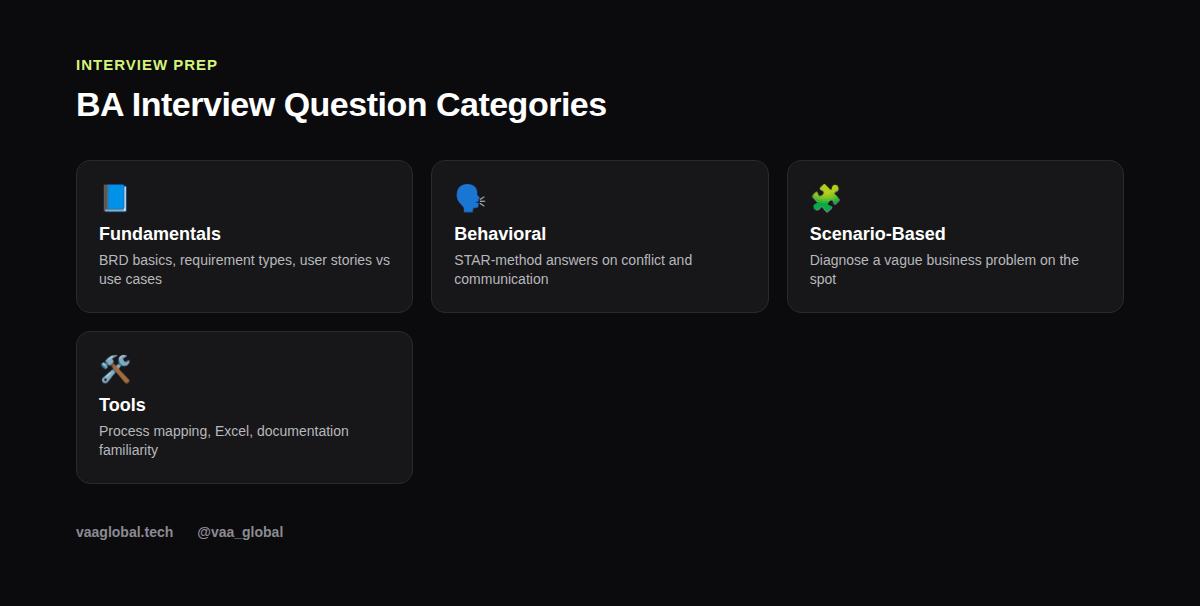
Every entry-level interview includes a round of fundamentals. These check that you know the vocabulary and can apply it, not just recite it. Common examples include:
- 'What is a business requirements document, and what belongs in one?'
- 'What is the difference between functional and non-functional requirements?'
- 'Explain the difference between a user story and a use case.'
- 'What is a SWOT analysis, and when would you use one?'
- 'How do you prioritize requirements when stakeholders disagree?'
For a deeper walkthrough of one of these specifically, see our guide on how to write a business requirements document, which covers the exact sections interviewers expect you to name.
Sample Answer: Walk Me Through How You Would Gather Requirements for a New Feature
This is one of the most common scenario questions, so it is worth having a structured answer ready. Here is an example of how a strong beginner answer sounds:
Notice that this answer is specific about method (interviews, surveys, documentation, sign-off) rather than vague. That specificity is what separates a memorable answer from a forgettable one.
Behavioral Questions and the STAR Method
Behavioral questions test soft skills: communication, conflict resolution, and adaptability. Interviewers commonly ask things like 'tell me about a time you had to explain a technical concept to a non-technical stakeholder' or 'describe a situation where requirements changed midway through a project.' Because these questions are about your past actions, the STAR method (Situation, Task, Action, Result) is the easiest way to structure an answer without rambling. For example, when asked about conflicting stakeholder needs, describe the situation briefly, the task you were responsible for, the specific action you took to reconcile the conflict, and the measurable or observable result. If you are new to the field and do not have a job history to draw from yet, use a practice project, a course assignment, or even a volunteer scenario; interviewers mainly want to see your reasoning process.
Technical and Tool-Based Questions
Many interviews also probe your familiarity with common business analyst tools, since day-to-day BA work involves documenting and visualizing processes. Expect questions such as 'which tools have you used for process mapping?' or 'how comfortable are you with Excel for data analysis?' Even as a beginner, you should be able to speak to at least basic process-mapping tools and spreadsheet functions. Our article on the best tools for business analysts as a beginner is a good primer if you are not yet comfortable naming specific tools in an interview.
How to Build a Business Analyst Interview Preparation Routine
Good business analyst interview preparation is not about memorizing answers word for word. Instead, treat it like building a small habit over a week or two. Spend fifteen minutes a day on requirements gathering interview questions, review one behavioral prompt, and practice saying your answer out loud. This matters because entry level business analyst questions often sound simple on paper but get harder to answer clearly under pressure. A short, consistent routine beats one long cramming session the night before. Here are a few practical BA interview tips worth repeating to yourself before you walk in: speak in plain language, use real examples, and never bluff a term you don't actually know.
Scenario and Problem-Solving Questions
Scenario questions simulate the ambiguity of real BA work. A typical prompt might be: 'A department says their current process is too slow, but they cannot explain why. How would you investigate?' The strongest answers walk through a logical sequence: observe the process directly, interview the people doing the work, map the current state, identify bottlenecks, and only then propose changes. Avoid jumping straight to a solution before you have mapped the problem; interviewers notice when candidates skip the diagnostic step, because that is exactly the mistake junior analysts make on the job.
Questions About Agile and Process Improvement
Because most modern teams work in agile environments, you should expect at least one question like 'how do you handle changing requirements in an agile sprint?' or 'what is your experience with backlog grooming?' You do not need to claim deep agile certification as a beginner, but you should be able to explain the basic cadence of sprints, standups, and backlog refinement, and how a BA's role shifts slightly depending on team structure.
Questions You Should Ask the Interviewer
Interviews go both ways, and asking thoughtful questions signals genuine interest. Consider asking: 'What does a typical week look like for a BA on this team?', 'How does the team currently handle changing requirements mid-sprint?', or 'What tools does the team use for documentation and process mapping?' These questions also give you useful information for deciding if the role is a good fit, which matters just as much as impressing the interviewer.
How to Prepare in the Week Before Your Interview
Spend a few days building a short portfolio of practice artifacts: a sample requirements document, a simple process diagram, and a one-page project summary you can speak to confidently. If you have not built anything yet, our guide on business analyst portfolio projects for beginners walks through exactly what to create. Additionally, review common terminology daily rather than cramming the night before, since interviewers can usually tell when an answer is memorized rather than understood.
The Bottom Line
Business analyst interview questions and answers follow a predictable pattern once you have seen a few rounds: fundamentals to test knowledge, behavioral questions to test communication, and scenarios to test judgment under ambiguity. Because the field rewards structured thinking over memorized facts, the best preparation is practicing how you explain your reasoning out loud, not just what you know. If you want a structured path into the field before you start interviewing, our 10-week Business Analysis course covers requirements elicitation, requirements modelling, process improvement, data analysis, solution evaluation, and agile business analysis, so you walk into interviews with real practice behind you. For more context on what the role looks like once you land it, see our piece on a day in the life of a remote business analyst, and if you are still deciding whether this path fits you at all, read how to become a business analyst in 2026 for the bigger picture. You might also check the OWASP documentation if your BA work ever touches security-adjacent requirements, since cross-functional awareness is increasingly expected even in pure business roles.