
Curious what a remote business analyst, day in the life, actually involves? It looks less like constant meetings and more like a rhythm of focused documentation time broken up by short, purposeful conversations. Because the role sits between stakeholders and development teams, remote BAs spend their day moving between listening, writing, and clarifying, often across multiple time zones. If you're considering this career path, understanding the actual daily rhythm matters more than the job description ever tells you.
Morning: Checking In Before the Day Starts
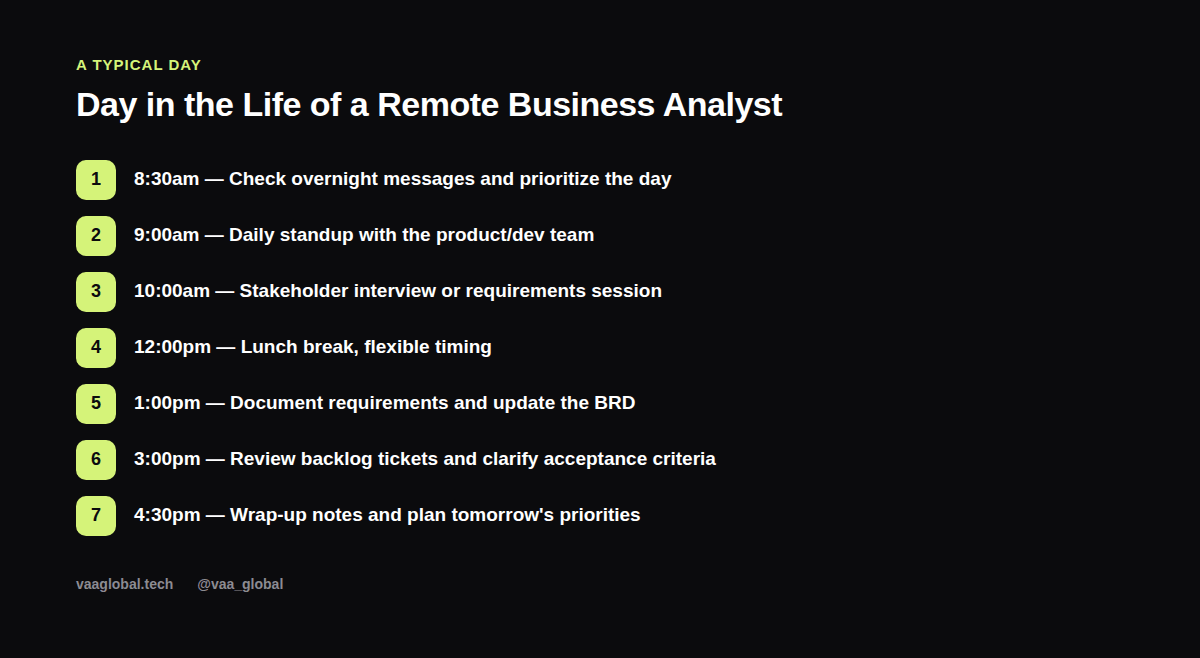
Most remote BAs start by reviewing overnight messages, since teams working across time zones often leave questions or updates while you were offline. This is less about urgency and more about triage: deciding what needs a response now, what can wait, and what actually needs a live conversation instead of a written one. A daily standup, usually 15 minutes, follows shortly after, where the BA shares blockers and aligns with the development team on priorities for the day.
Mid-Morning: Stakeholder Interviews and Requirements Sessions
This is often the most unpredictable part of the day, because stakeholder availability varies and requirements sessions can run long when a topic turns out to be more complicated than expected. A remote BA might spend an hour on a video call with a department head discussing a new feature request, asking clarifying questions, and taking detailed notes that will later become a formal requirements document. For a deeper look at how that documentation process works, see our guide on how to write a business requirements document.
Midday: A Flexible Lunch Break
One underrated perk of remote BA work is flexible scheduling around lunch. Unlike a rigid office lunch hour, remote analysts often shift their break to match energy levels or avoid overlapping with a key stakeholder's time zone. This flexibility is one of the reasons many people transition into remote work roles in the first place; our piece on the real difference between a job and a career in remote work explores this shift in more depth.
Afternoon: Deep Documentation Work
After meetings wind down, afternoons are typically reserved for focused, heads-down documentation: writing or revising a BRD, updating a process map, or drafting user stories for the next sprint. This is where the actual "analysis" in business analyst happens, since it requires synthesizing scattered conversation notes into something structured and unambiguous. Because this work demands concentration, many remote BAs block their calendar during these hours to avoid interruptions.
Late Afternoon: Backlog Review and Acceptance Criteria
Toward the end of the day, many remote BAs sync with developers or QA to clarify backlog tickets, especially around acceptance criteria. This is where ambiguity gets caught before it becomes a bug or a misunderstanding later in the sprint. A well-written user story with clear acceptance criteria saves the whole team hours of rework, so this step, though less visible, is one of the most valuable parts of the job.
How Communication Differs From an In-Office BA Role
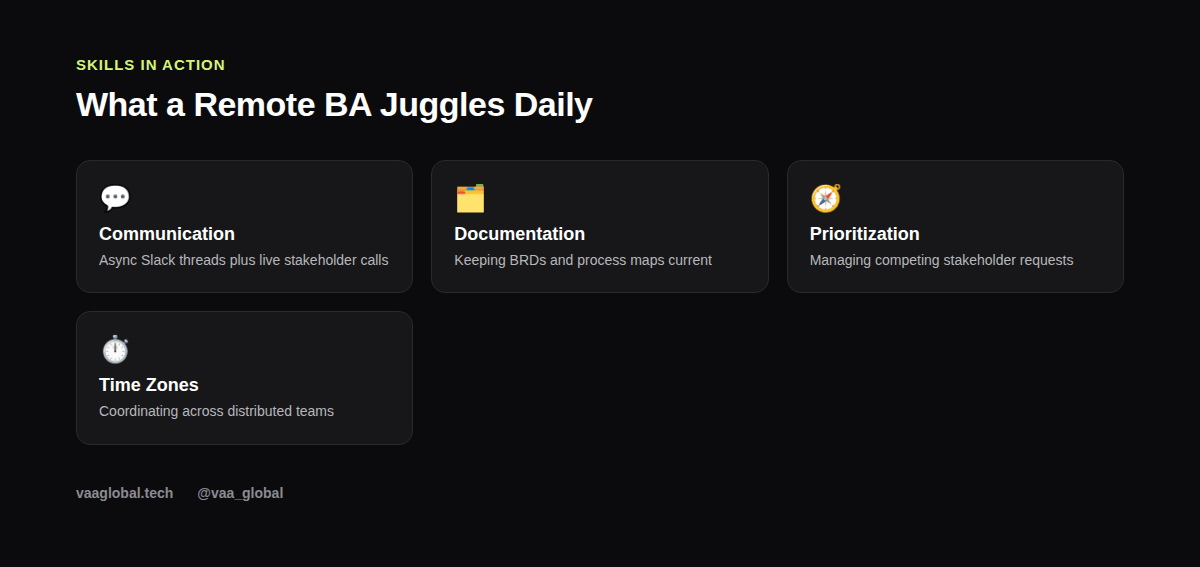
Remote business analysts rely heavily on asynchronous communication: written Slack updates, recorded video walkthroughs, and detailed comments on shared documents replace the quick hallway conversations an office-based BA might have. This means remote BAs often need stronger written communication skills than their in-office counterparts, because tone and nuance have to come through clearly in text. Our article on remote work communication explained breaks down exactly how to handle this shift if you're new to distributed teams.
Managing Time Zones as a Remote BA
If you're working with a global team, time zone overlap becomes a real scheduling puzzle. Some days you might have a 7am call with a client in Europe and a 9pm call with a team in the US. Successful remote BAs build buffer time into their schedule and get comfortable using async updates for anything that doesn't strictly require a live conversation.
What Does a Remote BA Do All Day, In Plain Terms?
If you're wondering what does a remote business analyst do all day in the simplest terms, the honest answer is: listen, write, and clarify, on repeat. The remote business analyst schedule rarely looks identical two days running, but the underlying business analyst daily tasks stay consistent — gathering input, documenting it, and checking that the development team understood it correctly. People often ask is remote business analysis a lot of meetings, and while meetings matter, they're usually shorter and more purposeful than in a traditional office, since async tools absorb a lot of the back-and-forth that would otherwise fill a calendar. Likewise, how do remote BAs manage different time zones comes down to discipline: block overlap hours for live conversation and push everything else into written updates.
What Makes a Good Remote BA Day Different From a Bad One
A good day feels structured even with unpredictable meetings, because the BA has clear priorities going in. A bad day usually comes from reactive firefighting — jumping between unplanned requests without protected documentation time. Building the discipline to block focus time, even as a junior analyst, makes a noticeable difference in output quality over time.
The Bottom Line
In short, a remote business analyst, day in the life, is really a blend of structured meetings, focused documentation, and ongoing asynchronous communication across a distributed team. It rewards people who can translate conversation into clarity and who are comfortable managing their own schedule without constant office oversight. If this rhythm sounds appealing, our 10-week Business Analysis course covers the requirements elicitation, process improvement, and agile business analysis skills that make up this daily routine. For a wider view of the career path, read how to become a business analyst in 2026, and the Project Management Institute publishes useful resources on the broader project lifecycle a BA operates within.