Learning how to write a business requirements document is one of the first real skills a new business analyst needs, because almost every project starts with one. A business requirements document, usually shortened to BRD, is the written agreement between stakeholders and the project team about what is being built and why. Without it, teams end up building the wrong thing, or arguing later about what was actually agreed. Getting the structure right the first time saves weeks of confusion down the line.
What a Business Requirements Document Actually Does
A BRD exists to answer one question clearly: what does the business need, and why? It is not a technical design document, and it is not a project plan. Instead, it sits between the business problem and the solution, translating stakeholder needs into something a development team, designer, or vendor can act on. Because it is often the single source of truth for a project, every later disagreement about scope gets resolved by pointing back to the BRD.
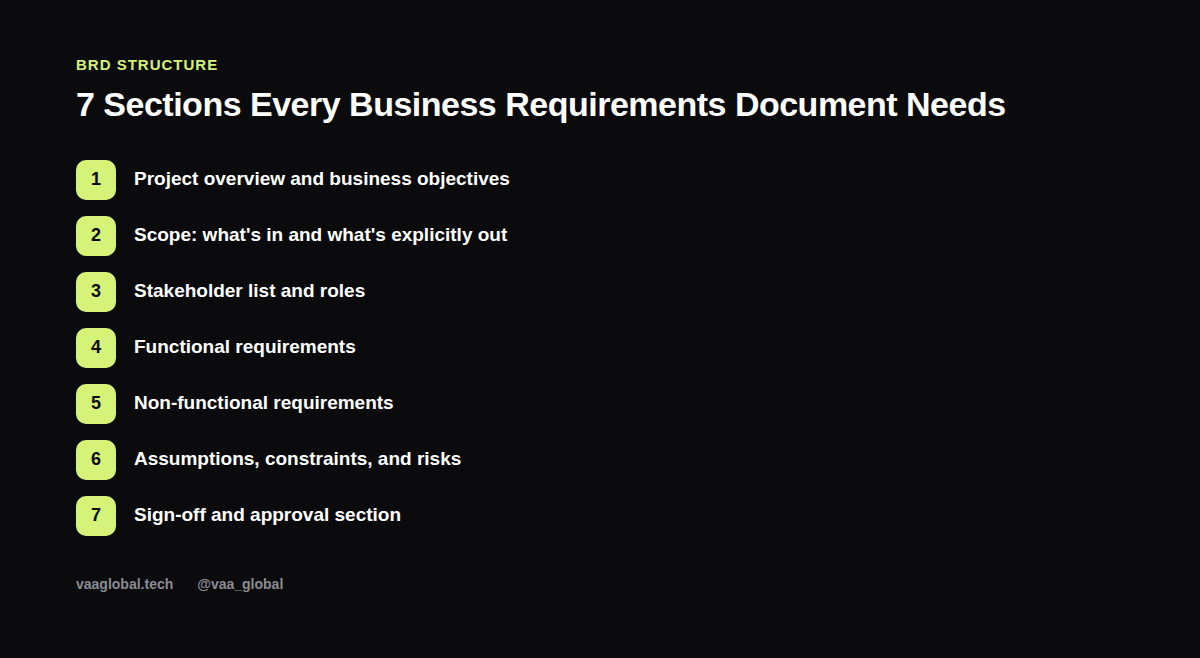
Section 1: Project Overview and Business Objectives
Start with a short paragraph explaining the business problem, who is affected, and what success looks like. For example: "The customer support team currently logs tickets manually in a spreadsheet, causing delayed responses and lost requests. This project will implement a shared ticketing system to reduce average response time." This section sets context so that anyone reading the document later, even months afterward, understands why the project exists.
Section 2: Scope — What's In and What's Explicitly Out
Scope is where most project disputes happen, so be explicit. List what the project will deliver and, just as importantly, what it will not. A line such as "Reporting dashboards are out of scope for phase one" prevents scope creep later, because stakeholders cannot claim it was implied. This single habit is one of the most valuable things you can learn as a business analyst, and it pairs well with what we cover in our guide on how to handle scope creep, even though that article is framed around freelance work.
Section 3: Stakeholders and Their Roles
List every person or group with a stake in the outcome, along with their role: decision-maker, reviewer, or end user. This matters because requirements conflicts often come down to stakeholders with different priorities, and knowing who has final sign-off authority avoids delays later.
Section 4: Functional Requirements
Functional requirements describe what the system must do. Write them as specific, testable statements rather than vague goals. Here is a before-and-after example:
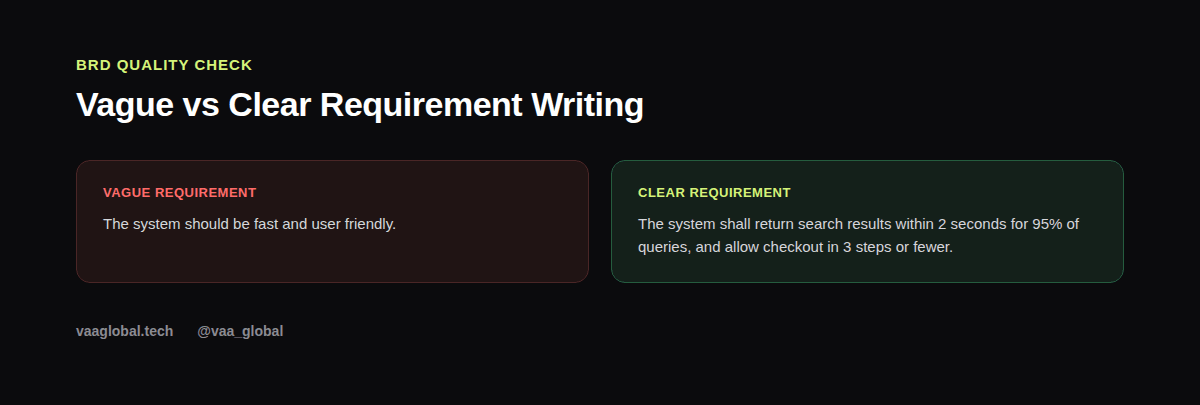
Notice how the clear version includes a measurable number (2 seconds, 95%, 3 steps). As a result, a developer or tester knows exactly when the requirement has been met, and there is no room for a later argument about whether "fast" was actually delivered.
Section 5: Non-Functional Requirements
Non-functional requirements cover things like performance, security, accessibility, and availability — qualities of the system rather than specific features. For example: "The system must be available 99.5% of the time during business hours" or "All stored customer data must be encrypted at rest." These are easy to forget as a beginner, but they often matter just as much to the business as the functional list.
Section 6: Assumptions, Constraints, and Risks
This section protects everyone involved. Assumptions are things you believe to be true but haven't verified (for example, "we assume the vendor API will be available by March"). Constraints are fixed limitations, such as budget or deadline. Risks are things that could go wrong, along with how likely they are and what their impact would be. Because projects rarely go exactly as planned, documenting this upfront gives the team a shared reference point if something shifts.
Section 7: Sign-Off and Approval
Finally, include a formal sign-off section where key stakeholders approve the document before development begins. This isn't just a formality — it's the moment where everyone agrees on what's being built, so if requirements change afterward, that change goes through a proper process rather than quietly rewriting the project scope.
Common Mistakes Beginners Make Writing a BRD
New business analysts often make the same few mistakes: writing requirements that are too vague to test, mixing business requirements with technical design details, skipping stakeholder sign-off, and forgetting non-functional requirements entirely. Another common mistake is writing the whole document alone instead of interviewing stakeholders directly; a BRD written without real conversations tends to miss the actual pain points. If you want to practice this skill before applying for roles, our guide on business analyst portfolio projects for beginners includes a sample BRD exercise you can build from scratch.
Tools That Make Writing a BRD Easier
You don't need expensive software to write a strong BRD. Google Docs or Microsoft Word work fine for the document itself, while a simple flowchart tool helps when a process needs visualizing alongside the text. For a wider list of what's worth learning, see our article on the best tools for business analysts as a beginner. The International Institute of Business Analysis (IIBA) also publishes widely referenced standards on requirements documentation if you want a deeper, more formal reference point.
Using a Business Requirements Document Template
If you're wondering what should be included in a business requirements document, start from a simple business requirements document template rather than a blank page. A template keeps the BRD sections explained consistently every time, so reviewers know exactly where to find scope, requirements, or sign-off without hunting. People often ask how do I write clear functional requirements, and the honest answer is: start from a template that forces you to state a measurable outcome for every line. Many beginners also ask what is the difference between a BRD and a scope document — a scope document is narrower, covering only boundaries, while a BRD includes scope plus the full requirements gathering process, stakeholders, and risks.
The Bottom Line
Once you understand how to write a business requirements document properly, the rest of business analysis becomes much easier, because the BRD is the foundation every later decision gets measured against. Keep requirements specific and testable, document scope clearly, and never skip stakeholder sign-off. If you're preparing for interviews next, our piece on business analyst interview questions and answers covers exactly how interviewers test this skill. And if you want structured, hands-on practice building real BRDs and other BA deliverables, our 10-week Business Analysis course walks through requirements elicitation, requirements modelling, process improvement, data analysis, solution evaluation, and agile business analysis from the ground up. For a wider sense of what the career path looks like, see how to become a business analyst in 2026.