Building business analyst portfolio projects for beginners is one of the smartest moves you can make before applying for your first role, because almost nobody gets hired on potential alone anymore. A portfolio gives you something concrete to discuss in interviews, and it proves you can actually do the work rather than just describe it. The good news is that you don't need a real job to build one; you need a real process and a few hours of focused effort.
Why a Portfolio Matters More Than a Certificate Alone
Certificates show you've been exposed to BA concepts, but they don't prove you can apply them. A portfolio closes that gap. When a hiring manager sees a real requirements document you wrote, with your own reasoning behind each section, it tells them more in two minutes than a resume bullet point ever could. Because entry-level BA roles are competitive, a portfolio is often the deciding factor between two similarly qualified candidates.
Project 1: A Sample Business Requirements Document
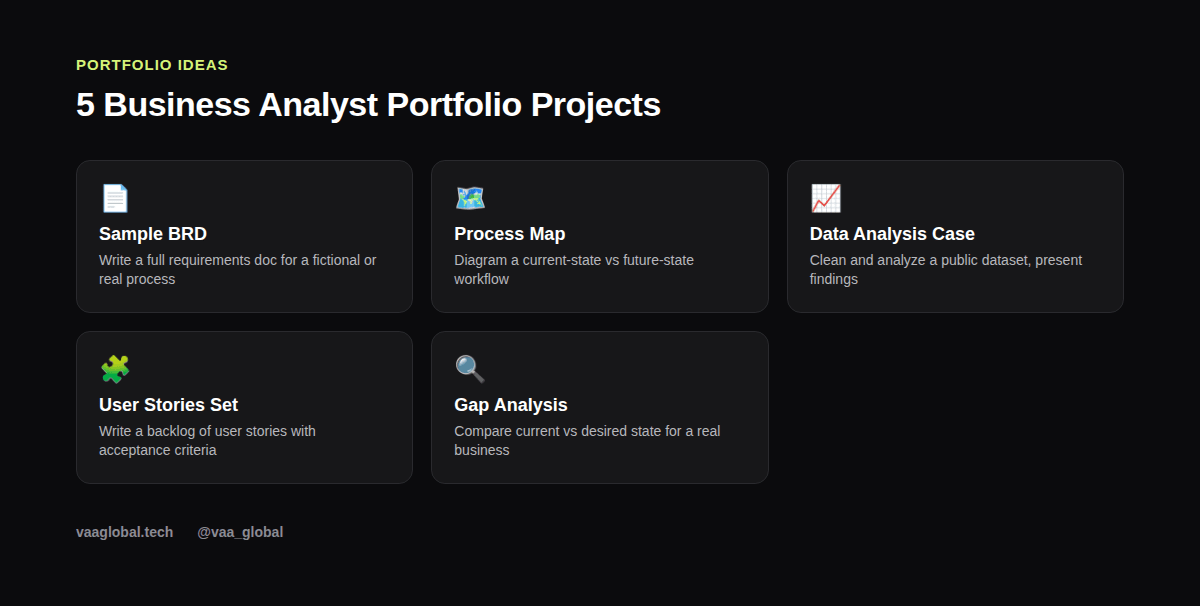
Pick a process you already understand well — a small business you're familiar with, a student organization, or even a personal project like planning an event. Write a full BRD covering the objective, scope, stakeholders, functional and non-functional requirements, and a sign-off section. Our detailed walkthrough on how to write a business requirements document covers exactly what each section needs, so use it as your template.
Project 2: A Current-State vs Future-State Process Map
Pick a process that has an obvious inefficiency — maybe how a small business handles customer inquiries, or how a team manages task handoffs. Map the process as it currently works, then map how it should work once improved. This two-diagram comparison is one of the clearest ways to demonstrate BA thinking, because it shows you can both observe and improve a process, not just document it.
Project 3: A Small Data Analysis Case Study
Find a free public dataset (government open data portals and Kaggle both have beginner-friendly options), clean it in a spreadsheet, and write a short case study: what question you asked, what you found, and what you'd recommend based on the data. Keep this one tight — one clear finding presented well beats five findings presented sloppily.
Project 4: A Backlog of User Stories With Acceptance Criteria
Pick a simple app feature (a login flow, a checkout process, a notification system) and write five to ten user stories in the standard format: "As a [user], I want [goal], so that [benefit]." For each story, add acceptance criteria describing exactly when the story is considered complete. This project demonstrates agile fluency, which many job postings specifically screen for.
Project 5: A Gap Analysis
Choose a real or realistic business scenario and compare its current state to a desired future state across a few dimensions (process, technology, staffing). Present the gaps clearly and suggest practical next steps. Gap analysis is a skill interviewers love to probe, so having a worked example ready gives you a concrete answer instead of an abstract one.
How to Present These Projects
Don't just dump raw documents into a folder. Instead, write a one-paragraph summary above each project explaining the context, your approach, and the outcome, then link or attach the actual artifact. A simple personal website, a shared Google Drive folder, or even a well-organized PDF works; the format matters far less than the clarity of your thinking. When you're ready to talk about these projects out loud, our guide on business analyst interview questions and answers shows exactly how interviewers expect you to walk through them.
How Many Projects Do You Actually Need?
You don't need all five before you start applying. Two or three well-executed projects beat five rushed ones. Prioritize the BRD and the process map first, since those two skills come up in nearly every BA interview, then add the others as time allows.
Mistakes to Avoid
Avoid picking an overly complex scenario just to look impressive; a clean, well-reasoned project on a simple process reads as more competent than a confusing one on a complicated topic. Also avoid skipping the explanation — a document with no context around it forces the interviewer to guess at your thinking, which works against you.
More BA Portfolio Ideas Worth Trying
If you want more BA portfolio ideas beyond the core five, consider adding a stakeholder analysis matrix, a SWOT analysis for a small business, or a simple KPI dashboard built in a spreadsheet. Each of these adds variety without requiring brand-new skills, since they build on the same sample business requirements document and process mapping project you've already created. As for what should a business analyst portfolio include at minimum, aim for documentation that shows you can gather, structure, and communicate information clearly — that is the acceptance criteria every reviewer is really checking against, even when they don't say so directly. Gap analysis, requirements elicitation, and stakeholder management are all related terms worth weaving into your project descriptions, since recruiters often scan for this exact vocabulary.
The Bottom Line
Business analyst portfolio projects for beginners are the single fastest way to turn theoretical knowledge into something you can actually show an employer. Start with a BRD and a process map, keep each project grounded in a real or realistic scenario, and present your reasoning clearly alongside the finished artifact. If you want structured guidance while you build these, our 10-week Business Analysis course walks through requirements elicitation, requirements modelling, process improvement, data analysis for BAs, solution evaluation, and agile business analysis, giving you both the skills and the practice projects to show for it. For tool recommendations while you build, see our piece on the best tools for business analysts as a beginner, and the IIBA offers useful standard templates if you want an industry-recognized structure to build from.