Knowing how to write a GRC policy document is a skill that separates rules people actually follow from rules that just sit in a shared drive collecting dust. A strong policy document is specific enough to test, realistic enough to follow, and structured enough that anyone — a new hire, an auditor, a regulator — can quickly understand what's required and why.
What Sections Does a Policy Document Need?
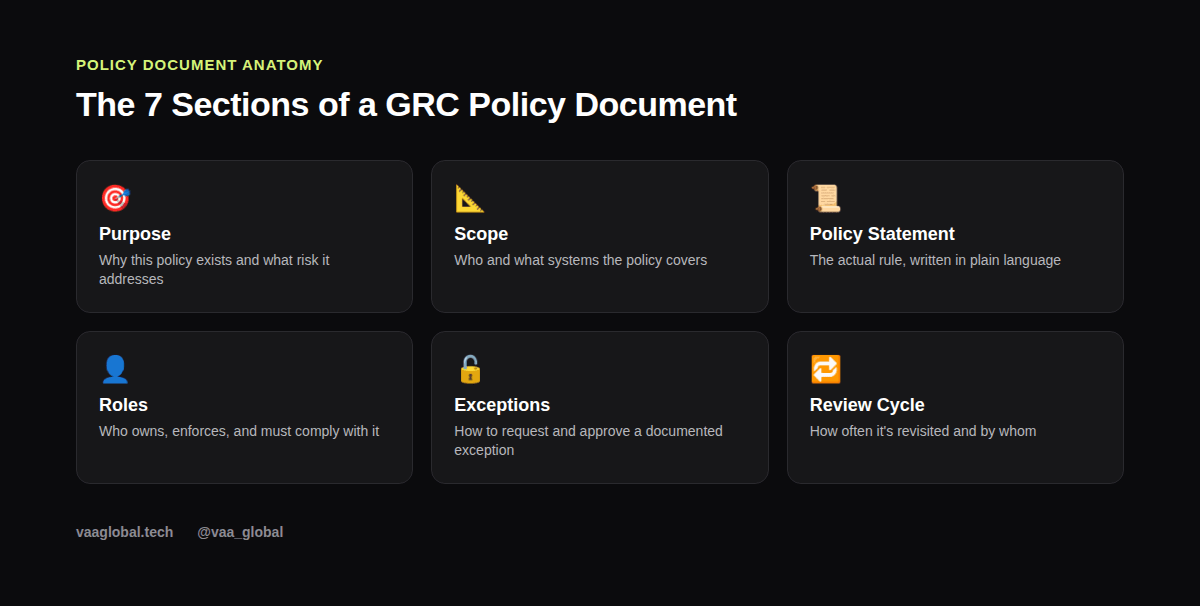
What sections does a policy document need to actually work? At minimum, seven: purpose, scope, the policy statement itself, roles and responsibilities, an exceptions process, a review cycle, and revision history. Skipping any of these creates a real gap. Skip scope, and nobody knows whether contractors are covered. Skip an exceptions process, and people either break the rule quietly or the rule becomes meaningless the first time a legitimate exception comes up.
Section 1: Purpose
Start with why. A purpose statement explains the risk the policy addresses, in one or two sentences. For example: "This policy exists to reduce the risk of unauthorized access to customer data by defining who may access production systems and under what conditions." A clear purpose helps everyone reading the policy — including the person who eventually has to approve an exception — understand the intent behind the rule, not just the letter of it.
Section 2: Policy Scope
Policy scope defines who and what the rule applies to. Does it cover full-time employees only, or contractors too? Does it apply to all systems, or just production environments? Being specific here prevents arguments later about whether the policy even applies to a given situation. A scope statement should be narrow enough to be meaningful and broad enough to actually cover the risk you're trying to manage.
Section 3: The Policy Statement
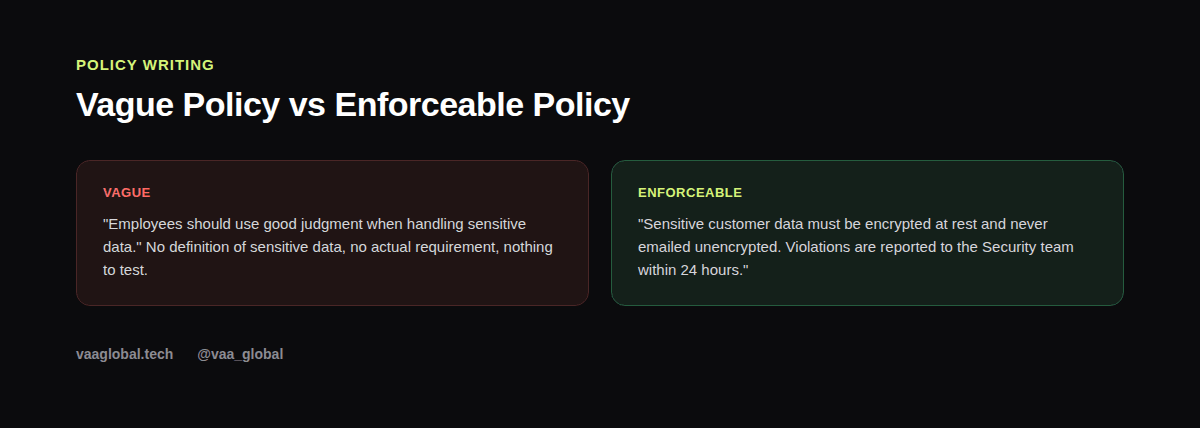
This is the actual rule, and it's where most weak policies fail. How do you write an enforceable policy statement? Avoid vague language like "use good judgment" or "take reasonable precautions" — these sound fine but give an auditor, or an employee trying to follow the rule, nothing concrete to check against. Compare a vague version against an enforceable one: a strong policy statement names the specific requirement and often the consequence for violating it, so there's no ambiguity about what compliance actually looks like.
Section 4: Roles and Responsibilities
Name who owns the policy, who's responsible for enforcing it day to day, and who must comply. Vague phrasing like "the relevant team" invites confusion — use actual role titles, like "the IT Security Manager" or "all engineering staff." This section is also where you note who approves exceptions, which ties directly into the next section.
Section 5: Exceptions Process
No policy survives contact with reality perfectly. A legitimate business need will eventually conflict with a strict rule, and when that happens, you want a documented exceptions process rather than quiet rule-breaking. A good exceptions process names who can request one, who approves it, how long an approved exception lasts, and where it gets logged. This log becomes valuable audit evidence later, showing that exceptions were tracked and approved, not just ignored.
Section 6: Review Cycle and Revision History
Who approves a new policy is usually the same person or committee who'll review it going forward — commonly leadership or a dedicated governance committee. State the review frequency directly in the document (annually is common for most policies), and keep a simple revision history table logging what changed, when, and who approved it. This turns the policy into a living document instead of a one-time artifact nobody revisits.
A Worked Example: Sample Policy Statement
Putting it together, here's a short sample for an access control policy: "Purpose: To limit the risk of unauthorized access to production systems. Scope: Applies to all employees and contractors with system credentials. Policy Statement: Access to production systems requires manager approval and is reviewed quarterly by the system owner; access not re-approved within 10 business days of review is automatically revoked. Roles: The IT Security Manager owns this policy; system owners are responsible for conducting reviews. Exceptions: Temporary access beyond standard roles requires written approval from the IT Security Manager and expires after 30 days. Review Cycle: Annually, or upon a major system change." Notice how specific and testable each line is — an auditor could check every claim against real records.
How Long Should a Company Policy Be?
How long should a company policy be is a common worry for first-time writers. There's no fixed page count, but shorter is almost always better as long as it's complete. A one-to-two page policy that covers all seven sections clearly beats a ten-page document full of legal padding that nobody actually reads. If a policy feels like it needs to be long to be thorough, that's often a sign it's trying to cover too many topics and should be split into separate, more focused policies instead.
Connecting Policy Writing to a GRC Career
Clear policy writing is one of the most portable GRC skills there is — it shows up in internal audit, compliance monitoring, and incident response planning alike. If you're building a portfolio of writing samples for job applications, drafting a sample policy from scratch (even for a hypothetical company) is a strong project to show during interviews, much like business analyst portfolio projects for beginners recommends building real artifacts rather than just listing skills. Build yourself a reusable policy template with the seven sections above as headers, and you can adapt it quickly for any new policy a job or practice project throws at you — it's the same approach best tools for business analysts recommends for documentation templates generally. Reviewing what HIPAA actually requires in plain language is also a good way to see how a real regulation gets translated into policy language, and the Institute of Internal Auditors publishes broader standards on governance documentation worth reading once you're comfortable with the basics.
The Bottom Line
Learning how to write a GRC policy document comes down to structure and specificity: cover purpose, scope, the policy statement, roles, exceptions, and a review cycle, and write every requirement specifically enough that someone could actually test whether it's being followed. A well-written policy protects the organization and makes life easier for everyone who has to follow it, which is exactly the point.