Building a GRC portfolio with no experience feels like a chicken-and-egg problem at first: how do you demonstrate governance, risk, and compliance skills when you've never had a GRC job? The good news is that this field rewards demonstrated thinking more than job titles, and there are several realistic, completable projects that show you actually understand how risk, controls, and audits work together.
Why a Portfolio Matters More Than You Think in GRC
Unlike some fields where a portfolio is a nice-to-have, in GRC it's genuinely one of your best levers as a beginner, because so many of the recognized certifications (CISA, CISSP, CRISC) require experience you may not have yet. Our guide to the best GRC certifications for beginners covers that gap in more detail. A portfolio sidesteps the credential problem entirely by letting your actual thinking speak for itself. In other words, instead of asking what projects prove GRC knowledge in the abstract, employers can simply look and judge for themselves. If you later decide to pursue a credential, both ISACA and ISC2 publish free study outlines that double as a useful checklist for which topics your portfolio projects should eventually cover.
Project Idea 1: Build a Mock Risk Register
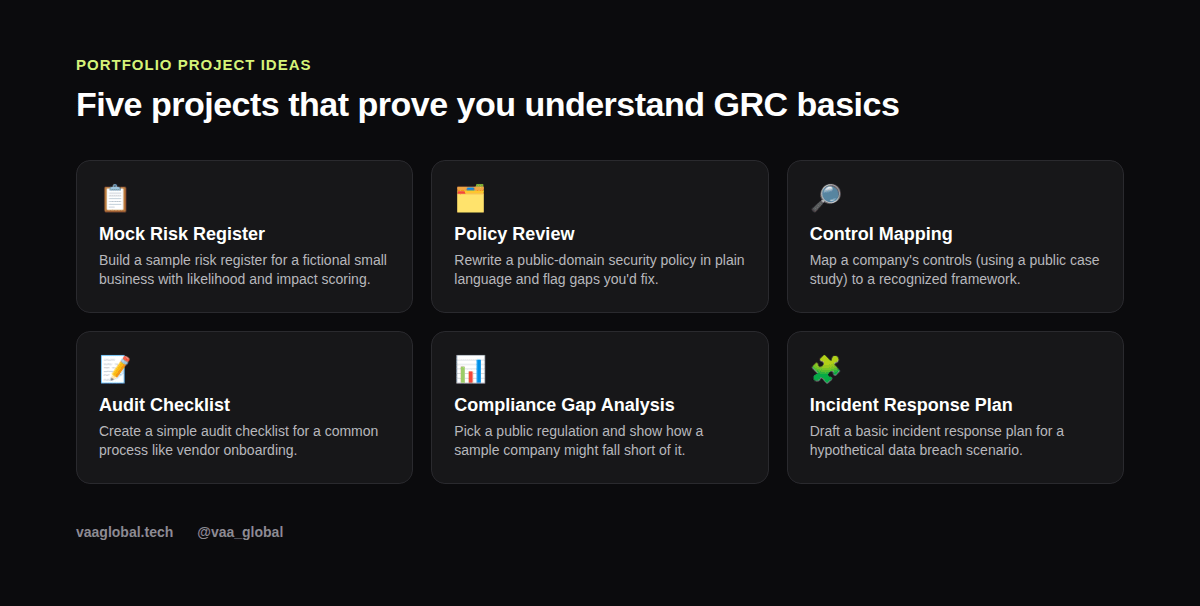
Pick a fictional or lightly disguised small business — a local retailer, a clinic, a logistics company — and build a simple risk register. List 8-12 realistic risks (data breach, vendor failure, regulatory non-compliance, key-person dependency), score each for likelihood and impact, and propose a response for each. This single exercise demonstrates structured thinking better than almost anything else on a beginner's CV.
Project Idea 2: Map Controls to a Framework
Take a publicly available case study (many regulators and consulting firms publish anonymized breach post-mortems) and map the company's existing or missing controls against a recognized control framework. This shows you understand that governance isn't abstract — it's specific, checkable things an organization either does or doesn't do.
Project Idea 3: Rewrite a Policy in Plain Language
Find a public-domain or open-source security or compliance policy template, and rewrite it so a non-technical employee could actually follow it. Add a short note on the gaps you noticed in the original. This is a compliance project idea that's genuinely useful real-world practice: most organizations struggle with policies nobody reads because they're written in dense legal language.
Project Idea 4: Draft a Basic Audit Checklist
Choose a common business process — vendor onboarding, employee offboarding, expense approvals — and build a simple audit checklist an internal auditor could use to verify the process is actually being followed. This is a small project but it mirrors real audit work closely.
Project Idea 5: Run a Compliance Gap Analysis
Pick a well-known regulation relevant to a region or industry you're interested in, and sketch out, using only public information, where a hypothetical mid-sized company might fall short of full compliance. Be careful to frame this as a learning exercise based on general principles, not as professional advice.
How Do I Show GRC Skills Without a Job?
This is really the central question behind the whole exercise. How do I show GRC skills without a job is best answered by treating each project like a small case study: state the problem, show your process, and reflect honestly on the limitations of working without live organizational data. Hiring managers understand you're working with simulated scenarios — what they're evaluating is your reasoning, not whether you had real client data.
What Should a GRC Portfolio Include Beyond the Projects
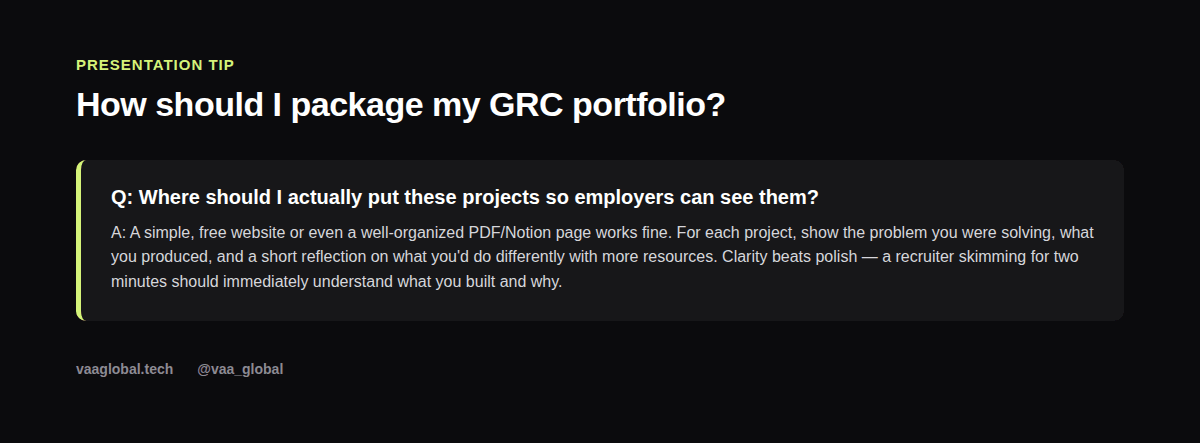
What should a GRC portfolio include besides the raw project work? A short intro explaining your background and why you're drawn to GRC, a one-paragraph summary above each project explaining your approach, and — if relevant — a note on which certifications or courses you're working toward. If you're coming from an adjacent field like business analysis or IT support, say so explicitly; transferable experience is a real asset, not something to hide.
Getting Noticed With No GRC Experience
How to get noticed with no GRC experience usually comes down to combining the portfolio with visible activity: share one project as a short post on LinkedIn, engage genuinely with other people's GRC content, and don't wait for a job posting to reach out to people doing the work already. A portfolio that nobody sees doesn't help much — pair it with the kind of outreach covered in our piece on networking online as a remote professional.
A Realistic Starting Foundation
If you want a technical foundation to pull real examples from, VAA Global's Cybersecurity course covers vulnerability management and incident response concepts that translate directly into stronger risk-register and control-mapping projects, even though it isn't a dedicated GRC program.
The Bottom Line
Ultimately, you don't need a job title to build a convincing GRC portfolio with no experience — you need a handful of well-reasoned, clearly presented projects that show you understand how risk, controls, and compliance actually connect. Therefore, instead of waiting until you feel fully qualified, start with one project, finish it properly, and build from there rather than trying to do all five at once. For instance, a single thorough risk register, published and explained well, often does more for your credibility than five rushed, shallow exercises ever could. Consequently, momentum matters more than perfection here: finish something small this week, however imperfect, and keep adding to it as your understanding grows.