These two phrases trip up almost everyone new to GRC, and honestly, even some experienced professionals use them loosely. With risk appetite vs risk tolerance explained clearly and with real examples, you'll be able to use both terms precisely — which matters a lot once you're writing or reading governance documents for a living.
Risk Appetite: The Big-Picture Statement
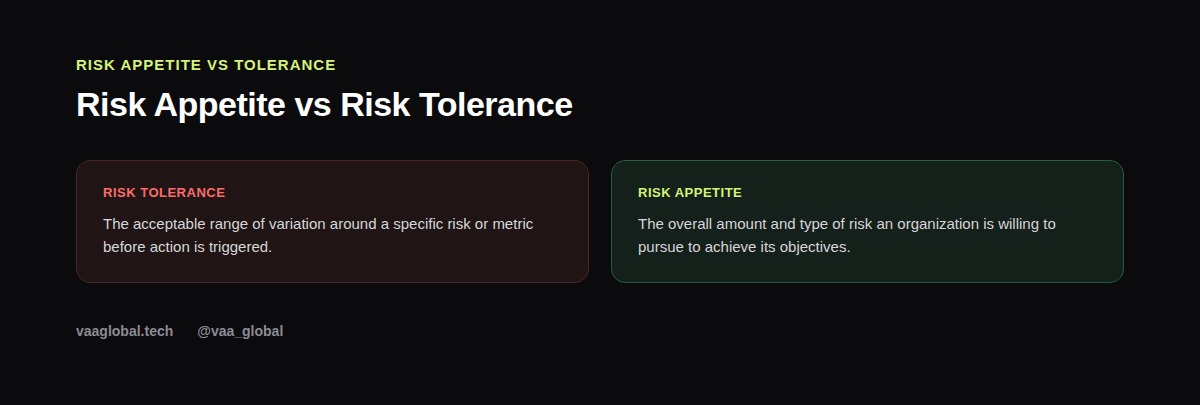
Risk appetite is set at a strategic level, often by the board of directors or senior leadership, and it describes the organization's general stance toward risk in pursuit of its objectives. A fast-growing startup might have a high risk appetite for operational risk because speed matters more than perfection early on, while a regulated bank might have a very low risk appetite for compliance risk because the consequences of getting it wrong are severe.
Risk Tolerance: The Specific, Measurable Boundary
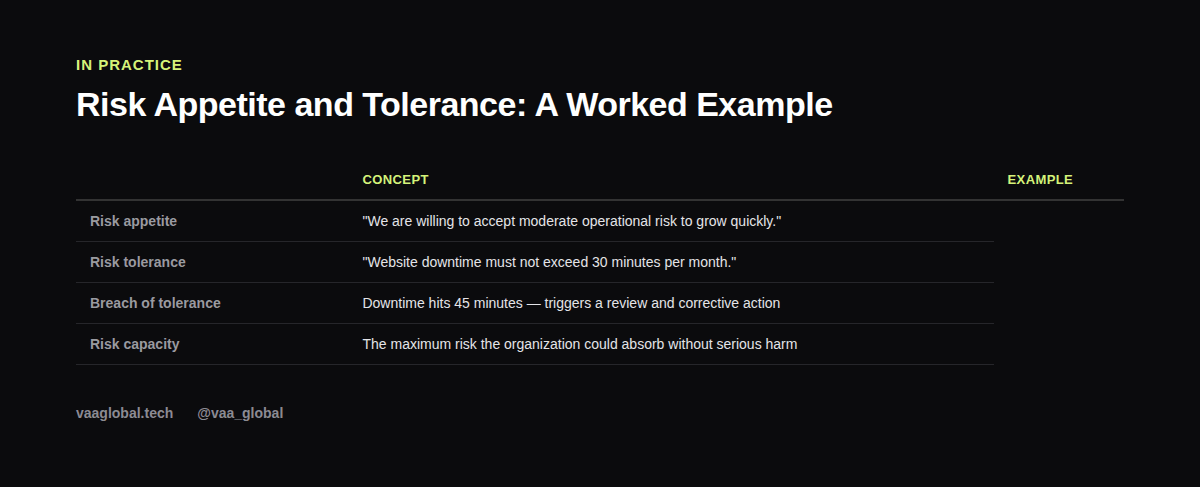
Risk tolerance translates that big-picture appetite into something concrete and measurable for a specific risk or metric. If a company's risk appetite statement says it accepts moderate operational risk, its risk tolerance might get specific: 'website downtime must not exceed 30 minutes per month.' That's a number someone can actually monitor and react to, unlike the broader appetite statement on its own.
Seeing the Difference Side by Side
The table below walks through a concrete example, showing how a single risk appetite statement gets translated into a specific risk tolerance threshold, and what happens when that threshold gets breached.
Risk Capacity: The Third Piece People Forget
There's a related but distinct third concept: risk capacity, which is the maximum amount of risk an organization could actually absorb without serious harm, regardless of what it's willing to accept. Risk appetite should always sit within risk capacity — an organization shouldn't choose to pursue more risk than it can actually survive, even if leadership feels confident about it. Confusing appetite with capacity is a common and sometimes expensive mistake.
Why Both Concepts Matter in GRC Work
Risk appetite gives strategic direction; risk tolerance gives operational teams something concrete to monitor day to day. Without a clear risk appetite, teams end up guessing what level of risk is actually acceptable. Without clear tolerance thresholds, even a well-written appetite statement stays too abstract to act on. Good governance connects the two explicitly, often through key risk indicators that get tracked against defined tolerance levels.
A Worked Example in Context
Picture a healthcare company with a risk appetite statement declaring low tolerance for anything touching patient data privacy. That broad statement gets translated into specific tolerances: zero unencrypted laptops in the field, breach notification within a defined internal timeframe, and mandatory annual HIPAA training completion above a set percentage. Each tolerance is something a GRC analyst can actually track and report on, tying directly back to the original appetite statement set by leadership.
Common Questions Beginners Ask
A frequent question is is risk appetite the same as risk tolerance — no, appetite is the broad strategic stance, tolerance is the specific measurable boundary, as covered above. People also ask how do you set a risk appetite statement, which usually involves leadership discussion about strategic priorities, informed by risk assessment data and sometimes board-level governance frameworks. On what happens if risk tolerance is breached, typically it triggers a defined escalation or corrective action, exactly as shown in the worked example table. And why does risk appetite matter for GRC — because it sets the baseline everything else, from risk registers to control design, gets measured against.
Governance Oversight: Keeping the Two Aligned
Governance structures exist precisely to keep appetite and tolerance aligned over time, since it's easy for the two to quietly drift apart. A board might approve a risk appetite statement once a year, while operational teams set and adjust specific tolerance thresholds far more frequently as conditions change. Periodic reporting back up to governance — showing where actual risk-taking sits relative to the stated appetite — closes that loop and keeps strategic intent connected to day-to-day decisions, rather than letting the two drift apart unnoticed.
Building This Into Your GRC Toolkit
Understanding risk appetite and tolerance rounds out the vocabulary you need alongside risk assessment basics and a working risk register. If you're exploring this topic as part of a broader GRC or compliance career path, our guide on what is a risk register and how to build one shows exactly where these thresholds get tracked in practice, the COSO framework explained simply covers how enterprise risk management formally incorporates appetite-setting, and risk assessment basics for GRC beginners fills in how the underlying risk data gets generated in the first place. COSO's own enterprise risk management guidance, available at coso.org, is a solid authoritative reference if you want to go deeper.
A Quick Sanity Check
If you're ever unsure which term applies, ask yourself whether you're describing a general stance (appetite) or a specific, checkable number (tolerance). "We're comfortable with moderate growth risk" is appetite. "Customer churn above six percent per quarter triggers a review" is tolerance. That quick mental test resolves most of the confusion beginners run into when switching between the two terms in conversation or in writing.
The Bottom Line
Once risk appetite vs risk tolerance clicks, a lot of GRC documentation suddenly makes more sense: one sets the broad strategic direction, the other gives teams a concrete number to actually monitor. Keep both concepts distinct in your own writing and conversations, and you'll immediately sound more precise than most beginners in this field.