The mistakes beginners make breaking into GRC tend to repeat across almost everyone starting out, which is actually good news, because it means they are predictable and avoidable once you know what to look for. Most of these errors come from reasonable instincts applied in the wrong direction, not from a lack of effort.
Mistake 1: Only Applying to Senior-Sounding Titles
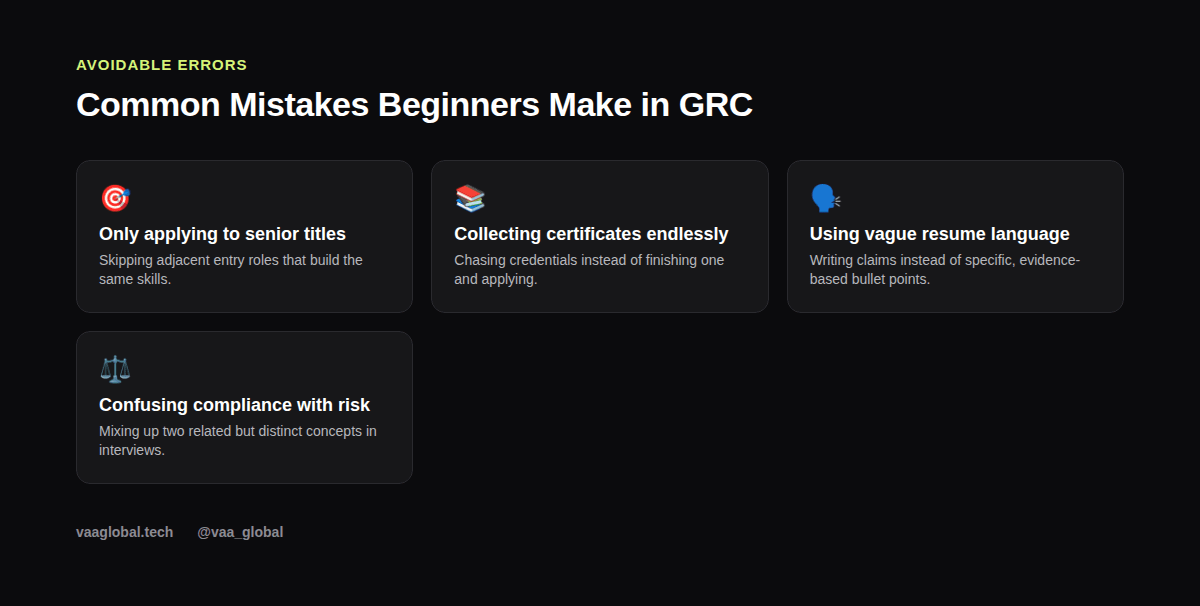
A lot of beginners apply exclusively to roles titled “GRC Analyst” and ignore adjacent titles like compliance coordinator, audit assistant or risk support specialist. This narrows the pool of realistic opportunities dramatically, since many entry-friendly roles that build identical skills sit under different, less obvious titles. The fix is simple: widen your search terms and treat any role involving policy reading, control checking, or documentation review as a legitimate entry point, regardless of its exact title.
Mistake 2: Collecting Certificates Instead of Finishing One
Should I get multiple GRC certifications before applying anywhere? This is one of the most common entry level compliance mistakes, and the honest answer is no, not before you have applied at all. Beginners sometimes spend six or more months stacking certificates, convinced that one more credential will finally make them ready, when a single finished certification combined with real applications would have gotten them interviews much sooner. Certificates prove you can commit to learning; they do not by themselves prove job readiness the way an actual application process does.
Mistake 3: Vague Resume Language With No Evidence
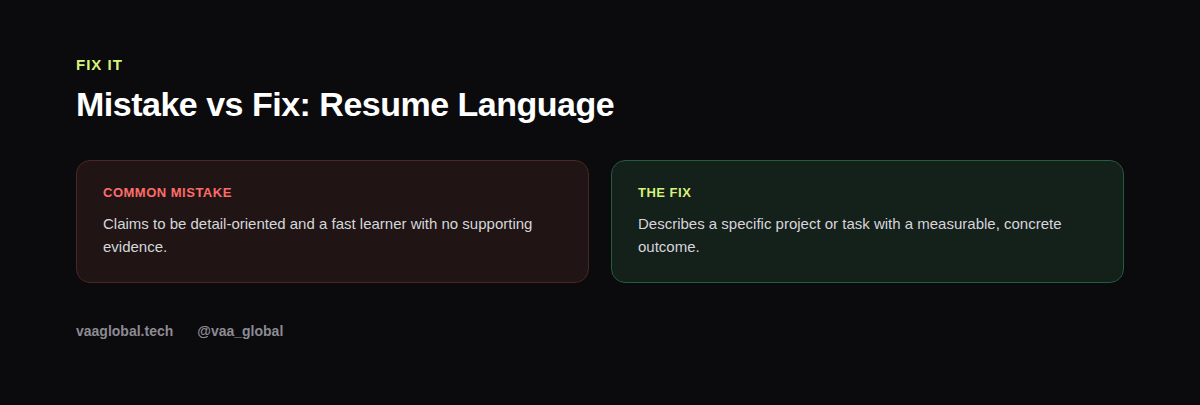
GRC resume mistakes almost always come down to one pattern: claiming traits instead of demonstrating them. Writing “detail-oriented and a fast learner” proves nothing on its own, while describing a specific self-built risk register or a concretely reframed past task proves exactly the same qualities through evidence instead of assertion. If this sounds familiar, our detailed guide on building a GRC resume with no experience walks through specific rewrites you can apply directly to your own document.
Mistake 4: Confusing Compliance With Risk Management
GRC interview mistakes frequently include treating compliance and risk management as interchangeable terms, which signals to an interviewer that you have not studied the fundamentals carefully. Compliance means following specific, defined rules; risk management means making judgment calls about things that are not always written down anywhere yet. Mixing these up in an interview, even once, is often enough for an experienced interviewer to probe further and discover the gap, so it is worth reviewing our breakdown of what GRC actually means, broken down clearly before any interview.
Mistake 5: Giving Up on Networking Too Early
GRC job search errors often include treating networking as a one-time event rather than an ongoing habit. Sending two LinkedIn messages and concluding that networking does not work is a common and understandable mistake, but most genuinely useful professional conversations happen after five, ten or more outreach attempts spread over weeks, not after two. Consistency, not intensity, is what eventually produces useful conversations and occasionally a direct referral.
Why Am I Not Getting GRC Interviews? A Diagnostic
Why am I not getting GRC interviews despite applying regularly? Walk through the mistakes above as a checklist. Are you only applying to exact-title GRC Analyst roles. Is your resume full of unsupported claims rather than specific evidence. Have you mixed up compliance and risk language anywhere in your application materials. Answering these honestly usually reveals at least one fixable issue, since a near-total silence from employers almost always traces back to one of these patterns rather than bad luck alone.
How Do I Avoid Sounding Vague in a GRC Interview?
How do I avoid sounding vague in a GRC interview once you actually land one? Prepare two or three specific examples in advance, even from a self-built portfolio project, and practice describing them with concrete details: what the situation was, what you actually did, and what the measurable outcome was. Our guide on GRC interview questions and answers covers this preparation in more depth with sample answers you can adapt directly.
A Simple Networking Strategy That Avoids Mistake Five
Because networking strategy is where so many beginners quietly give up, build a repeatable habit instead of relying on motivation. For example, set a standing reminder to message two GRC professionals every week, ask specifically how they got their first role, and keep a simple log of who you contacted and when. This turns certification overload and vague entry level roles confusion into a secondary concern, since consistent networking often surfaces openings and honest feedback faster than job boards alone. ISACA's community and career resources are a reasonable place to find people actually working in the field to reach out to.
The Bottom Line
The mistakes beginners make breaking into GRC are consistent and, more importantly, fixable: widen your job title search, finish one certification instead of chasing many, replace vague claims with specific evidence, get the compliance-versus-risk distinction right, and keep networking consistently rather than giving up after a couple of tries. Fixing even two or three of these will meaningfully improve your results within a few months.