Learning to stay current with changing regulations as a GRC professional is one of those ongoing tasks nobody fully masters, because the regulatory landscape simply never stops moving. The good news is you don't need to read everything the moment it's published — you need a sustainable, repeatable system that catches what actually matters to your organization.
How Do GRC Professionals Keep Up With New Laws?
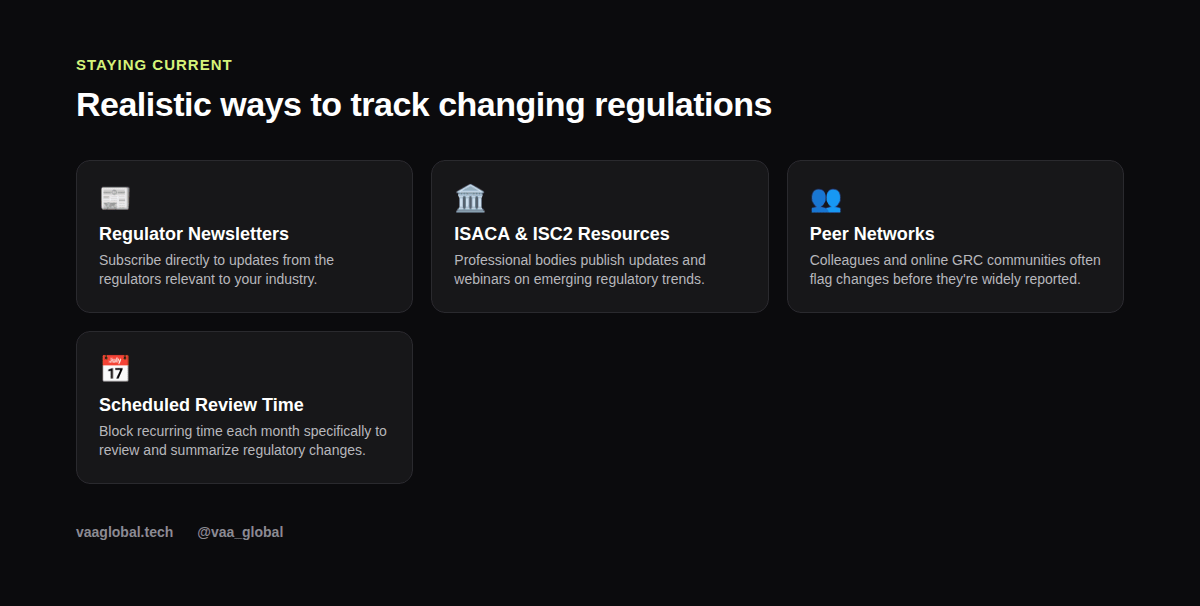
How do GRC professionals keep up with new laws without it consuming their whole job? Mostly by relying on curated sources rather than trying to monitor every regulator directly. Subscribing to official bulletins from the regulators relevant to your specific industry is the foundation, since that's the primary source, but layering in secondary sources that summarize and interpret changes saves enormous time.
What Sources Should I Follow for Regulatory Updates?
What sources should I follow for regulatory updates, practically speaking? Start with the regulator's own newsletter or bulletin system for your industry and region. Add professional body resources — ISACA and ISC2 both publish updates, webinars, and continuing education content relevant to regulatory change management. Finally, follow a handful of trusted industry analysts or law firms that publish plain-language summaries; they do a lot of the interpretive heavy lifting for you.
How Often Should I Review Regulatory Changes?
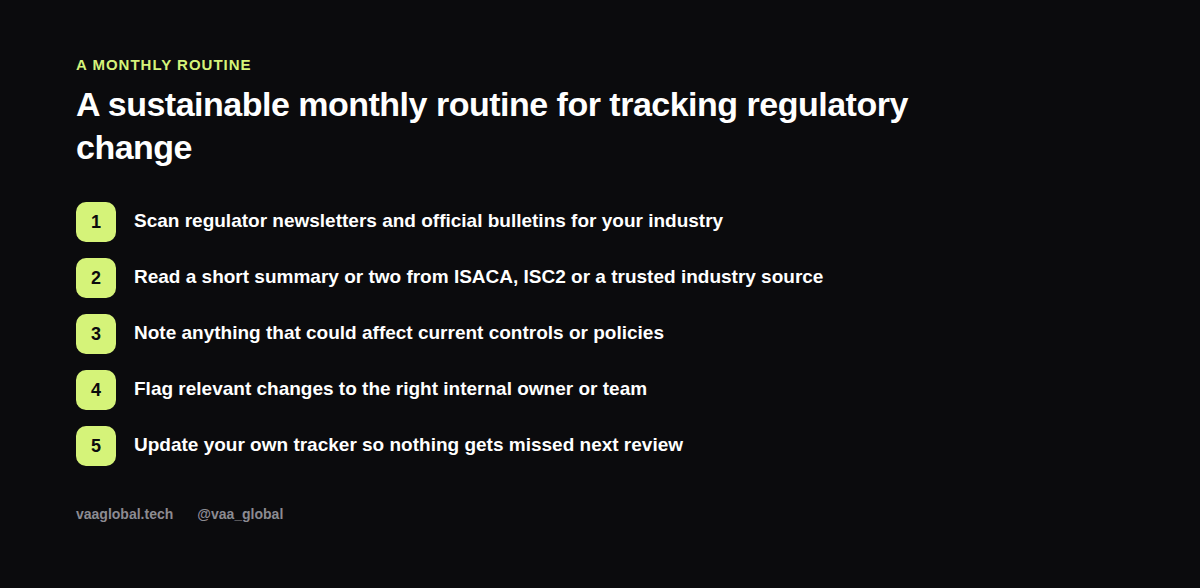
How often should I review regulatory changes to stay genuinely current without burning out? A monthly dedicated review session works well for most roles, supplemented by immediately reading anything flagged as urgent by your regulator or professional body. Daily monitoring sounds thorough but tends to create fatigue and inconsistency; a scheduled, recurring review habit is more sustainable and, honestly, more reliable over a full year.
Building a Simple Tracking System
You don't need expensive software to track compliance updates well. A simple spreadsheet logging the date, the source, a one-line summary, what internal policy or control it affects, and who you notified is often enough for a small-to-mid-sized organization. This is the same kind of lightweight tracking approach covered in our broader guide to GRC tools every beginner should learn, where spreadsheets consistently outperform fancier tools for people just starting out. The habit of consistently logging matters far more than the sophistication of the tool.
Is There a Tool That Tracks Regulatory Changes Automatically?
Is there a tool that tracks regulatory changes automatically, so you don't have to do this manually at all? Larger GRC platforms and dedicated regulatory monitoring tools do exist and can automate parts of this, particularly for heavily regulated industries like finance and healthcare. For smaller organizations or earlier-career professionals, though, a well-maintained manual system plus a few good newsletter subscriptions covers most of the same ground without the added licensing cost.
Translating Changes Into Action
Spotting a regulatory change is only half the job. The other half is figuring out what it actually means for your organization's existing policies and controls, and then making sure the right person owns the resulting update. A regulatory change that never gets translated into an actual policy revision is functionally useless — this is often where GRC professionals add the most real value, not in the reading itself.
Continuing Education Keeps Your Baseline Sharp
Beyond day-to-day monitoring, GRC continuing education — conference sessions, professional body courses, even structured reading lists — helps keep your underlying knowledge current, not just your awareness of specific recent changes. This matters more the longer you're in the field, since foundational concepts also evolve, even if more slowly than specific regulatory text. If you're earlier in your career and still building that baseline, our overview of the best GRC certifications for beginners is a reasonable place to see how formal credentials and ongoing learning fit together over a career.
Don't Try to Be the Expert on Everything
No single person can track every regulation relevant to a large organization alone. Lean on your peer network, the kind covered in our guide on networking in the GRC field, and don't be afraid to say 'I'll check and get back to you' rather than guessing. Being known as someone who verifies rather than assumes is a genuine professional asset in this field, and it's one of the simplest ways to build trust quickly with colleagues who are relying on your read of a regulatory change to make real decisions.
The Bottom Line
You don't need to read every regulatory announcement the day it's published to stay current with changing regulations as a GRC professional — you need a handful of reliable sources, a sustainable review rhythm, and a simple system for turning what you learn into actual policy and control updates. Build that system once, and staying current becomes a habit instead of a constant source of anxiety. This same discipline is worth comparing against how teams at different scales handle it, which our piece on GRC for startups versus GRC for enterprises explores in more detail, since a one-person compliance function and a dedicated regulatory affairs team solve this same problem very differently.