Weighing CISA vs CISSP is one of the most common crossroads for anyone building a career across GRC, IT audit, or information security, and picking wrong isn't the end of the world, but picking with intention saves time and study effort. Both are well-respected, globally recognized certifications, but they're built for genuinely different day-to-day roles, and understanding that difference matters more than chasing whichever one sounds more impressive.
What Is the Difference Between CISA and CISSP?
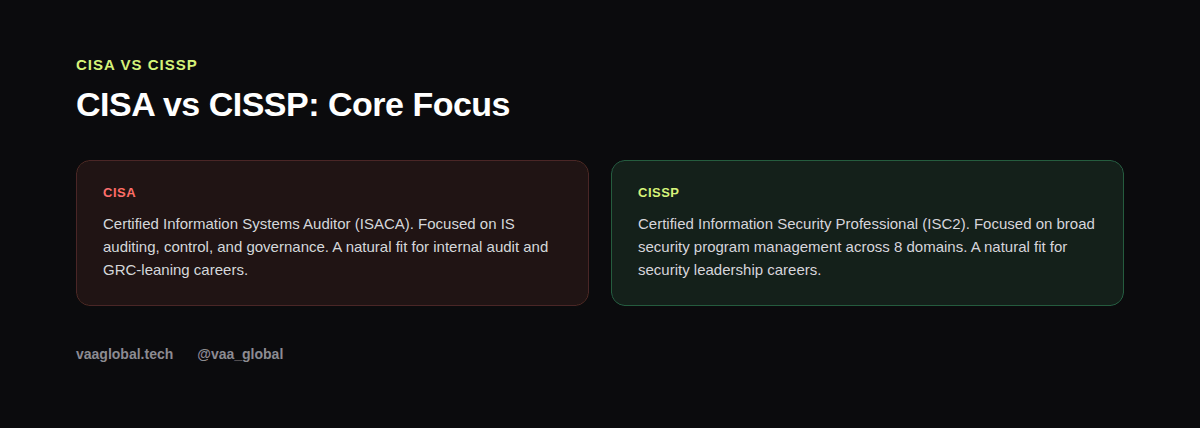
What is the difference between CISA and CISSP at the core? CISA is maintained by ISACA and focuses specifically on auditing information systems — evaluating controls, governance, and risk management from an auditor's perspective. CISSP is maintained by ISC2 and takes a much broader view of information security, covering eight domains that span security architecture, risk management, network security, and more, aimed at people managing or leading a security program rather than specifically auditing one.
What CISA Covers
CISA certification centers on IT audit, control, and governance. The exam domains cover the IS audit process itself, IT governance and management, information systems acquisition and development, operations and business resilience, and protecting information assets. If your day-to-day work involves testing controls, evaluating whether systems meet compliance requirements, or reporting audit findings, CISA maps directly onto that work.
What CISSP Covers
CISSP certification spans a wider security management footprint across eight domains, commonly summarized as security and risk management, asset security, security architecture and engineering, communication and network security, identity and access management, security assessment and testing, security operations, and software development security. It's a broader, management-oriented credential that signals you can oversee a security program end to end, not just audit one piece of it.
Which Certification Is Better for GRC?
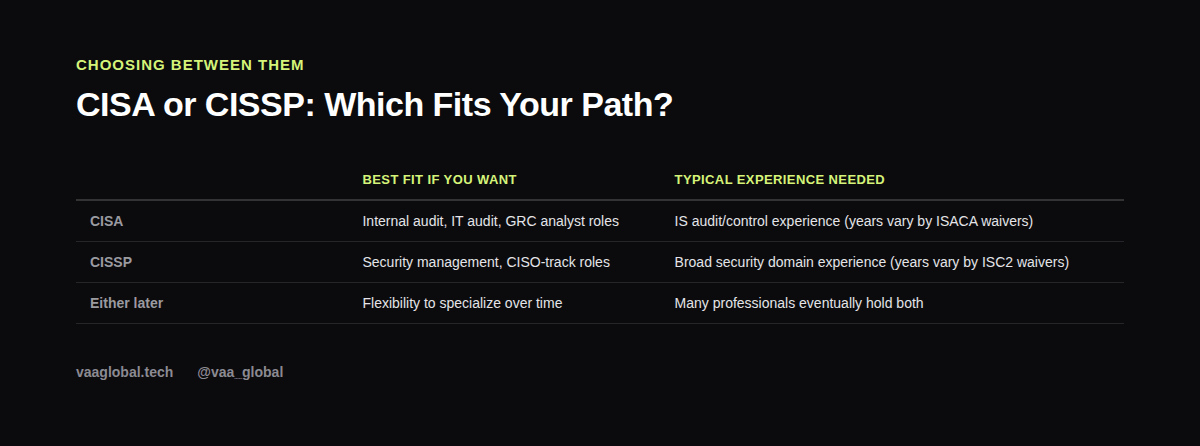
Which certification is better for GRC specifically depends on which part of GRC you're drawn to. If internal audit, compliance monitoring, or IT audit work is the direction you're heading, CISA aligns more directly with that daily work and the way employers in those roles screen candidates. If you're more drawn to designing and running the broader security program — the thing GRC teams are often checking on — CISSP is the stronger signal. Neither certification is objectively superior; they're built for different lanes within the same general field.
Do I Need Experience Before Taking CISA or CISSP?
Do I need experience before taking CISA or CISSP is a question almost every beginner asks, and the honest answer is: both certifications generally require a minimum amount of relevant professional experience to become fully certified, though the exact requirements, waivers, and allowed substitutions (like relevant education) change over time and are best confirmed directly with ISACA and ISC2 rather than from a secondhand summary. Some people choose to pass the exam first and work toward meeting the experience requirement afterward, since the exam itself doesn't require prior certification to sit for it, but policies on this vary and are worth checking directly.
A Worked Example: Deciding Based on Your Actual Work
A practical way to decide: write down your last ten work tasks, or the ten tasks you'd most want in your next job. If most of them look like testing a control, reviewing evidence, or writing up an audit finding, that's a CISA-shaped set of tasks. If most of them look like designing an access policy, managing a security program, or leading an incident response, that's a CISSP-shaped set. People whose work genuinely spans both sometimes end up pursuing both certifications over the course of their career, just not usually at the same time.
Can I Get Both CISA and CISSP?
Can I get both CISA and CISSP eventually? Yes, and plenty of experienced GRC and security professionals do hold both over the course of their career, since the two credentials complement each other rather than compete. The more practical question for a beginner usually isn't whether both are possible, but which one matches where they are right now — pursuing the certification that matches your current role and experience almost always beats chasing both at once before you have real-world context to anchor the material to.
How These Certifications Fit a Career Path
If you're still early in deciding between an audit-leaning GRC path or a security-leaning path, building foundational skills first is usually more valuable than jumping straight to an advanced certification exam. VAA Global's Cybersecurity course covers networking, vulnerability management, and incident response fundamentals that build toward either path, and reading cybersecurity certifications for beginners in Nigeria and internal audit basics for GRC beginners alongside this article gives a fuller picture of both lanes before you commit study time to either exam. The Institute of Internal Auditors is also worth knowing about, since its own CIA (Certified Internal Auditor) credential is a third option some GRC-focused professionals consider alongside CISA.
The Bottom Line
Deciding CISA vs CISSP really comes down to matching the certification to the work you actually want to do, not to whichever name sounds more prestigious. CISA fits audit, controls, and governance-focused careers; CISSP fits broader security management and leadership careers. Get clear on your direction first, confirm current experience requirements directly with ISACA or ISC2, and the right first certification usually becomes obvious.