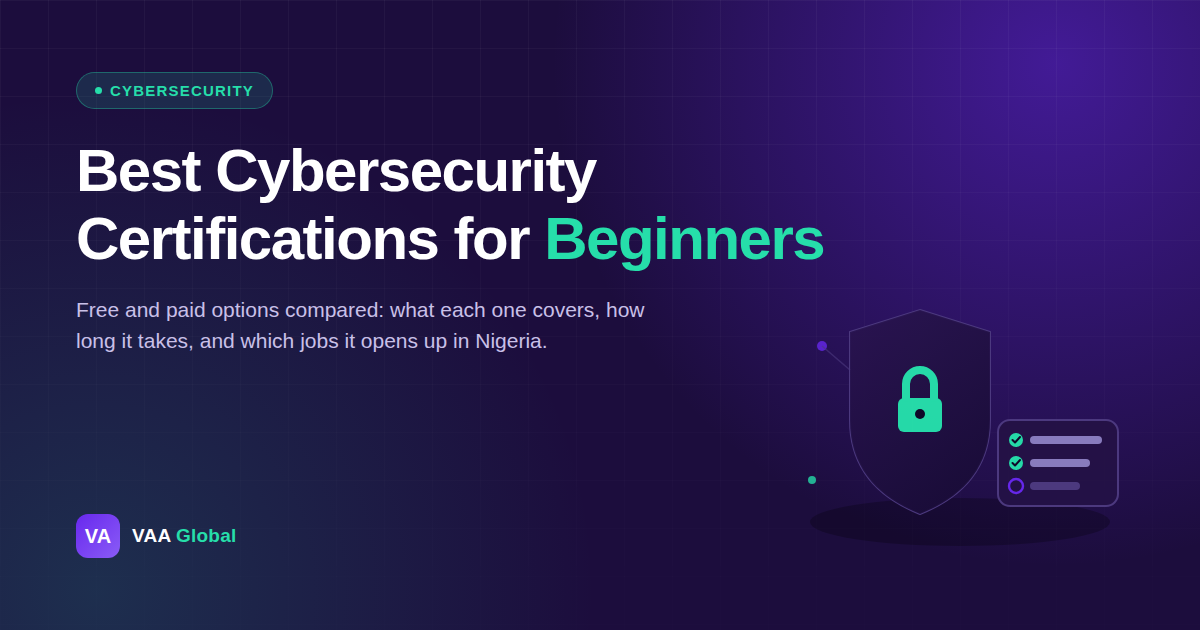
Confused by all the acronyms? Cybersecurity certifications for beginners fall into a few clear tiers. You only need to know a handful to make a smart choice. This guide compares the real options in Nigeria. It covers what each one opens up. It also shows how to pick your first one, even with no experience, without wasting money.
Do You Need a Certification to Work in Cybersecurity?
Not always, but it helps a lot. Most hiring managers use certifications as a fast filter. A recognized certificate proves you know the basics. It will not replace hands-on skill. But it gets your CV past the first round, even for remote roles outside Nigeria.
Why Certifications Matter More Than a Degree Here
Cybersecurity moves fast. Threats change every month. Because of this, employers care more about current, practical knowledge than an old degree. A certification is also faster and cheaper to earn. As a result, it is the more realistic entry point for most beginners, including career switchers with no prior IT background.
How Long Does It Take to Get a Cybersecurity Certification?
Most beginners get certified faster than they expect. ISC2 CC usually takes two to four weeks of focused study. CompTIA Security+ takes a bit longer, often six to ten weeks. Either way, you do not need months of study first. You can start applying for entry-level roles far sooner than you think.
The Free Starting Point: ISC2 Certified in Cybersecurity
The ISC2 Certified in Cybersecurity (CC) is free. The exam is free. The training is free too. It covers core information security basics: access control, and incident response. Because there is no cost barrier, it is the lowest-risk way to test your interest, before you spend money elsewhere.
CompTIA Security+: The Industry-Standard Next Step
CompTIA Security+ is the most requested entry-level certification in real job posts. It covers security concepts, risk, cryptography, and network defense in more depth than ISC2 CC. Many employers list it as a baseline requirement. This holds true even for junior information security roles. So it is worth the cost once you are committed.
Google Cybersecurity Certificate: Practical and Portfolio-Friendly
This Coursera-based program teaches SIEM tools, network basics, and simple Python. It is built for total beginners. It also includes projects you can show in a portfolio. As a result, it pairs well with Security+: one proves practical skill, the other proves standard knowledge.
Which Certification Should You Choose First?
Start with ISC2 CC if budget is tight, or you are still testing your interest. Move to Security+ once you are committed, since it opens the most doors. Add the Google certificate too if you want hands-on projects for your portfolio. In short, that list covers the best cybersecurity certifications for beginners worth pursuing right now, in almost any order.
What Entry-Level Roles These Certifications Open Up
SOC analyst, GRC analyst, and security administrator roles hire the most beginners. These jobs take people fresh from a certification, a bootcamp, or an adjacent IT role. From there, most analysts specialize further. For example, some move into penetration testing. Others move into governance, once they have real experience behind them.
How to Learn Cybersecurity in Nigeria Without Guessing
You can self-study every certification above with free material. However, structured training still saves time. It tells you exactly what to study, and in what order, instead of guessing alone. If you want a guided path, explore VAA Global's Cybersecurity training program, which builds toward these same entry-level roles. You can also take VAA Global's free Career Compass quiz to confirm the field fits you. Or browse the full list of 33 VAA Global courses if you are still deciding between tracks. For more on how the training works day to day, read about VAA Global's story and approach.
The Bottom Line
You do not need a computer science degree to start a cybersecurity career path in Nigeria. Start free with ISC2 CC. Add CompTIA Security+ once you are committed. Then build a small portfolio with the Google certificate. That combination, plus steady effort, is enough to land your first entry-level cybersecurity job, even with no experience to begin with.