If you're new to governance, risk, and compliance (GRC), getting a handle on internal audit basics is one of the best places to start, because internal audit sits at the center of how organizations actually check whether their rules and controls work. Internal audit isn't about catching people doing something wrong — though that happens sometimes — it's mostly about systematically checking whether a company's processes, controls, and risk management actually function the way they're supposed to.
What Internal Audit Actually Does
At its core, the internal audit function asks one simple question over and over: does reality match what the policy says should happen? If a company's policy says all new vendors must go through a security review before onboarding, internal audit will pull a sample of recently onboarded vendors and check whether that review actually happened. That's the internal audit process in a nutshell — compare what should happen against what did happen, then flag the gap.
Internal auditors work across finance, IT, operations, HR, and compliance. A single internal audit function might review financial close processes one quarter and access control reviews the next. This variety is part of why internal audit is such a common entry point into a broader GRC career — you get exposure to how a whole organization runs, not just one department.
The Internal Audit Process, Step by Step
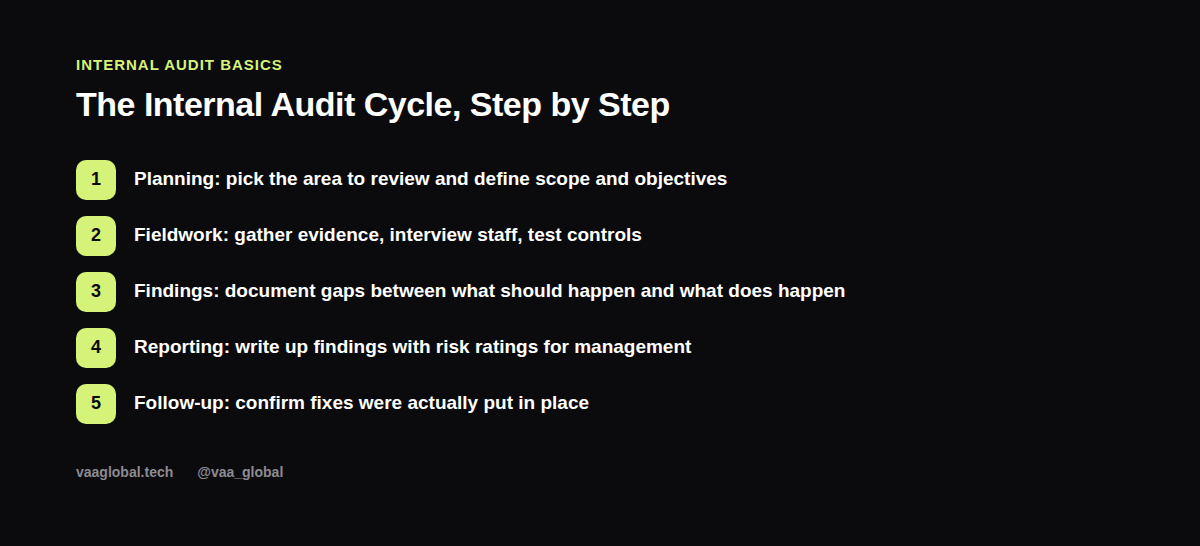
Most internal audit work follows a consistent cycle, whether the audit is big or small:
- Planning: The auditor and audit team pick which area to review (sometimes this comes from an annual risk-based audit plan) and define the scope — what's in, what's out, what time period is covered.
- Fieldwork: This is the hands-on part. Auditors pull documents, interview process owners, and test a sample of transactions or controls to see if they hold up.
- Findings: Any gap between policy and practice gets written up, usually with a severity rating (high, medium, low) based on the risk it represents.
- Reporting: Findings go into a report for management, often with recommended remediation steps and a deadline.
- Follow-up: A good internal audit function circles back later to confirm the fix actually happened, rather than just trusting management's word.
Risk-Based Audit Planning
Most mature internal audit functions don't audit everything every year — that would take forever and burn out the team. Instead, they use a risk-based audit approach: rank business areas by how much risk they carry (financial impact, regulatory exposure, past history of issues) and spend audit hours where the risk is highest. A payment processing system usually gets audited more often than, say, the office supply ordering process, because the downside of a failure is much bigger.
Internal Audit vs External Audit
People new to GRC often mix these up, so it's worth being precise.
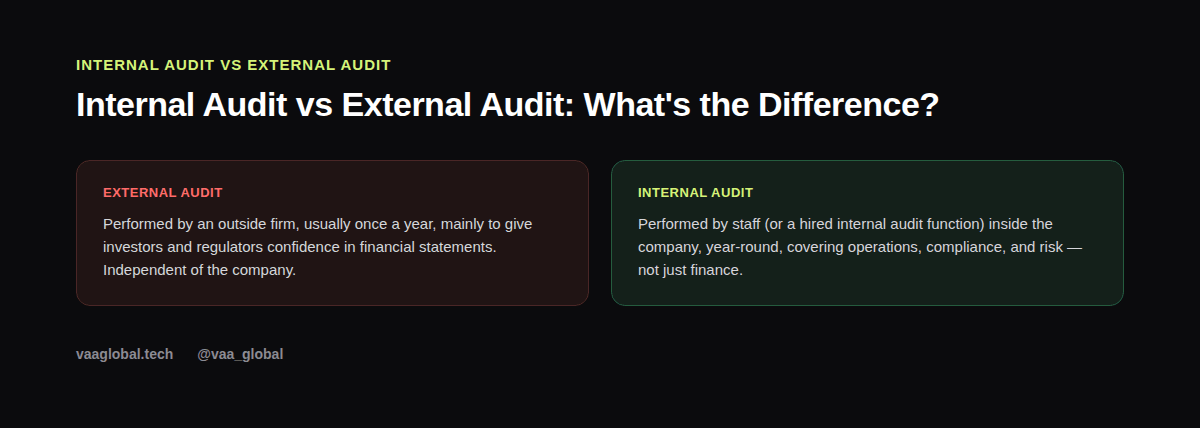
External audit is typically done by an outside accounting firm, focuses heavily on financial statements, and happens once a year to satisfy regulators and investors. Internal audit happens year-round, is run by (or on behalf of) the organization itself, and covers a much wider range — operations, IT, compliance, and risk, not just the books. Some internal audit functions also support external auditors by providing documentation and context, but the two roles stay separate to preserve independence.
Gathering Audit Evidence
Audit evidence is anything that proves a control did or didn't happen — a signed approval, a system log, a ticket in a helpdesk tool, a screenshot of a configuration setting. Auditors are trained to prefer evidence that's independently verifiable over a verbal assurance. If someone says "yes, we review access quarterly," a good auditor asks to see the actual review records, not just take their word for it. This is a core habit worth building early if you're aiming at any GRC analyst role.
A Worked Example: Testing a Control
Say the audit scope includes testing whether terminated employees have their system access revoked within 24 hours, per company policy. A sample approach might look like this:
- Pull a list of all employees terminated in the last quarter from HR records.
- For each one, check the timestamp their access was revoked in IT systems.
- Compare the gap between termination date and revocation date against the 24-hour policy.
- Flag any exceptions and calculate what percentage of the sample passed.
If 18 of 20 sampled terminations passed but 2 took three days to revoke access, that's a finding worth reporting — not a crisis, but a real gap that needs a fix, like adding an automated trigger between the HR system and IT provisioning.
Common Internal Audit Findings
New auditors quickly notice the same categories of problems show up again and again: controls that exist on paper but aren't actually performed, missing documentation, inconsistent application of a policy across teams, and outdated procedures that no longer match how the business actually operates. Recognizing these patterns is a skill that builds with repetition — it's one reason internal audit experience is so valued across the wider compliance monitoring and risk field. If you want a sense of what a narrower, operational audit looks like in practice, a hotel night audit checklist or a guest experience audit write-up follows the same logic on a smaller scale — check what should happen against what did.
Internal Audit as a Career Path into GRC
Internal audit is a genuinely common way people land in governance, risk, and compliance work. You don't need a finance degree to start — strong attention to detail, clear writing, and comfort asking direct questions matter more day to day. From an internal audit role, people often move into compliance monitoring, risk management, or specialized areas like IT audit. If you're exploring adjacent skills, VAA Global's Cybersecurity course covers some of the technical grounding — like vulnerability management and incident response — that overlaps with IT audit work, though it isn't a GRC course itself.
For a deeper, authoritative overview of the internal audit profession and its standards, the Institute of Internal Auditors (IIA) is the recognized global body and a good next stop.
Getting Started: What to Read and Practice
If you want hands-on exposure before applying for roles, try writing a mock audit program for something simple, like your own household budget process or a small business's expense approvals. Define the scope, list what you'd check, and practice writing a finding the way an auditor would: what the policy says, what you observed, why it matters, and what should change. This kind of practice translates directly into interview conversations, similar to how people preparing for business analyst interview questions build a portfolio of worked examples ahead of time.
The Bottom Line
Internal audit basics boil down to a repeatable cycle — plan, test, find, report, follow up — applied with a healthy amount of skepticism and a preference for real evidence over assurances. It's detail-oriented work, but it's also one of the clearest on-ramps into a broader GRC career, since it exposes you to how controls, risk, and compliance actually operate across a whole organization. Master the basics here and the rest of GRC starts to make a lot more sense.