So, what is GRC? GRC stands for Governance, Risk and Compliance, and it is the umbrella term for how an organization sets its rules, figures out what could go wrong, and proves it is following the laws and standards that apply to it. If you have ever wondered what people mean when they talk about “GRC roles” or “GRC software,” this is the plain-English version, written for someone who has never worked in the field before.
Breaking Down the Three Letters
Governance is the top layer. It covers how decisions get made, who is accountable for what, and which policies exist to guide behavior. For example, a company's governance structure decides who signs off on a new vendor contract, or who approves a change to the pricing model. Without governance, decisions get made inconsistently, and nobody is clearly responsible when something goes wrong.
Risk management is the middle layer. This is the practice of identifying things that could damage the business, such as a data breach, a key supplier going bankrupt, or a regulatory fine, and then deciding how seriously to treat each one. A risk analyst might build a simple scoring system: how likely is this to happen, and how bad would it be if it did? High-likelihood, high-impact risks get prioritized first, and this scoring exercise is usually called a risk assessment.
Compliance is the bottom layer, and it is often where beginners start. Compliance means following the external rules, such as data protection law or anti-money-laundering regulations, as well as internal policies the company has set for itself. A compliance analyst's day-to-day work often involves checking whether a process actually matches what the policy document says it should do, and collecting evidence to prove it.
Why GRC Exists as a Single Function
You might ask why these three things are grouped together instead of being handled separately. The honest answer is that they overlap constantly. A new data privacy law (compliance) creates new risks if the company is not ready for it (risk), and someone has to decide how the company will respond (governance). Because of this, many organizations now run GRC as one connected program rather than three disconnected departments, often supported by GRC software that tracks policies, risks and controls in one place.
What a GRC Framework Actually Looks Like
A GRC framework is simply a structured, repeatable way of doing governance, risk and compliance work, instead of handling each issue ad hoc. A typical framework includes a policy library, a risk register (a running list of identified risks and their owners), a set of internal controls that reduce each risk, and a schedule for testing whether those controls are actually working. For instance, if “unauthorized access to customer data” is a listed risk, the related control might be “all employee laptops require multi-factor authentication,” and the test might be a quarterly check that MFA is actually enabled on every device.
Where GRC Shows Up in Everyday Business
GRC is not only for banks and hospitals, even though those industries have the heaviest regulatory requirements. A growing e-commerce company needs GRC thinking to handle payment card data safely. A remote-first startup needs it to manage who has access to sensitive systems. Even a small nonprofit needs basic governance to decide how funds get approved and spent. As a result, GRC skills transfer across almost every industry, which is one reason the field keeps growing.
How GRC Connects to Other Career Paths
If you have looked into cybersecurity, internal audit, or even project management, you have already brushed up against GRC without knowing it. Vulnerability management and incident response, which are core cybersecurity skills, directly feed into the risk side of GRC. If you want to understand how those skills overlap, it is worth reading about starting a career in cybersecurity from scratch, since many people move between the two fields. VAA Global's Cybersecurity course covers vulnerability management and incident response, both of which show up constantly in GRC risk conversations, even though it is not a GRC course itself.
Who Actually Does GRC Work
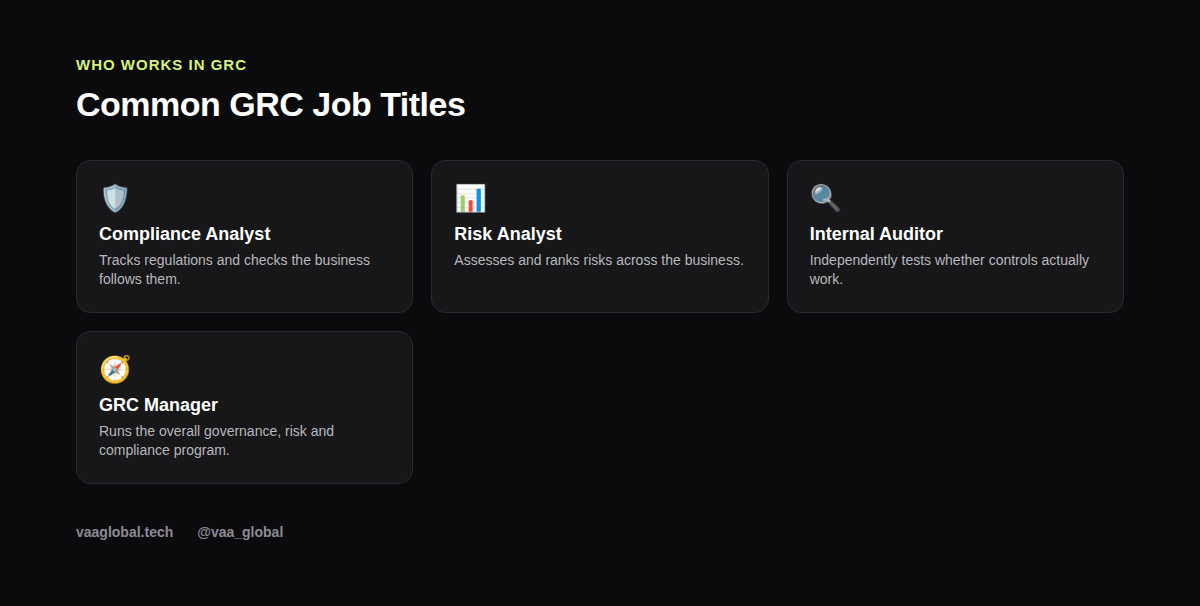
In a mid-size or large company, you will usually find GRC responsibilities spread across a few job titles: compliance analysts, risk analysts, internal auditors and GRC managers. In smaller companies, one person might wear all these hats. None of these roles typically require a technical degree to start; what matters more is attention to detail, comfort with reading policy documents, and the ability to ask “how do we know this is actually true?” instead of taking a process description at face value.
Common Beginner Misunderstandings
A lot of beginners assume GRC is mostly about writing policies. In reality, far more time goes into checking whether existing policies are being followed, and documenting the evidence. Another common mix-up is treating compliance and risk as the same thing; compliance is about following defined rules, while risk management is about judgment calls on things that are not always written down anywhere. Understanding this distinction early will save you confusion in interviews and on the job.
What Does GRC Stand For, And Why Does It Matter?
To recap plainly: what does GRC stand for? Governance, Risk and Compliance. Why is GRC important for companies? Because without it, decisions get made without accountability, risks go unnoticed until they cause damage, and regulators or customers eventually find out the business was not following its own rules. A compliance officer role exists specifically to catch that last problem before it becomes a lawsuit or a fine. If you are still unsure what is the difference between governance and compliance, remember that governance sets the rules and compliance proves they were followed; one is about decision-making authority, the other is about evidence. This is also where a regulatory requirement becomes real work: someone has to translate a new law into an actual policy, communicate it, and check it is being followed through routine audit activity. For a broader sense of how organizations document this kind of regulatory requirement work, ISACA's resources on governance and risk are a useful reference point for GRC-related credentials and career guidance.
If you are weighing GRC against a related field, it also helps to understand how business analysis skills like requirements gathering and process mapping feed into GRC work; VAA Global's Business Analysis course covers process improvement and requirements modelling, both of which show up when you are documenting controls. And if you are generally exploring remote career options before committing to GRC specifically, this roundup of top remote jobs for Nigerians in 2026 is worth a look too.
The Bottom Line
So, what is GRC, in one sentence? It is the combined discipline of setting the right rules (governance), understanding what could go wrong (risk), and proving the rules are actually followed (compliance). It is a field with real entry points for beginners, strong demand across industries, and a surprising amount of overlap with cybersecurity and internal audit. If this breakdown made sense to you, the next logical step is learning what day-to-day GRC work actually looks like and how to get your first role in it.