
If you've just started learning GRC, understanding what is a risk register and how to build one is one of the fastest ways to go from abstract theory to something you can actually produce for a job application or a real project. It's one of the most practical, hands-on documents in the entire field.
Why a Risk Register Exists
Every organization faces risks — security incidents, vendor failures, regulatory changes, staff turnover, and more. Without a central place to record them, individual risks tend to live only in someone's head or inbox, which means they get forgotten, duplicated, or dropped the moment that person changes roles. A risk register fixes that by giving risk a permanent, shared home.
The Core Fields Every Risk Register Needs
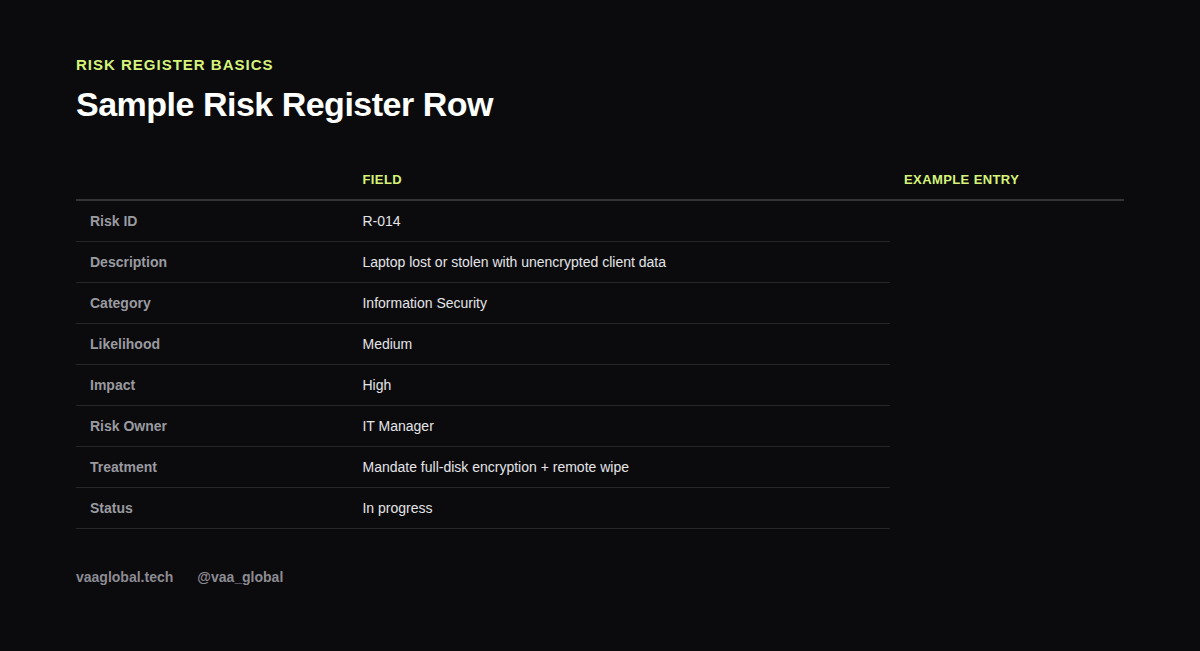
While formats vary by organization, most risk registers share a common set of fields: a unique risk ID, a clear description, a category, a likelihood rating, an impact rating, a named risk owner, the planned treatment, and a current status. The sample row shown above illustrates how these fields come together for a single, realistic risk.
Likelihood and Impact: The Two Numbers That Drive Prioritization
Likelihood estimates how probable a risk is to occur, while impact estimates how severe the consequences would be if it did. Multiplying or combining these two (often on a simple scale like Low/Medium/High, or 1–5) produces a rough risk score that helps teams decide what to tackle first. This is closely tied to risk assessment basics more broadly — the register is where assessment results actually live and get tracked.
Risk Ownership: Why Every Risk Needs a Name Attached
A risk without an owner tends to drift. Assigning a specific risk owner — a person, not just a department — creates accountability for actually treating the risk rather than just acknowledging it exists. The owner doesn't have to personally fix everything; they're responsible for making sure the treatment plan moves forward and gets reported on.

How to Actually Build One, Step by Step
Start by gathering risks from multiple sources: interviews with department leads, past incidents, audit findings, and even informal brainstorming sessions. Next, write each risk clearly and sort it into a category so patterns become visible. Then rate likelihood and impact consistently, using the same scale across every entry. Assign an owner to each risk, and finally, record the treatment plan and current status, revisiting the whole register on a regular schedule rather than leaving it to go stale.
A Worked Example
Take the sample row above: a lost or stolen laptop containing unencrypted client data. Likelihood is rated Medium because laptops do get lost occasionally; impact is rated High because unencrypted client data getting exposed could trigger serious regulatory and reputational consequences. The treatment plan — mandating full-disk encryption and remote wipe — directly reduces the impact side of that equation, even if the likelihood of losing a laptop stays roughly the same.
Risk Register vs. Risk Assessment: Not Quite the Same Thing
A risk register is the document; a risk assessment is the process. You run a risk assessment to identify and evaluate risks, and the results get recorded in the risk register. Beginners sometimes use the two terms interchangeably, but keeping them distinct helps when you're explaining your work in an interview or writing up a project.
Common Questions Beginners Ask
A frequent question is what fields go in a risk register — covered above, but worth repeating: ID, description, category, likelihood, impact, owner, treatment, and status, at minimum. People also ask how often should a risk register be updated; there's no single universal answer, but many teams review it quarterly at minimum and immediately after any major incident. On who owns a risk register, the document itself is often maintained by a GRC or risk management function, even though individual risks within it are owned by different people across the business. And is a risk register the same as a risk assessment — no, as explained above, one is the output document and the other is the process that feeds it.
Mitigation, Residual Risk, and Keeping the Register Honest
A good risk register doesn't stop at listing the raw risk — it also tracks mitigation steps and the residual risk left over once those steps are in place. Residual risk matters because very few treatments eliminate a risk entirely; a register that only shows the original rating and never updates it as treatments land gives a falsely static picture. Reviewing residual risk alongside the original rating is one of the clearest signs that a risk management program is actually functioning, rather than just producing paperwork.
Why This Skill Matters for Your Career
Knowing how to build and maintain a risk register is a concrete, demonstrable skill you can bring up in interviews, even as a complete beginner — you can literally build a sample register as a portfolio piece. This pairs well with broader operations and analysis skills; if you're also exploring adjacent paths, check out our guide on key metrics every operations manager should track, how to become a business analyst, or business analyst interview questions and answers, since risk tracking shows up across all of these fields regularly. For a more formal reference on how risk terminology is defined, ISO's risk management standard is a solid source to check.
The Bottom Line
Now that you know what is a risk register and how to build one, the next step is practice: pick three or four plausible risks for any organization you're familiar with, even a small business or a course project, and draft a real register using the fields above. That single exercise does more for your GRC credibility than hours of passive reading.