Ask anyone who's worked near internal audit or financial controls and they'll have an opinion on COSO. This COSO framework explained simply guide skips the dense committee language and focuses on what you actually need to know: what COSO covers, why it matters, and how its five components fit together.
Where COSO Came From
COSO was formed in the mid-1980s by several US professional accounting and auditing organizations, originally to study the causes of fraudulent financial reporting. Over time, its work evolved into the widely used Internal Control — Integrated Framework, and later an Enterprise Risk Management (ERM) framework as well. You can read the current frameworks directly at coso.org rather than relying only on secondhand summaries.
The Five Components, in Plain Language
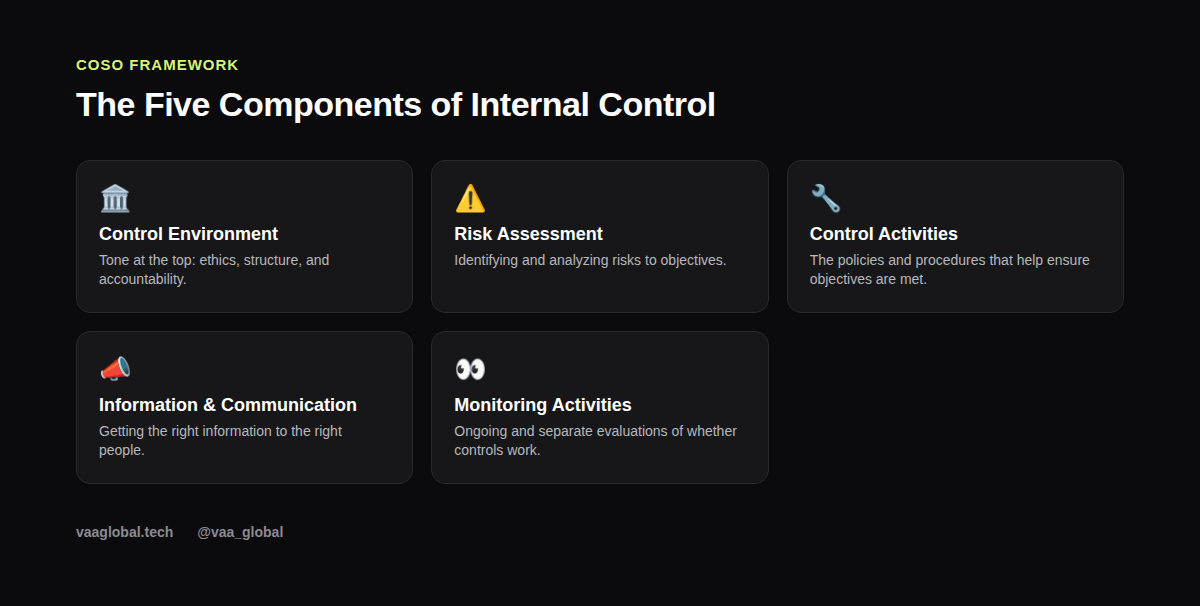
Control Environment is the tone at the top — the ethics, organizational structure, and accountability that shape everything else. Risk Assessment is about identifying and analyzing risks to the organization's objectives, which overlaps heavily with risk assessment basics covered elsewhere in GRC. Control Activities are the actual policies and procedures that help ensure things go as planned, like requiring two signatures on large payments. Information and Communication is about getting the right information to the right people at the right time. Monitoring Activities covers both ongoing checks built into daily operations and separate evaluations, like internal audits, that confirm controls are actually working.
COSO and Internal Control Over Financial Reporting
COSO's Internal Control — Integrated Framework is especially well known because it's commonly referenced when organizations design and evaluate internal controls over financial reporting. Auditors and finance teams use the five components as a checklist of sorts, asking whether each area is genuinely functioning rather than just documented on paper.
COSO ERM: Risk Beyond the Balance Sheet
Separately from internal control, COSO also publishes an enterprise risk management (ERM) framework, which takes a broader view — connecting risk management to strategy and performance across the whole organization, not just financial controls. If you're studying risk appetite and risk tolerance as separate concepts, COSO's ERM framework is one of the places those ideas get formally defined and discussed.
Is COSO Legally Required?
COSO itself isn't a law. However, it's so widely adopted that many regulatory expectations around internal control effectively assume a COSO-style structure, even without naming COSO directly. If you need a definitive answer about a specific legal requirement in your jurisdiction or industry, check with a qualified professional or the relevant regulator rather than treating this article as legal guidance.
A Worked Example
Picture a mid-sized company worried about expense fraud. Under the Control Activities component, they might require manager approval for any expense over a set threshold. Under Monitoring Activities, internal audit periodically samples expense reports to confirm that approval actually happened, rather than assuming the policy is followed just because it exists. If the sample turns up gaps, that feeds back into strengthening the control environment and tightening the control activity itself.
Common Questions Beginners Ask
A frequent question is what are the five components of COSO — control environment, risk assessment, control activities, information and communication, and monitoring activities, exactly as shown in the grid above. People also ask is COSO required by law, and as covered above, no it isn't directly, though its influence is everywhere in practice. On how is COSO different from ISO 31000, COSO is more specifically tied to internal control and, through its ERM framework, enterprise risk, while ISO 31000 is a general risk management guidance standard without the same financial-reporting roots. And what does COSO stand for — the Committee of Sponsoring Organizations of the Treadway Commission.
How COSO and GRC Software Fit Together
In practice, most companies don't track COSO components in a binder; they map controls into a GRC platform, a spreadsheet, or an audit management tool, then tag each control to one or more of the five components. This mapping makes it much easier to answer a simple but important question during an audit: for any given risk, which component is actually responsible for catching a failure, and did it? If a control fails, the mapping often reveals whether the real gap was in Control Activities (the control itself was weak) or in Monitoring Activities (the control existed but nobody checked whether it worked).
Why This Matters for Your Career
Understanding COSO is genuinely valuable if you're aiming for internal audit, compliance, or risk roles, since so many organizations structure their control documentation around its five components whether or not they say so explicitly. This knowledge pairs naturally with broader operations and business analysis skills — see our guides on how to become a business analyst and key metrics every operations manager should track for adjacent skill-building, or what is a risk register and how to build one to see how COSO's risk assessment component connects to a concrete working document.
The Bottom Line
With the COSO framework explained simply, the key takeaway is that strong internal control comes down to five interconnected pieces — tone, risk awareness, concrete controls, good communication, and ongoing monitoring. None of them work well in isolation, which is exactly why COSO presents them as one integrated framework rather than five separate checklists.