This guide to risk assessment basics for GRC beginners covers the process that sits underneath almost everything else in governance, risk, and compliance work. Once you understand how risk gets identified and rated, frameworks like ISO 27001 and NIST CSF make a lot more sense, because they all lean on the same underlying logic.
Why Risk Assessment Comes First
Before you can treat a risk, you have to know it exists and understand roughly how serious it is. That's the entire point of a risk assessment: turning a vague sense of 'this could go wrong' into something specific enough to act on. Skipping this step is how organizations end up spending money fixing the wrong problems while real risks go unaddressed.
Identifying Risks: Where They Actually Come From
Risks surface from many places — incident history, employee interviews, audit findings, industry news, and sometimes just careful brainstorming about what could go wrong in a process. A thorough risk identification exercise casts a wide net before narrowing down, because a risk you never identified can't be assessed, treated, or tracked at all.
Likelihood and Impact: The Two Core Ratings
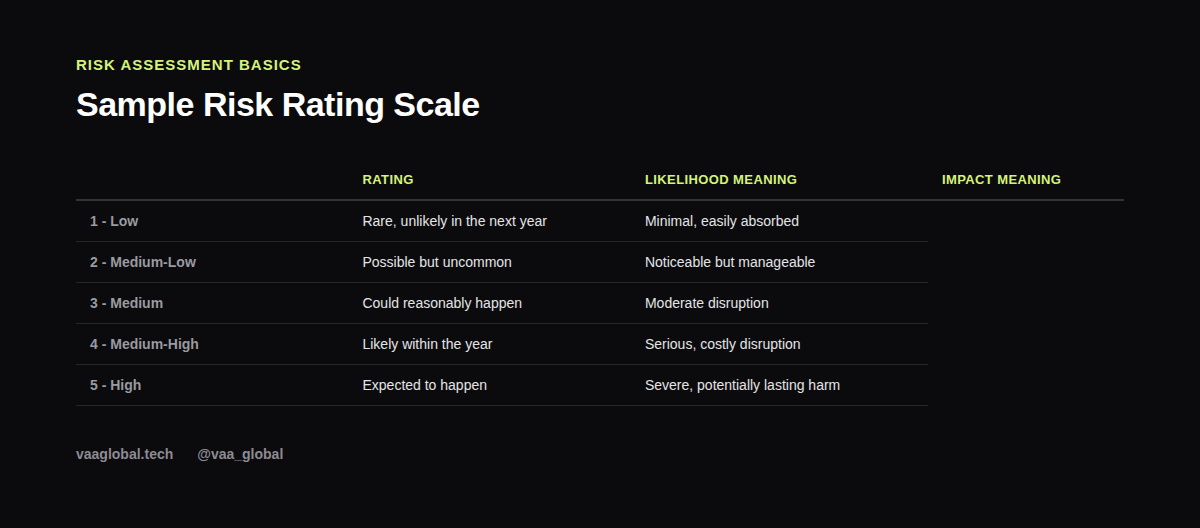
Every risk assessment method, no matter how sophisticated, comes back to two core questions: how likely is this to happen, and how bad would it be if it did? The sample risk rating scale above shows one simple way to structure both likelihood and impact on a five-point scale, from Low to High. Combining the two ratings — often by multiplying them — gives teams a rough score they can use to compare very different risks against each other.
Qualitative vs. Quantitative Risk Assessment
Most beginners start with qualitative risk assessment, using descriptive labels like Low, Medium, and High rather than hard numbers. Quantitative risk assessment goes further, trying to estimate actual financial impact or statistical probability, which requires more data and is harder to do reliably for brand-new risks. Many organizations use qualitative assessment as a starting point and only build toward quantitative methods for their highest-priority risks.
The Full Risk Assessment Process
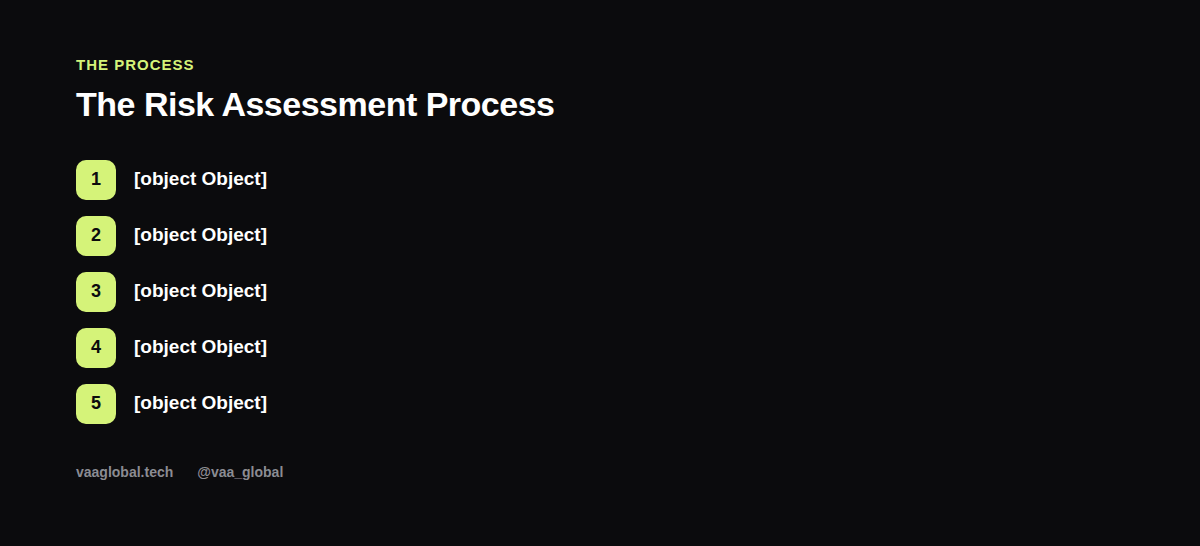
As the graphic above shows, the process generally runs through five stages: identify the risks, analyze their likelihood and impact, evaluate and prioritize them against each other, decide how to treat the highest-priority ones, and then monitor the situation and reassess as things change. This loop repeats continuously rather than running once and being considered finished.
A Worked Example
Imagine assessing the risk of a key vendor going out of business. Likelihood might be rated Medium-Low if the vendor seems financially stable but the market is volatile. Impact might be rated High if that vendor handles something critical, like payment processing, with no backup in place. That combination pushes the risk up the priority list, which is exactly the kind of judgment call third-party vendor risk management programs are built to make systematically rather than by gut feeling alone.
Risk Prioritization: Why You Can't Treat Everything at Once
No organization has unlimited time or budget, so risk prioritization matters just as much as the rating itself. A risk matrix — plotting likelihood against impact — visually separates the handful of risks that need urgent attention from the long tail of lower-priority items that can wait or simply be monitored.
Common Questions Beginners Ask
People often ask how do you rate risk likelihood and impact, and the honest answer is: consistently, using the same scale across your whole risk register, even if the scale itself is simple. Others ask what is the risk assessment process, which is the five-stage loop described above. A common point of confusion is is risk assessment the same as risk analysis — the terms are often used interchangeably in practice, though some frameworks treat analysis as one specific sub-step within the broader assessment process. And on how often should risk assessments happen, most mature programs reassess at least annually and after any significant change, incident, or new regulation, though the right cadence really depends on the organization's risk appetite and industry.
Risk Matrix in Practice
A risk matrix (sometimes called a risk heat map) is simply a grid with likelihood on one axis and impact on the other. Each assessed risk gets plotted as a dot or cell, and risks in the top-right corner — high likelihood, high impact — jump to the front of the queue. This visual approach makes risk prioritization much easier to explain to non-specialists than a spreadsheet full of numbers, which is part of why it shows up constantly in GRC reporting and executive risk reviews alike.
Where This Skill Takes You
Risk assessment is a foundational skill across GRC, operations, and even project management roles. If you're exploring adjacent paths, our guides on how to become a business analyst, key metrics every operations manager should track, and what is a risk register and how to build one all touch on risk-adjacent thinking, and learning to build a risk register gives you a natural next step for applying what you've assessed. For the formal international reference on risk management terminology and process, see ISO 31000.
The Bottom Line
Mastering risk assessment basics for GRC beginners means learning to identify risks honestly, rate them consistently using likelihood and impact, and prioritize ruthlessly rather than treating every risk as equally urgent. Get comfortable with that loop, and nearly every GRC framework you encounter afterward will feel far less intimidating.