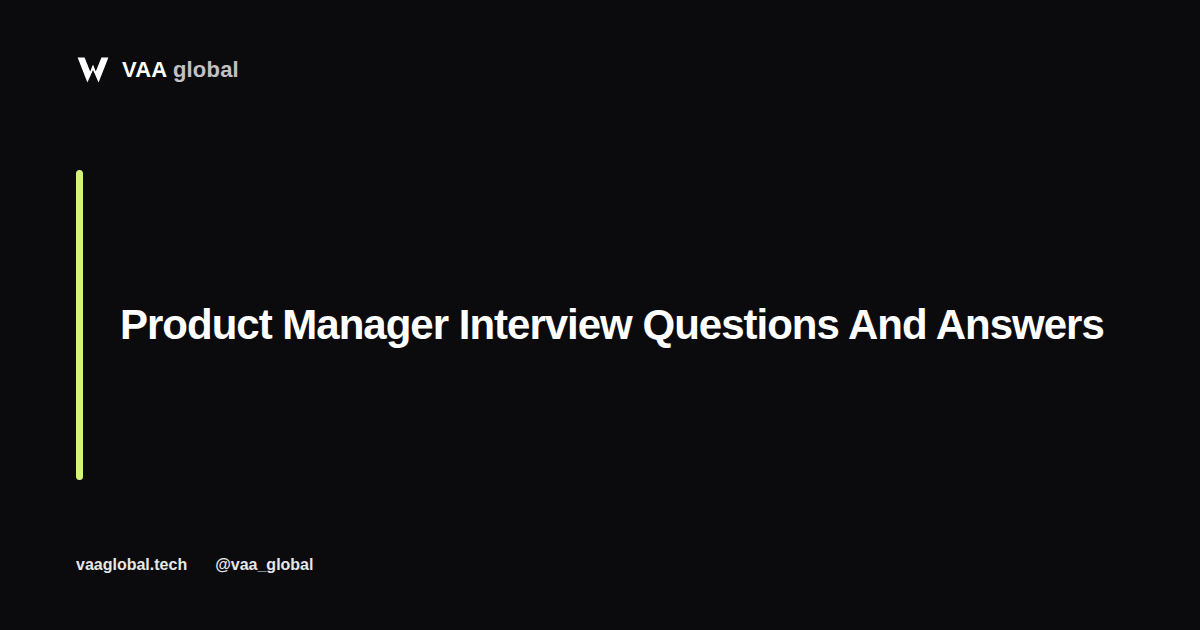
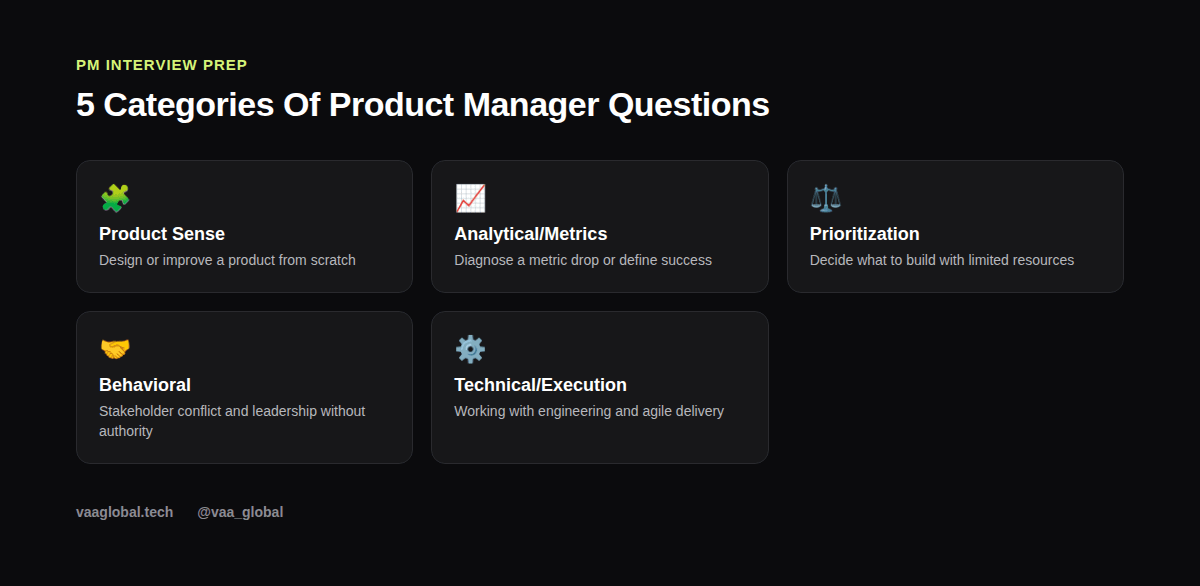
Product manager interview questions and answers tend to cluster into five recognizable categories, and once you can name those categories, the whole process feels far less like guessing and far more like preparation. Because product management sits at the intersection of business, design, and engineering, interviewers typically test all three angles across a single conversation. A candidate who only prepares technical answers, or only behavioral stories, usually gets caught off guard somewhere in the middle.
Product Sense Interview Questions
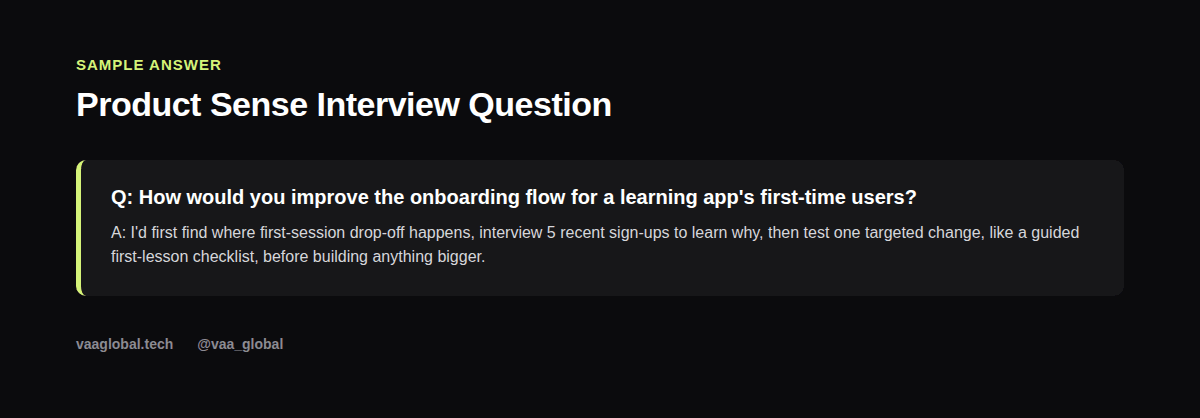
Product sense interview questions typically ask you to design, improve, or evaluate a product, often one the interviewer uses daily. For example: "How would you improve the onboarding flow for a learning app's first-time users?" A strong answer starts by clarifying the user and goal, proposes a hypothesis for where the problem likely is, and suggests a small, testable change rather than a sprawling redesign. Jumping straight to solutions without naming the user or the problem first is the single most common mistake in this category.
Analytical And Metrics Questions
Metrics interview questions often sound like: "Daily active users dropped 15% last week, how would you investigate?" Strong candidates narrow the problem methodically: is the drop across all user segments or concentrated in one, did it start suddenly or trend down gradually, and did anything ship around that time. Naming a clear north-star metric and the supporting metrics underneath it also shows you understand how product teams actually define success, rather than treating every number as equally important.
Prioritization Questions
A classic prioritization prompt is: "You have five feature requests and only enough engineering time for two, how do you decide?" The strongest answers reference an actual framework rather than gut feeling, and naming one by name, such as RICE or MoSCoW, shows preparation. If these frameworks are unfamiliar, common product management frameworks explained covers the most widely used ones before you walk into this kind of question.
Behavioral And Stakeholder Management Questions
Because product managers rarely have direct authority over designers or engineers, interviewers want to see how you influence without formal power. A typical question: "Tell me about a time a stakeholder disagreed with your roadmap decision." Describe the disagreement honestly, the specific steps you took to understand their concern, and how you resolved it, even if the resolution was a compromise rather than a clean win. Interviewers are often more interested in your process than in whether you got your original way.
Execution And Working With Engineering
Execution questions test whether you can actually ship, not just ideate. Expect something like: "How do you handle a feature that's behind schedule right before launch?" A credible answer discusses cutting scope deliberately rather than cutting quality, communicating the tradeoff clearly to stakeholders, and documenting what got cut for a later release. This connects closely to writing clear specs in the first place; see how to write a product requirements document for the documentation habits that prevent this kind of fire drill in the first place.
How To Prepare If You Have No PM Job Title Yet
If you are breaking into product management without direct experience, lean on a portfolio of practice projects rather than apologizing for the gap. Writing a PRD for an app you use daily, running a mock prioritization exercise, or shadowing how an existing product makes tradeoffs all count as preparation. How to build a product management portfolio with no experience and how to break into product management from a non-tech background both go deeper into building that credibility before your first interview.
Questions To Ask The Interviewer
Toward the end of the interview, ask about the team's current biggest product challenge, how success is measured for the role in the first 90 days, or how decisions get made when data and stakeholder opinion disagree. Frameworks referenced by the Project Management Institute on structured decision-making can be a useful reference point if you want to sound informed without reciting jargon.
A Note On Technical Depth
Some product manager interview questions and answers probe technical fluency, especially at companies building developer tools or infrastructure. You do not need to code, but understanding basic concepts like APIs, databases, and how frontend and backend roles divide responsibility helps you ask engineers better questions and avoid proposing solutions that are technically unrealistic.
What Interviewers Are Really Scoring You On
Behind every product manager interview question, panels are quietly scoring a few underlying product manager skills: how you reason under ambiguity, how you use data and user research together instead of picking one, how clearly you communicate tradeoffs on the roadmap and backlog, and whether your judgment holds up when the "right" answer is not obvious. Because of this, what should I say in a PM behavioral interview matters less than how you think out loud; interviewers would rather hear you reason through uncertainty in real time than deliver a polished answer that skips the messy middle. How do I answer product sense questions when you genuinely do not know the product well? Say so, then reason from first principles about the user and the goal, since fabricating familiarity you do not have is usually obvious and costs you more credibility than admitting the gap honestly.
The Bottom Line
Product manager interview questions and answers reward structured thinking over cleverness. Because each category above tests a different muscle, product sense, analytics, prioritization, influence, and execution, preparing one strong, specific example per category gives you a reliable toolkit you can adapt to almost any question the panel throws at you.