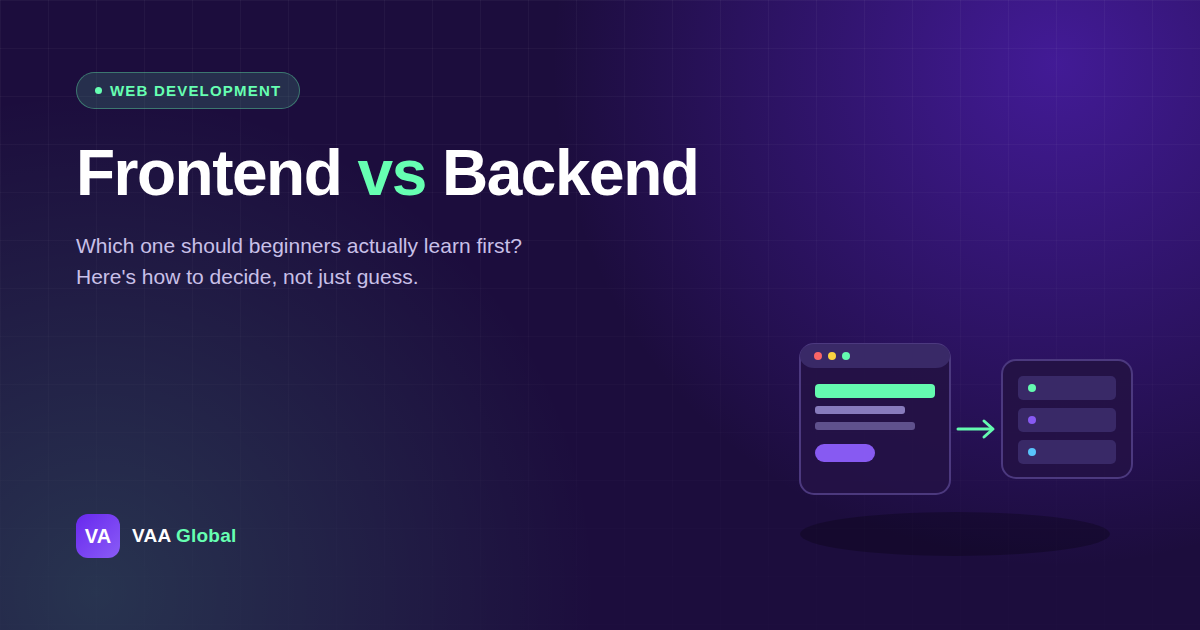
Frontend vs backend development is one of the first real choices in web development. Both are valid paths. However, one is usually friendlier for total beginners. This guide breaks down the real difference, then helps you pick a starting point.
Which Should Beginners Learn First?
Start with frontend if you are unsure. It gives fast, visual feedback. You write code, open a browser, and see your work instantly. That instant feedback loop builds motivation early, which matters a lot in your first few weeks of learning to code.
What Frontend Development Actually Covers
Frontend developer skills center on what users actually see and click. That means HTML, CSS, and JavaScript. It also means frameworks like React. Because the results are visual, beginners can build small, satisfying projects quickly. This alone keeps many new developers motivated long enough to stick with it.
What Backend Development Actually Covers
Backend developer skills center on what happens behind the scenes instead. That includes servers, databases, and APIs, often using tools like Node.js. Nothing is visible on screen right away. As a result, backend work can feel more abstract at first, even though the logic itself is not necessarily harder.
Is Frontend or Backend Easier for Beginners?
Frontend is generally considered easier to start with, mainly because of that immediate visual feedback. Backend is not harder in a deeper sense. It simply asks you to reason about logic and data before you can see any result. For many total beginners, that delay in feedback is the real obstacle, not the difficulty of the concepts themselves.
Frontend vs Backend: Which Pays More?
Pay varies by company, location, and experience more than by track. However, backend and fullstack roles often command slightly higher pay in many markets, since they carry more responsibility for how data and logic actually work. Frontend roles remain in strong demand too, especially as more companies invest in polished user experiences.
What About Choosing Fullstack Instead?
Many developers eventually learn both. That is exactly how you become a fullstack developer over time. According to practical guidance on where to start first, there is no universally right answer. Your interests and long-term goals matter more than any single trend does.
How to Decide Based on What You Enjoy
If you like visual design and user experience, start with frontend. If you are drawn to logic, data, and how systems fit together, backend may suit you better. Neither choice locks you out of the other later, since the fundamentals overlap more than most beginners expect.
How to Start Learning Web Development the Right Way
Self-study works, but structured training removes a lot of the guesswork around sequencing and depth. If you want a guided path, explore VAA Global's Programming School, which teaches frontend, backend, and fullstack tracks from the ground up. You can also take VAA Global's free Career Compass quiz to see which track fits you, browse the full list of 33 VAA Global courses if you are still deciding between paths, or read about VAA Global's story and approach to training.
Do You Need a Computer Science Degree?
No. Most working developers, on both frontend and backend, learn through bootcamps, structured courses, or self-study rather than a formal degree. Employers increasingly care more about a working portfolio and real projects than about where you studied. That makes web development one of the more realistic tech careers to break into without years of prior schooling.
What Does a Typical Day Look Like in Each Role?
A frontend developer spends the day turning designs into working interfaces, fixing layout issues, and testing how pages behave across devices. A backend developer spends more time writing the logic that powers those interfaces, managing databases, and making sure data moves safely between systems. Both roles involve constant problem solving, just aimed at different layers of the same product.
The Bottom Line
Frontend vs backend development is not really a permanent choice, since most developers eventually touch both. Start with frontend if you want quick wins and visible progress. Start with backend if logic and systems excite you more. Either path is a real, well-paid career in web development.