Walking into a junior developer interview without a plan is one of the most common ways candidates lose offers they were technically qualified for. Because these interviews mix technical questions, behavioral questions, and sometimes a live coding exercise, preparation needs to cover more than just memorizing algorithms. If you are asking how do I pass a coding interview with no experience, or even wondering what should I wear to a developer interview, this guide breaks down exactly what to expect and how to get ready for each part.
What a Junior Developer Interview Actually Tests
Companies hiring for entry level developer roles are rarely expecting you to know everything already. Instead, they are checking whether you can reason through a problem, communicate your thinking, and learn quickly on the job. For example, a technical screen might ask you to reverse a string or find duplicates in an array, not because the task itself matters, but because how you approach it reveals your problem-solving habits.
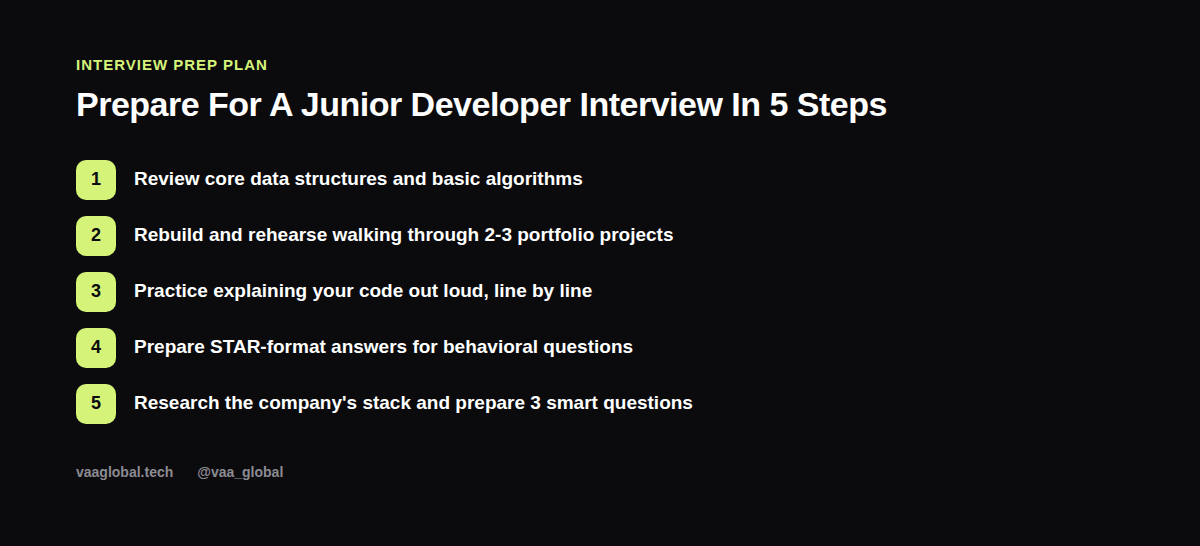
Step 1: Review Core Data Structures and Algorithms
You do not need to memorize every sorting algorithm, but you should be comfortable with arrays, objects or dictionaries, loops, and basic recursion. Sites like freeCodeCamp and the official MDN JavaScript guide are reliable free references for brushing up before interview week. If you still need a broader base of practice material, this list of free resources to practice coding as a beginner covers several solid starting points.
Step 2: Rehearse Walking Through Your Portfolio Projects
Interviewers almost always ask you to explain something you built, so being able to walk through your own code clearly is essential. Pick two or three strong examples from your coding portfolio project work and practice explaining what problem it solved, what you built first, and one challenge you ran into and fixed. Saying this out loud beforehand, even to yourself, prevents you from freezing when asked live.
Step 3: Expect a Live Coding or Take-Home Exercise
Many junior developer interviews include a small coding exercise, either live on a shared screen or as a take-home task with a deadline. If you get stuck during a live exercise, talk through your thinking rather than going silent, because interviewers usually care more about your reasoning than a perfect first attempt. Ask clarifying questions before diving in, since jumping straight into code without understanding the requirement is a common, avoidable mistake, similar to the broader mistakes beginner programmers make under pressure.
Step 4: Prepare for Behavioral Questions Too
Technical skill alone rarely wins the offer; how you handle setbacks and work with others matters just as much. Use the STAR format, Situation, Task, Action, Result, to structure answers to questions like describing a time you disagreed with feedback, or a project that did not go as planned. Keep each answer under two minutes and focus on what you actually did and learned, not just what happened to you.
Step 5: Research the Company and Prepare Smart Questions
Before the interview, look up the company's product, its tech stack if listed, and any recent news. Then prepare three genuine questions, such as what the onboarding process looks like for junior developers, or how code reviews typically work on the team. Asking thoughtful questions signals real interest and often leaves a stronger final impression than one more technical answer.
Common Junior Developer Interview Questions to Expect
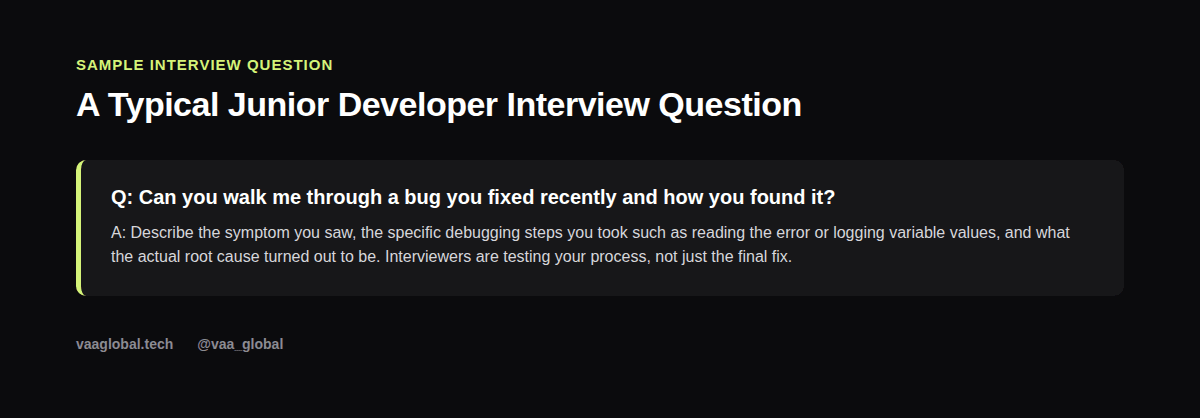
Typical questions include explaining the difference between a variable and a constant, describing how you would debug a function that returns the wrong value, and walking through a recent project. You should also expect questions about version control basics, such as what a Git commit is for, and general problem-solving prompts like FizzBuzz. Practicing a handful of these out loud, not just in your head, makes a measurable difference in how confident you sound on the day.
What to Do in the Final 24 Hours Before the Interview
Re-read the job description and match two or three of your skills directly to its requirements. Test your internet connection and camera setup if it is virtual, and have your resume and portfolio links open in a tab so you can reference them quickly if asked. Finally, get a full night's sleep; a clear head answers questions far better than a few extra hours of last-minute cramming.
What If You Get a Whiteboard Question?
Some companies still use a whiteboard question, where you solve a problem by writing code on a physical or virtual board without an editor to catch typos. This can feel intimidating at first. However, the goal is still the same: show your reasoning clearly, step by step, rather than racing to a perfect answer. Say your plan out loud before you start writing, because a recruiter sitting in on the interview is often grading your communication just as closely as your code. If you freeze, it is fine to say you need a moment to think; silence followed by a clear plan reads far better than a rushed, confused attempt.
Working With a Recruiter Before the Interview
If a recruiter is coordinating the process, use them. Ask what format the interview will take, how many rounds there are, and who you will be speaking with. A good recruiter will usually share this information freely, and knowing it in advance means one less unknown to worry about on interview day.
Quick Interview Tips for Developers to Remember
A short list of interview tips for developers worth repeating to yourself before you walk in: speak your reasoning out loud, do not pretend to know something you do not, ask for clarification instead of guessing, and treat every answer as a short story with a clear beginning and end. These small habits consistently make candidates sound more senior than their experience alone would suggest.
The Bottom Line
Preparing for a junior developer interview is less about having a perfect answer for every possible question and more about demonstrating clear thinking, honest communication, and genuine curiosity about the role. Review fundamentals, rehearse your projects out loud, prepare for behavioral questions, and come with real questions of your own. If you want structured, mentor-supported preparation alongside real project work before you reach this stage, VAA Global's programming and software development training includes job assistance built into the fully remote program.