Learning how to break into product management from a non-tech background is less about becoming an engineer and more about proving you can translate between users, business goals, and a technical team. Because many successful product managers come from marketing, customer support, sales, or even teaching, a non-technical background is not the obstacle most career changers assume it is. What actually matters is whether you can reason clearly about problems and communicate tradeoffs, which are skills plenty of non-tech jobs already build.
Why Non-Technical Backgrounds Are More Common Than You Think
A persistent myth is that every product manager was previously an engineer. In reality, many companies deliberately hire non-technical product managers because they bring direct customer or business perspective that a purely technical team can miss. Because the PM role is fundamentally about translation between users, business, and engineering, having lived on the user or business side of that triangle is a genuine asset, not a liability to apologize for.
Identifying Your Transferable Skills First
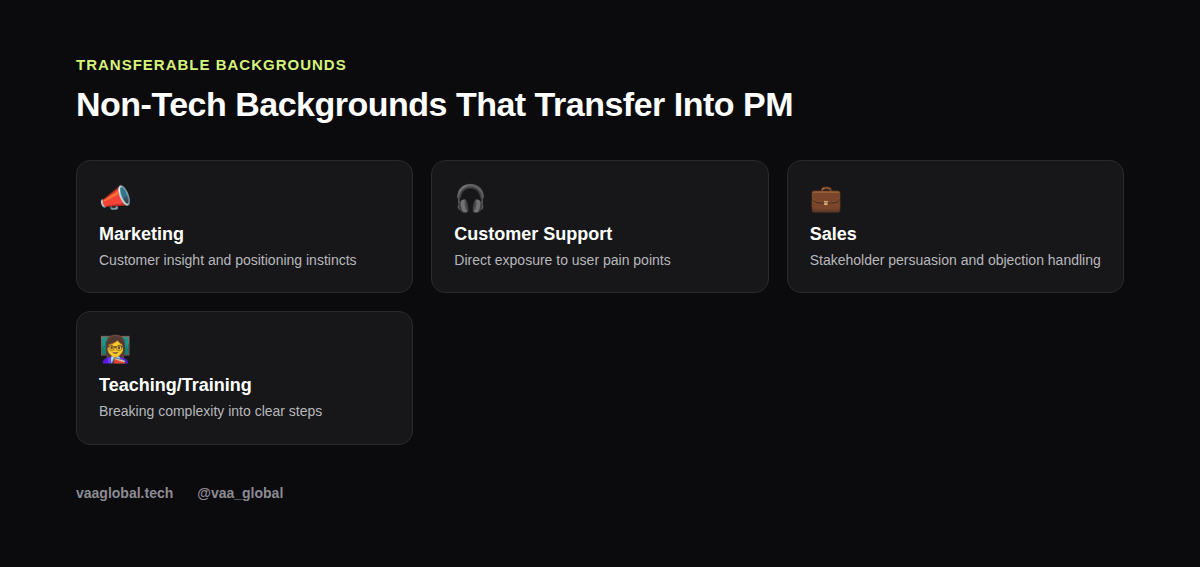
Before learning anything new, inventory what you already have. Marketing roles build customer insight and positioning instincts. Customer support gives direct, daily exposure to user pain points, arguably more exposure than many PMs get. Sales builds stakeholder persuasion and objection handling. Teaching or training builds the ability to break complexity into clear, sequential steps, a skill that maps directly onto writing specs and explaining decisions to engineers.
Learning The Vocabulary Without A Computer Science Degree
You do not need to code to become a product manager, but you do need fluency in the vocabulary: user stories, backlog, sprint, roadmap, and basic prioritization frameworks. If terms like RICE and MoSCoW are unfamiliar, common product management frameworks explained covers the core ones in plain language. Similarly, understanding how frontend and backend development differ, even at a conceptual level, helps you ask engineers better questions without needing to write code yourself.
Building Proof Through Case Studies
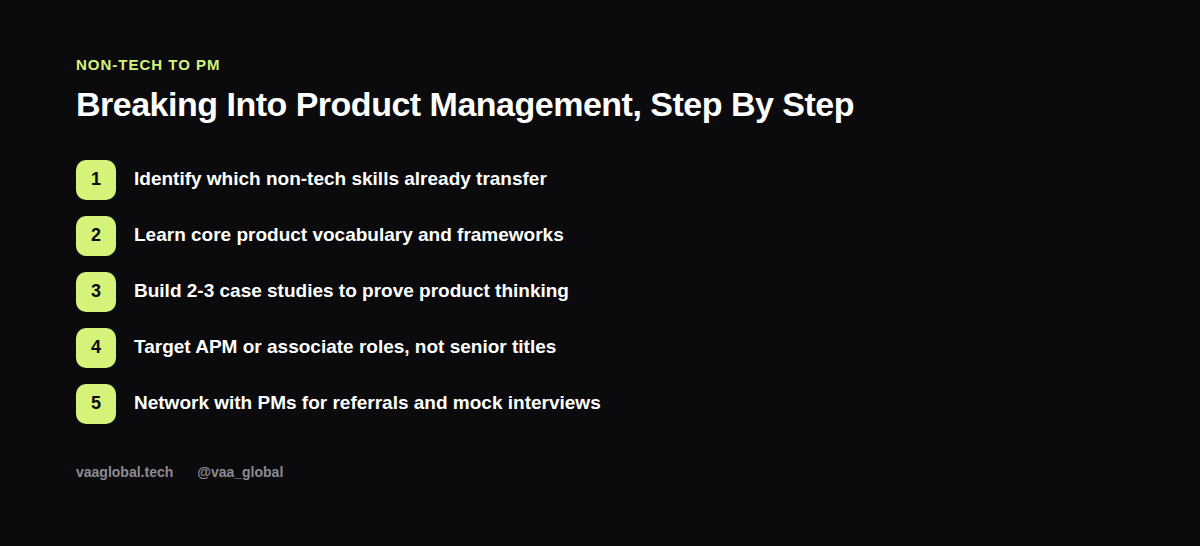
Because you lack a formal PM title, case studies do the convincing for you. Pick 2-3 apps you use regularly, identify a real friction point in each, and work through the problem, research, solution, and success metrics the way a working PM would. For a full walkthrough of this process, how to build a product management portfolio with no experience breaks this down step by step, including how to write a sample product requirements document to go alongside it.
Targeting The Right Entry-Level Titles
Applying directly for "Senior Product Manager" roles with no PM title on your resume is rarely productive. Instead, target associate product manager, product analyst, or product operations roles, which are explicitly designed as entry points. Some companies also hire "product marketing manager" or "business analyst" roles that sit adjacent to product and can serve as a stepping stone if a direct APM role is not immediately available.
Networking With Working Product Managers
Cold outreach to working PMs for a 15-minute conversation is one of the highest-leverage activities for a career changer, because referrals and informal mock interviews meaningfully increase your odds compared to applying blind through a job board. Be specific in your ask: request feedback on one of your case studies rather than a vague "can you give me advice," since specific requests are easier for busy people to say yes to.
Preparing For Interviews As A Non-Technical Candidate
Expect interviewers to probe your technical comfort level directly, often through execution-focused questions. Being honest about your current technical depth while demonstrating genuine curiosity, for instance by describing a time you learned a new technical concept quickly, tends to land better than overstating your fluency. For a full breakdown of common question categories, see product manager interview questions and answers.
Formal Learning To Speed Up The Transition
Self-teaching works, but it is slow and easy to get wrong without feedback. A structured product management course covering customer discovery, product strategy, prioritization and roadmapping, prototyping, agile delivery, and metrics gives non-technical career changers a guided path through exactly the material that self-study tends to skip or misunderstand, such as agile delivery mechanics referenced in the Scrum Alliance resources.
Answering The Questions Most Career Changers Ask First
Can I become a product manager without a tech background at all, even starting from zero? Yes, and it happens often enough that most companies have an established, if informal, path for it. What skills do non-technical PMs need most urgently in their first 90 days? Clear written communication, basic data literacy for reading dashboards, and the discipline to validate assumptions before building, rather than any specific coding language. How do I get an entry-level product management job without a referral already in hand? Apply broadly to associate and analyst-level roles while simultaneously building your network, since the two efforts compound each other; a strong case study gives your network outreach something concrete to react to, instead of a vague request for advice.
The Bottom Line
Breaking into product management from a non-tech background is a realistic, well-worn path, not an exception. Because the role rewards clear thinking, communication, and user empathy over a specific degree, the real work is translating your existing experience into product language and building the case-study evidence that proves you can already think the way the job requires.