Building a product management portfolio with no experience is entirely possible because the core skill the role demands, structured problem-solving, does not require a job title to practice. Unlike roles that need a company's internal data or tools, you can run a convincing product management exercise on any app already on your phone. Because hiring managers for junior PM roles already expect limited direct experience, a sharp, well-reasoned case study often outweighs a thin resume with a vague job title.
Why A Portfolio Matters More In Product Than Elsewhere
Product management is judged almost entirely on how you think, not on a credential you can list in one line. As a result, a portfolio that shows your reasoning process, including the options you rejected and why, demonstrates far more than a resume bullet point ever could. Recruiters screening for breaking into product management specifically look for this kind of evidence, because it is the closest substitute available for actual on-the-job performance.
Choosing The Right Apps For Your Case Studies
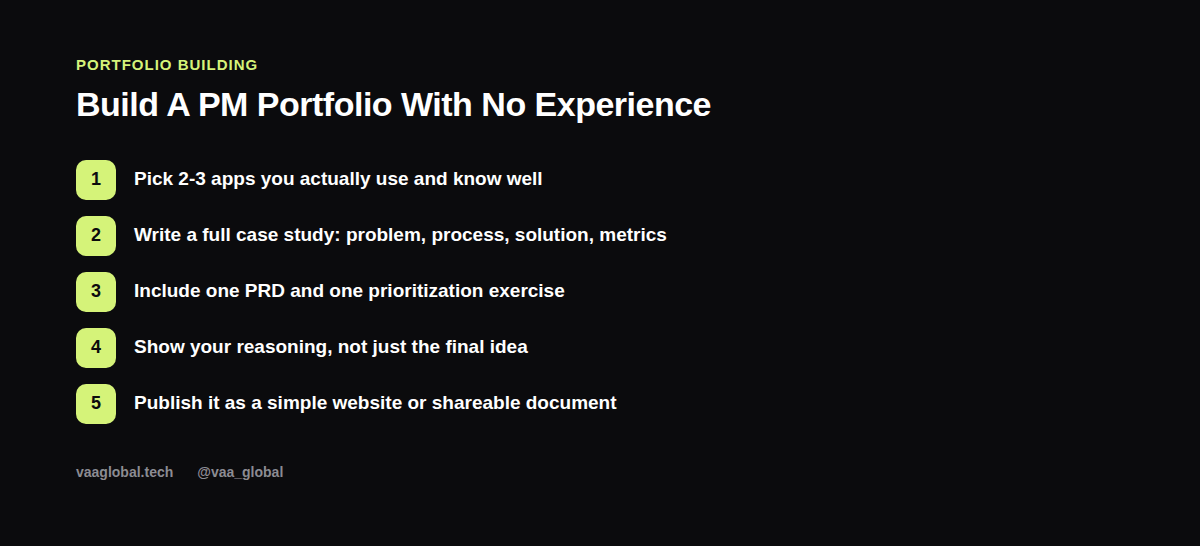
Pick products you already understand deeply as a user, ideally ones you use multiple times a week. Familiarity matters because strong product sense exercises require noticing real friction, not inventing a hypothetical problem. A food delivery app, a banking app, or an app relevant to VAA Global's own course categories, such as a learning platform, all work well, since daily use gives you concrete, specific observations rather than generic critique.
Structuring Each Case Study Properly
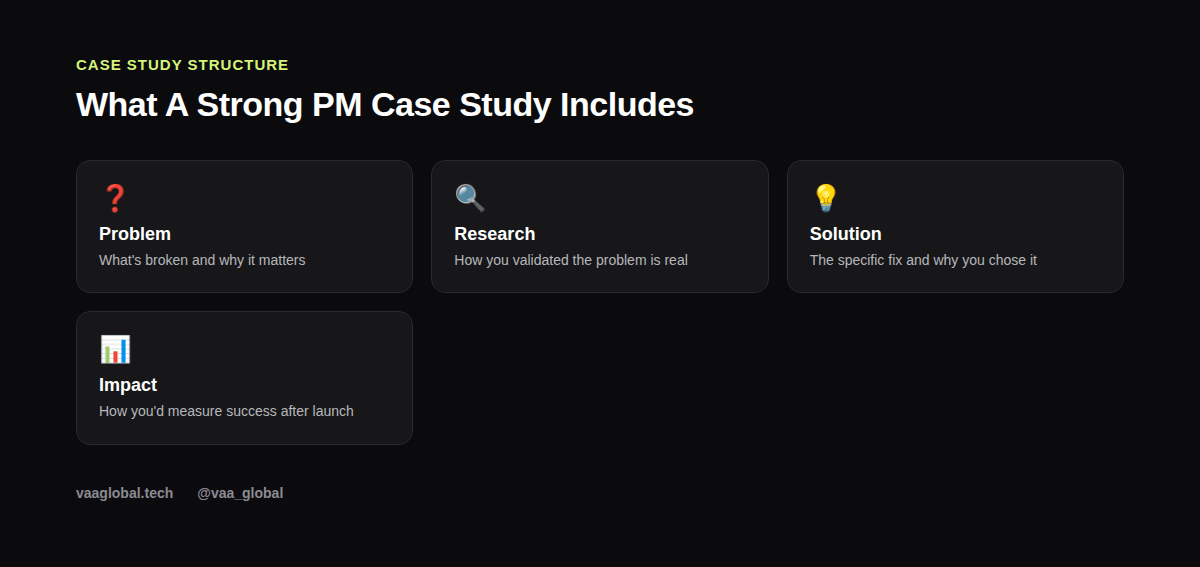
Every case study needs the same backbone: the problem you identified, how you validated that it is real (even informally, like surveying five friends who use the same app), the solution you propose, and how you would measure whether it worked after launch. Skipping the validation step is one of the most common giveaways of an unpracticed candidate, since real product managers rarely build based on a single personal opinion.
Including A Sample PRD In Your Portfolio
One of your 2-3 projects should include a full, detailed product requirements document, not just a summary paragraph. This shows you can translate a product idea into something engineering could realistically build. If you need a refresher on structure, how to write a product requirements document walks through every section a PRD needs, from problem statement to acceptance criteria.
Demonstrating Prioritization Thinking
Include at least one exercise where you had to choose between competing options with limited resources, and show the framework you used to decide. Naming a specific framework, such as RICE scoring or a simple impact-versus-effort matrix, signals that your prioritization is systematic rather than arbitrary; common product management frameworks explained is a useful reference if you want to use a recognized method rather than inventing your own.
Where To Publish Your Portfolio
You do not need custom development skills to publish this work. A simple personal website, a well-formatted Notion page, or even a clean PDF shared as a link all work fine at this stage. If building a website feels intimidating, how to build a portfolio website with no coding covers accessible no-code options that take an afternoon, not a web development course, to get live.
Writing About Your Process, Not Just The Outcome
The temptation is to present only the polished final idea, but interviewers are far more interested in your reasoning along the way. Mention the alternative solutions you considered and rejected, and explain why. For example, if you considered adding a new feature but decided a smaller onboarding tweak would test the hypothesis faster and cheaper, say so explicitly; this kind of judgment is exactly what product sense exercises in real interviews are trying to surface.
Using Your Portfolio Alongside Formal Learning
A portfolio works best paired with structured fundamentals rather than built from guesswork alone. Product management for beginners benefits from learning customer discovery, prioritization, and agile delivery concepts properly first, which is exactly what VAA Global's product management course covers across a ten-week program, giving you a shared vocabulary and method to apply directly to your portfolio projects.
Getting Feedback Before You Apply
Before sending your portfolio out widely, get feedback from at least one person working in product, even informally. Communities built around frameworks referenced by groups like the Scrum Alliance often include practitioners willing to give beginners quick, honest feedback on a case study's reasoning. A fresh pair of eyes will usually catch gaps in logic that are invisible to you after staring at your own work for weeks.
Common Questions While You're Building
How do I build a product portfolio with no job experience if I am worried nobody will take it seriously? Treat it the same way a developer treats a GitHub repository: as evidence, not as a formality, and let the depth of your reasoning do the convincing. How do I prove product skills without a job otherwise? Through a visible, documented hypothesis-and-test pattern across each case study, since that pattern is exactly what product teams run internally every sprint. If you are also unsure where should I publish a product management portfolio beyond a personal site, a public Notion page or even a well-organized Google Doc works fine as a starting point, as long as the link is easy to share and does not require a login to view.
The Bottom Line
A strong product management portfolio with no experience comes down to proof of thinking, not proof of employment. Because the skills that matter, problem framing, validation, prioritization, and clear writing, are all practicable without a job offer, the only real barrier between you and a credible portfolio is the time it takes to sit down and build one.