Knowing how to write a product requirements document is one of the first concrete skills that separates someone who talks about product management from someone who can actually do the job. A PRD exists to answer one question clearly for everyone involved: what are we building, for whom, and how will we know it worked. Because engineers, designers, and stakeholders all read the same document with different priorities, a well-written PRD has to be specific enough for engineering while staying readable for a non-technical executive.
Why A PRD Exists In The First Place
Without a shared document, teams rely on scattered Slack messages, verbal agreements, and assumptions that quietly diverge the moment two people interpret a conversation differently. A PRD prevents that by giving everyone a single source of truth. Because engineering estimates, design decisions, and stakeholder expectations all trace back to the same document, disagreements later in the project get resolved by pointing at the PRD rather than relitigating the original conversation from memory.
Starting With The Problem Statement, Not The Solution
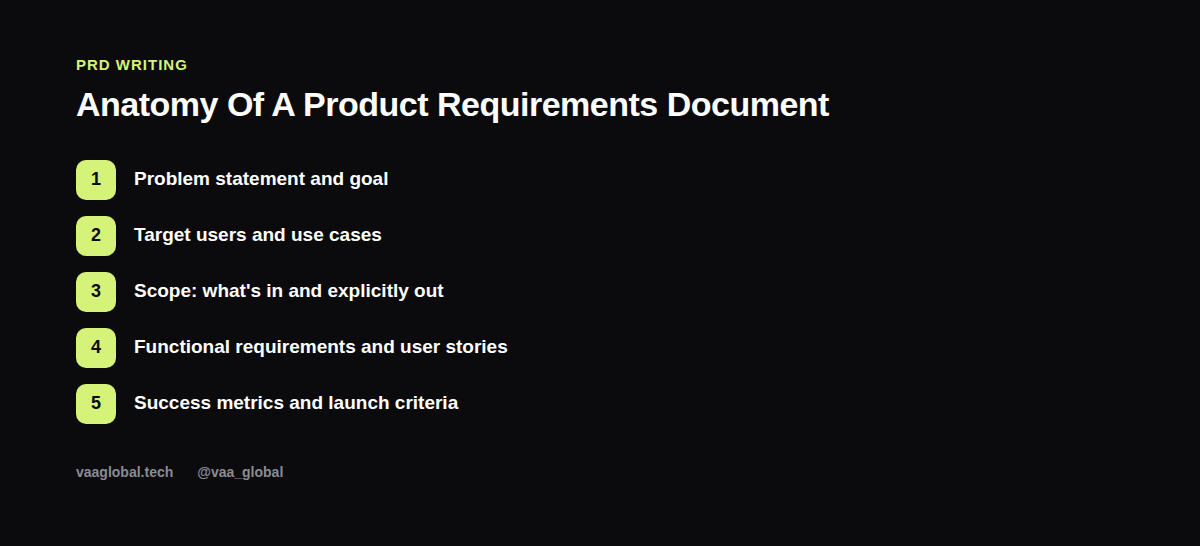
The most common mistake beginners make is jumping straight to features. Instead, open with the problem: what is broken, for whom, and why does it matter now. For example, "Users abandon checkout at a 38% rate because the form requires account creation before payment" is a problem statement that justifies everything that follows. If you skip this and start with "Add guest checkout," reviewers cannot evaluate whether the solution actually fits the problem, which is precisely the kind of gap that creates scope arguments later.
Defining Target Users And Use Cases
Name specifically who this feature is for. "All users" is rarely true and almost never useful for prioritization. Instead, describe the actual segment, such as "first-time mobile users on slow connections," and the specific scenario they are in when they hit this problem. This section also doubles as a sanity check: if you cannot describe a real user and situation, the feature may not be solving a real problem yet.
Setting Scope: What's In And What's Explicitly Out
Scope creep is one of the most common ways product projects go off the rails, so an explicit "out of scope" list is just as important as what is in scope. For instance, a PRD for a password reset flow might explicitly exclude two-factor authentication changes, even if that topic comes up in discussion, simply to keep the current effort focused. Writing this down protects the team from well-meaning scope additions mid-project that quietly double the timeline.
Writing Functional Requirements As User Stories
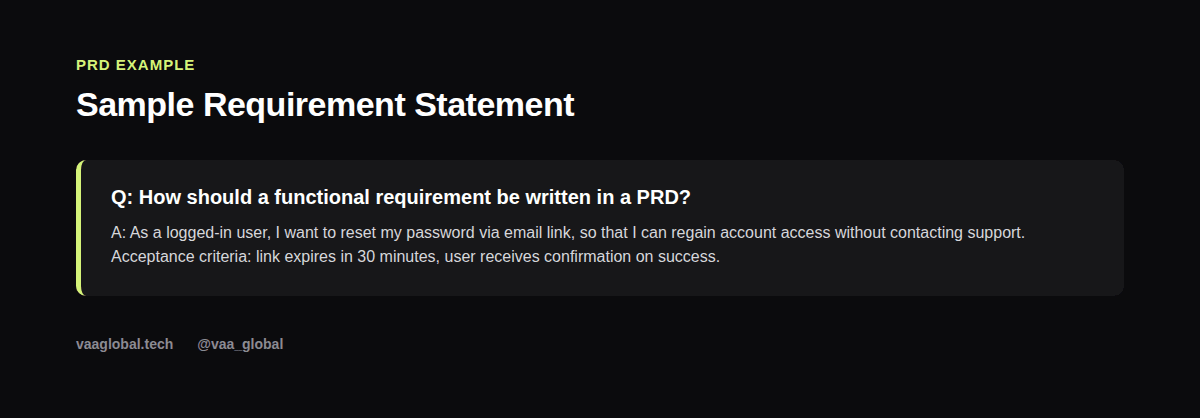
Functional requirements describe what the product must do, and the clearest way to write them is as user stories with acceptance criteria. A standard format is: "As a [user], I want to [action], so that [benefit]." For example: "As a logged-in user, I want to reset my password via email link, so that I can regain account access without contacting support. Acceptance criteria: link expires in 30 minutes, user receives confirmation on success." This structure forces specificity that a vague bullet point like "add password reset" never achieves.
Choosing Success Metrics And Launch Criteria
Every PRD needs a way to measure whether the feature actually worked after launch. Tie this directly back to the original problem statement; if checkout abandonment was the issue, the success metric should be checkout completion rate, not a vanity metric like total page views. Agile practices described by the Agile Manifesto emphasize working software and customer value over comprehensive documentation, and a PRD should serve that spirit: enough detail to build confidently, not an exhaustive specification nobody will finish reading.
Common PRD Mistakes To Avoid
Beginners often write PRDs that are either far too long, trying to cover every edge case before anyone has validated the core idea, or far too vague, leaving engineers to guess at critical details. Another common mistake is treating the PRD as finished once written; in practice, PRDs evolve as engineering uncovers technical constraints or user research reveals new information, so build in a habit of revisiting it. If you are also drafting a PRD as part of a portfolio project while breaking into the field, pairing it with examples described in how to build a product management portfolio with no experience will make the document itself part of your proof of skill.
How PRDs Fit Into The Broader Product Process
A PRD typically comes after initial discovery and before detailed design and engineering work begins, acting as the bridge between "we think this is worth building" and "here is exactly what we're building." It connects closely to prioritization frameworks you may already be using; if you want a refresher on those, common product management frameworks explained covers the frameworks that typically justify why a given PRD made the roadmap in the first place.
Practicing This Skill Before You Have A PM Job
You do not need a product manager title to practice writing PRDs. Pick an app you use daily, identify a real friction point, and write a full PRD for a fix, following the structure above. This exercise, repeated for 2-3 different products, builds the muscle fast and gives you concrete writing samples for interviews. A structured product management course covering product strategy, prioritization, roadmapping, and agile delivery can also walk you through PRD writing with feedback, rather than practicing in isolation.
How Detailed Should A PRD Be, Really
How detailed should a PRD be is one of the most common questions beginners ask, and the honest answer is: detailed enough that an engineer could build the feature without pinging you every hour, but not so detailed that you are specifying things design and engineering should own, like exact pixel spacing or database schema. A good test is whether a stakeholder reading only the PRD, without talking to you, could explain the feature back correctly. If the wireframe, backlog ticket, and sprint plan that follow all trace cleanly back to the PRD, you have hit roughly the right level of detail. What should a product requirements document include beyond the core sections depends on your team; some add a rollout plan or a section on dependencies with other roadmap items, while others keep that in a separate ticket entirely.
The Bottom Line
Learning how to write a product requirements document is less about following a rigid template and more about forcing clarity before resources get spent. Because a PRD's real job is preventing expensive misunderstandings, the sections above, problem, users, scope, requirements, and metrics, matter far more than the exact formatting you choose to present them in.