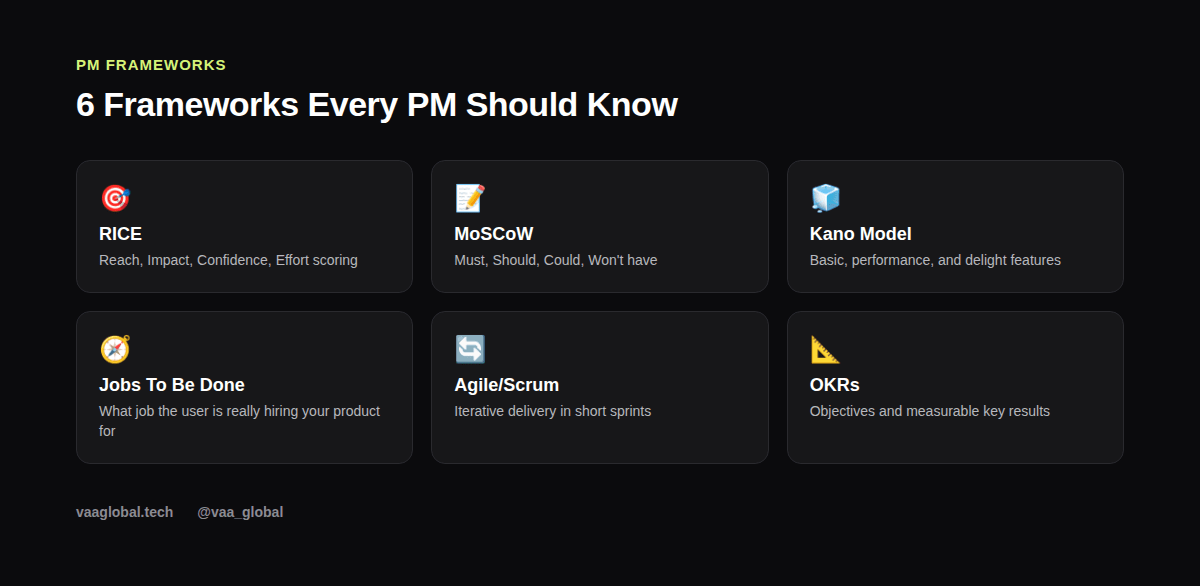
Common product management frameworks explained in plain language turn out to be far less intimidating than their acronyms suggest, because each one is really just a structured way to answer a question product teams face constantly: what should we build next, and why. Because resources are always limited, relying on gut feeling alone tends to favor whoever argues loudest in the room. Frameworks fix that by giving teams a shared, repeatable way to compare options.
Why Frameworks Exist At All
Every framework on this list solves the same underlying problem: turning a subjective debate into something closer to a comparable, defensible decision. For instance, two features might both sound exciting in a meeting, but scoring them against the same criteria usually reveals that one clearly deserves priority. Because frameworks create a shared language, they also make it easier to explain a decision to stakeholders after the fact, rather than relying on memory of a heated discussion.
RICE Scoring For Prioritization
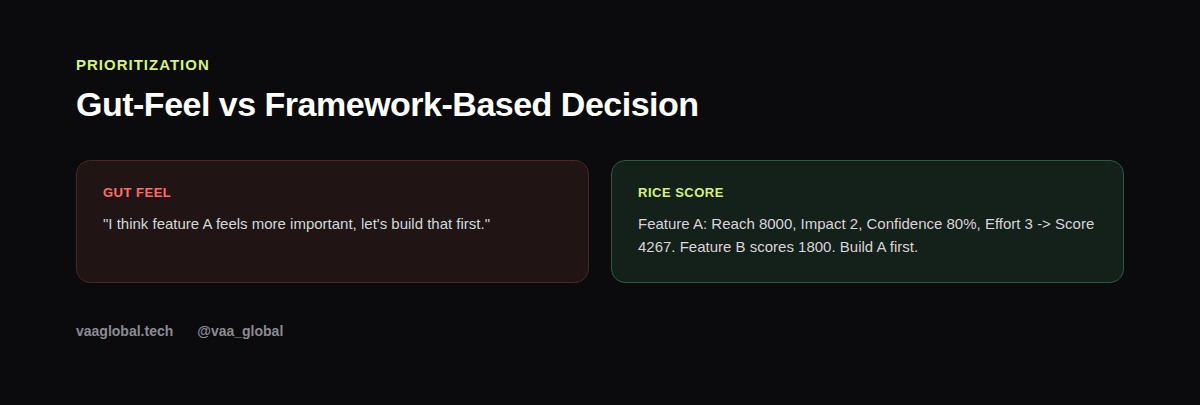
RICE stands for Reach (how many users it affects), Impact (how much it helps each user), Confidence (how sure you are about your estimates), and Effort (how much work it takes). You multiply Reach by Impact by Confidence, then divide by Effort, to get a comparable score across very different ideas. For example, Feature A might score Reach 8,000, Impact 2, Confidence 80%, Effort 3, producing a score of roughly 4,267, while Feature B scores only 1,800, making the prioritization call far less debatable than a gut-feel discussion.
MoSCoW For Scope Decisions
MoSCoW prioritization sorts requirements into Must have, Should have, Could have, and Won't have for this release. It is especially useful during scope conversations for a single release or sprint, where RICE's longer-term scoring feels like overkill. A common use case is launch planning: deciding which features are truly required for launch (Must) versus genuinely nice but deferrable (Could), which keeps a team from quietly expanding scope right before a deadline.
The Kano Model For Understanding Feature Value
The Kano model sorts features into basic expectations (their absence causes dissatisfaction, but their presence does not create much delight), performance features (more is generally better), and delight features (unexpected extras that create strong positive reactions). Understanding which bucket a feature falls into prevents a common mistake: pouring resources into a delight feature while a basic expectation is still broken, which usually frustrates users more than it impresses them.
Jobs To Be Done For Framing The Real Problem
Jobs To Be Done reframes the question from "what feature should we build" to "what job is the user actually hiring our product to do." A classic example, often attributed to Harvard's Clayton Christensen, is that people do not want a drill, they want a hole in the wall; the drill is just the current solution. This lens prevents teams from getting attached to a specific feature and instead keeps attention on the underlying need it is supposed to satisfy.
Agile And Scrum For Delivery
Agile and Scrum are less about choosing what to build and more about how work gets delivered: in short, iterative cycles with frequent feedback, rather than one long build-and-ship cycle. The Agile Manifesto itself is a short, worthwhile read for understanding the values behind the method, beyond just the ceremony of daily standups and sprint planning that most teams associate with it.
OKRs For Connecting Work To Strategy
OKRs for product teams set a qualitative Objective (where you want to be) paired with 2-4 measurable Key Results (how you'll know you got there). Unlike RICE or MoSCoW, which help decide what to build, OKRs operate a level above that, connecting day-to-day prioritization decisions back to a larger strategic goal, so a team does not end up shipping a long list of individually reasonable features that do not actually add up to anything meaningful.
Which Framework Should Beginners Learn First
If you are new to product management, start with RICE and MoSCoW, since both are simple enough to apply within a single afternoon and come up constantly in interviews; see product manager interview questions and answers for how prioritization questions typically test this. Once those feel natural, layer in Jobs To Be Done for problem framing and OKRs for connecting work to strategy. Practicing all of them on a sample project, such as the ones described in building a product management portfolio with no experience, cements the learning far faster than reading about them alone.
Learning These Frameworks Properly
Reading about frameworks only gets you so far; applying them to a real, specific decision is what makes them stick. A structured product management course covering prioritization and roadmapping alongside agile delivery and metrics gives you guided practice with each of these tools, rather than trying to piece together six different blog posts and hoping they fit together coherently.
Which Prioritization Framework Should Beginners Learn First, Revisited
If you remember one thing from this guide, make it this: which prioritization framework should beginners learn first depends on your context, but RICE and MoSCoW cover the vast majority of real decisions you'll face on a roadmap or in a backlog. Both frameworks force you to name tradeoffs explicitly instead of hiding them behind confident-sounding opinions, and both give stakeholders a transparent reason for a decision rather than a verdict handed down from above. That transparency builds trust with engineering and design faster than almost anything else a junior product manager can do early on.
The Bottom Line
Common product management frameworks explained side by side reveal that none of them is a silver bullet; each solves a different part of the prioritization and strategy puzzle. Because most experienced product managers mix and match two or three of these depending on the decision in front of them, the goal is not memorizing every framework, but knowing which tool fits which situation.