Doing mock interview practice alone might sound like a poor substitute for the real thing, but with the right method it can actually be more useful than a casual run-through with a friend who doesn't know what to listen for. The key is treating your solo practice like a structured rehearsal rather than just silently rereading your answers in your head, which is where most people stop short.
Why Practicing Out Loud Beats Practicing in Your Head
Thinking through an answer silently feels like preparation, but it hides a lot of problems that only show up once you actually open your mouth: awkward phrasing, run-on sentences, or forgetting the point halfway through. Speaking your answer out loud forces your brain to organize the thought the same way it will have to under real interview pressure, which is why it's a non-negotiable step even when you're practicing alone.
What Questions Should I Practice Before an Interview?
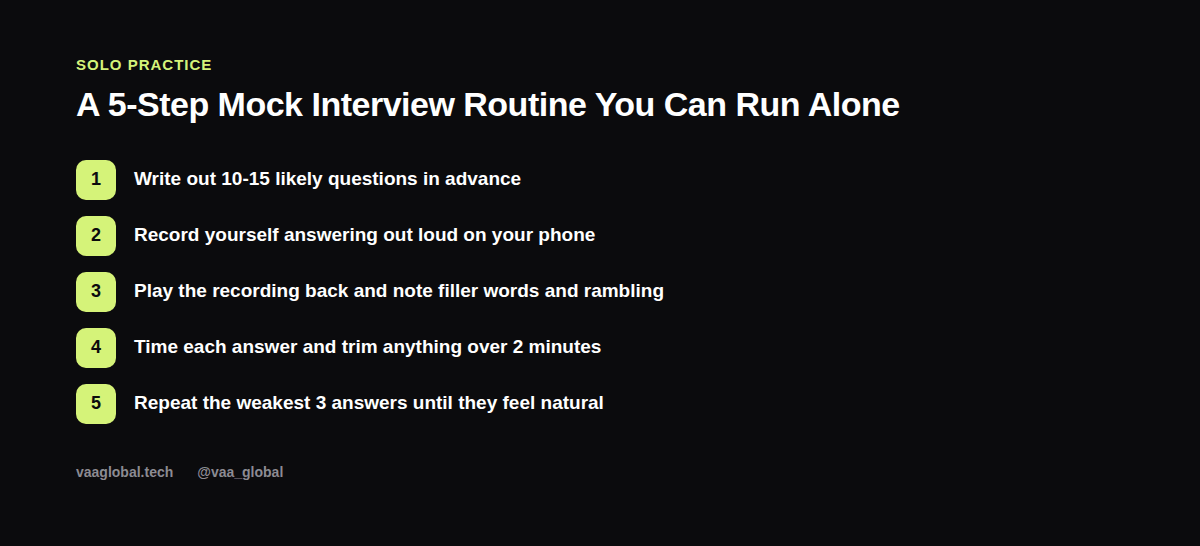
According to career coaching resources, a strong set of practice interview questions covers both universal and role-specific prompts. Start with the predictable core for interview rehearsal: tell me about yourself, why do you want this role, why are you leaving your current job, describe a challenge you overcame, and where do you see yourself in a few years. Add 5-8 questions specific to the role itself, pulled directly from the job description's key responsibilities. If the role is behavioral-heavy, prepare 3-4 stories using the STAR method (Situation, Task, Action, Result) that you can adapt to multiple questions, since the same story often answers several different prompts.
Can I Record Myself for Interview Practice?
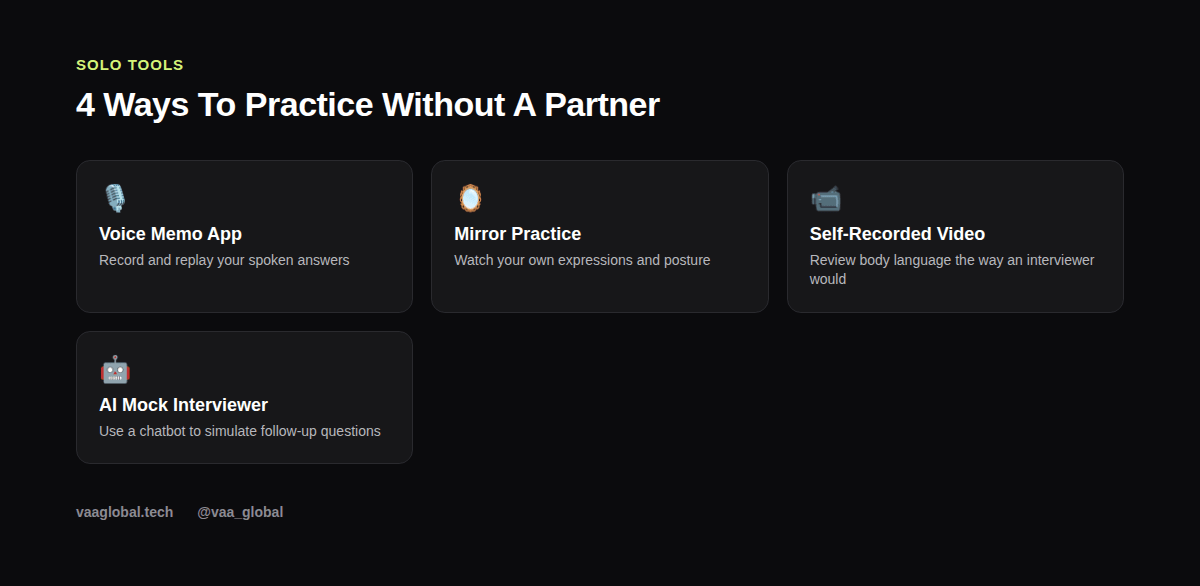
Yes, and you should — it's the single most useful tool for solo mock interview practice. Use your phone's voice memo app at minimum, or record video if you're preparing for a video interview specifically. Audio alone will catch filler words (“um,” “like,” “so yeah”), pacing issues, and rambling. Video adds the ability to review your posture, eye contact, and facial expressions, which matters just as much for remote roles conducted over Zoom or Google Meet.
How to Actually Review Your Own Recording
Listen or watch with a notepad, not passively. Note every time you say a filler word, every answer that runs past two minutes without a clear point, and any place where you trail off or lose your thread. Resist the urge to only focus on what went wrong; also note what felt genuinely strong so you can repeat it deliberately next time. Most people find their own voice cringeworthy at first — that discomfort fades quickly with repetition.
Using a Mirror for Body Language
If recording video feels like too much at first, practicing in front of a mirror is a reasonable middle step. Watch your facial expressions as you talk, check whether your posture slumps as you get into a longer answer, and notice if nervous habits (touching your face, looking away) show up. This matters especially for anyone prone to common video interview body language mistakes, since those habits are far easier to catch in a mirror than in the moment.
Using an AI Mock Interviewer
AI chatbots can role-play as an interviewer, asking a question, listening to your typed or spoken response, and following up the way a real interviewer might. This is a genuinely useful supplement precisely because it introduces unpredictability, something a script alone doesn't. It works best as a complement to your recorded self-practice, not a replacement for it — more on that in our guide to using AI tools to improve your job search.
How Many Times Should I Rehearse an Interview Answer?
Enough times that it sounds natural, not memorized — usually three to five run-throughs per answer is the sweet spot. Fewer than that and you'll still stumble under pressure; more than that and some people start sounding robotic or over-rehearsed. If an answer still feels clunky after five attempts, the structure of the answer itself is probably the issue, not your delivery, so revisit the content before rehearsing it more.
Timing Your Answers
Use your phone's stopwatch while you record. Most strong interview answers land between 60 and 120 seconds; shorter can feel thin, and much longer tends to lose the interviewer's attention or wander off the original question. If you consistently run long, practice identifying the one key point of each answer and leading with it, then adding only the supporting detail that's actually necessary.
Building a Repeatable Weekly Routine
Don't try to cram all your mock interview practice into the night before. Spread it across several short sessions in the days leading up to the interview — fifteen to twenty minutes is enough per session. This spaced repetition builds real interview confidence and helps your answers settle into memory naturally rather than being freshly memorized and fragile under pressure, and it leaves you time to also work on researching the company before your interview.
The Bottom Line
Mock interview practice alone works just as well as practicing with another person, as long as you treat it with real structure: speak out loud, record yourself, review honestly, and repeat your weak spots deliberately. Build that routine in the days before any interview, and you'll walk in sounding prepared rather than rehearsed.