Knowing how to research a company before an interview is one of the fastest ways to separate yourself from candidates who clearly didn't bother. It doesn't need to take days, and it isn't about memorizing trivia — it's about walking in with a genuine sense of what the company does, how it talks about itself, and why you specifically want to work there, so your answers sound informed rather than generic.
What Should I Look Up Before a Job Interview?
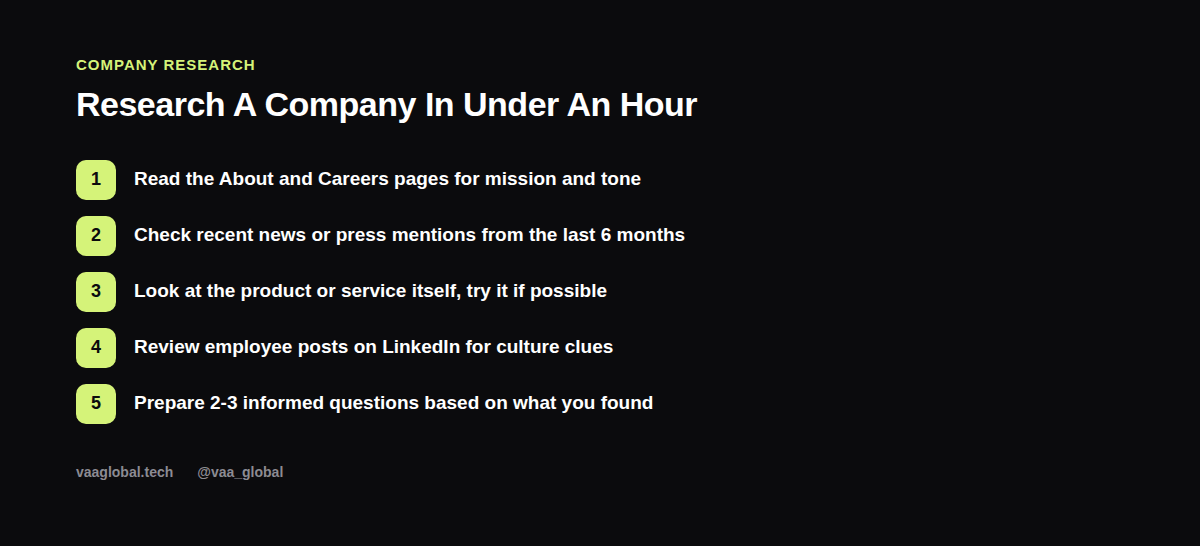
Start with the basics: what the company actually does, who their customers are, and how they describe their mission and values. Then layer in anything timely — a recent product launch, funding round, leadership change, or public statement. Finally, look at the specific team or department you'd be joining, if that information is public, since interviewers often appreciate questions that show you understand where your role fits into the bigger picture.
Start With the Company's Own Website
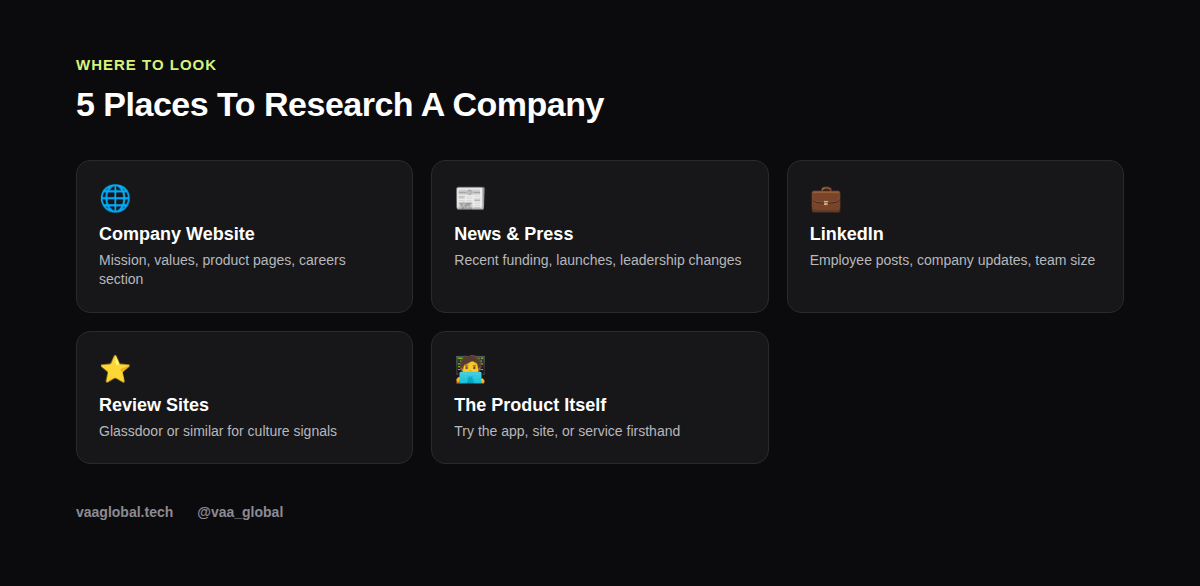
The About page, Careers page, and any product or service pages tell you how the company wants to be seen. Pay attention to language: do they emphasize speed and growth, or stability and process? Do they talk about customers, mission, or technology first? This tone often carries into the interview itself, and echoing it back naturally (without sounding like you're reciting their marketing copy) signals genuine company culture research.
Check Recent News and Press
A quick search for the company name plus “news” over the last six months can surface funding announcements, leadership changes, product launches, or even layoffs — all useful context. If you find something significant, you don't need to bring it up unprompted, but being aware of it means you won't be caught off guard if the interviewer references it.
Where Can I Find Company Reviews?
Sites like Glassdoor offer employee reviews, interview experiences, and sometimes salary ranges. Read these with a grain of salt — reviews tend to skew toward strong opinions in either direction — but patterns across multiple reviews (consistent mentions of management style, pace of work, or remote culture) are worth noting. Combine this with LinkedIn, where current employees often post organically about day-to-day work and company updates.
Try the Product or Service Yourself
If the company sells a product, app, or service you can access, actually use it before the interview. Nothing demonstrates genuine interest faster than being able to say “I tried your onboarding flow and noticed X” rather than vague praise. For B2B or niche companies where direct access isn't possible, watch a demo video or read case studies on their site instead.
Understanding the Role Within the Bigger Picture
Reread the job description after your research and notice how it connects to what you've learned about the company's direction. If they've recently expanded into a new market, for example, and the role involves customer support, you might ask how that expansion is shaping the support team's priorities. This kind of connection shows you're thinking about the business, not just the job listing in isolation.
How Much Company Research Is Enough?
For most interviews, 30-60 minutes of focused research is plenty. You're not writing a report — you need just enough to speak knowledgeably for a few minutes and ask two or three genuinely informed questions. Spending hours digging for obscure details usually isn't worth the time compared to practicing your actual interview answers, which matters more overall; see our guide on mock interview practice you can do alone.
What If You Can't Find Much Information About a Small Company?
Smaller or newer companies sometimes have thin online presence. In that case, lean more heavily on the job posting itself, any founder or team LinkedIn profiles, and direct questions during the interview. It's completely fair to ask the interviewer to tell you more about the company's current stage and goals — this is a legitimate research method, not a sign of unpreparedness, as long as you've clearly tried the basics first.
Turning Research Into Smart Questions to Ask
The real payoff of company research is the quality of questions you ask at the end of a job interview. A generic “What's the culture like?” says you didn't dig very deep. A question like “I saw you recently expanded into [specific area] — how is that affecting this team's priorities this year?” says you actually paid attention.
Taking Notes So You Remember Under Pressure
Write down three or four key facts and your planned questions in a short bullet list, then glance at it right before the call starts. It's easy to blank on details once nerves kick in, and having notes nearby (even just off-screen for a video interview) is a completely normal, low-risk safety net. This small habit pairs well with the broader preparation covered in our guide to remote job interview preparation, where company research is just one piece of a bigger routine that also includes your answers and setup.
Why This Effort Pays Off Beyond the Interview
The research you do before an interview doesn't disappear once you've asked your questions — it also helps you evaluate whether the company culture and direction genuinely fit what you want, which matters just as much as impressing them. A hiring manager, LinkedIn connection, or former employee you spoke to during this process can sometimes become a longer-term professional contact, so treat the research phase as relationship-building, not just a box to check before the call.
The Bottom Line
Learning how to research a company before an interview doesn't take long, but it changes how you come across entirely — from someone reciting a generic script to someone who clearly wants this specific role at this specific company. Spend the hour, and let it show naturally in the questions you ask and the examples you give.