Figuring out how to apply for remote jobs with no local experience feels like a chicken-and-egg problem at first — companies want proof you can do the work, but you can't get that proof without someone hiring you first. The way around it isn't pretending you have experience you don't; it's building other forms of credible proof that speak just as loudly to a hiring manager, especially one hiring internationally and already used to evaluating candidates they've never met in person.
Can I Get a Remote Job With Zero Work Experience?
Yes, especially for entry-level remote work in fields like virtual assistance, customer support, data entry, content writing, and junior tech roles. These areas often value demonstrated skill and reliability over a traditional job history, which makes them genuinely accessible starting points if you're building a case from scratch.
What Counts as Experience If I've Never Had a Job?
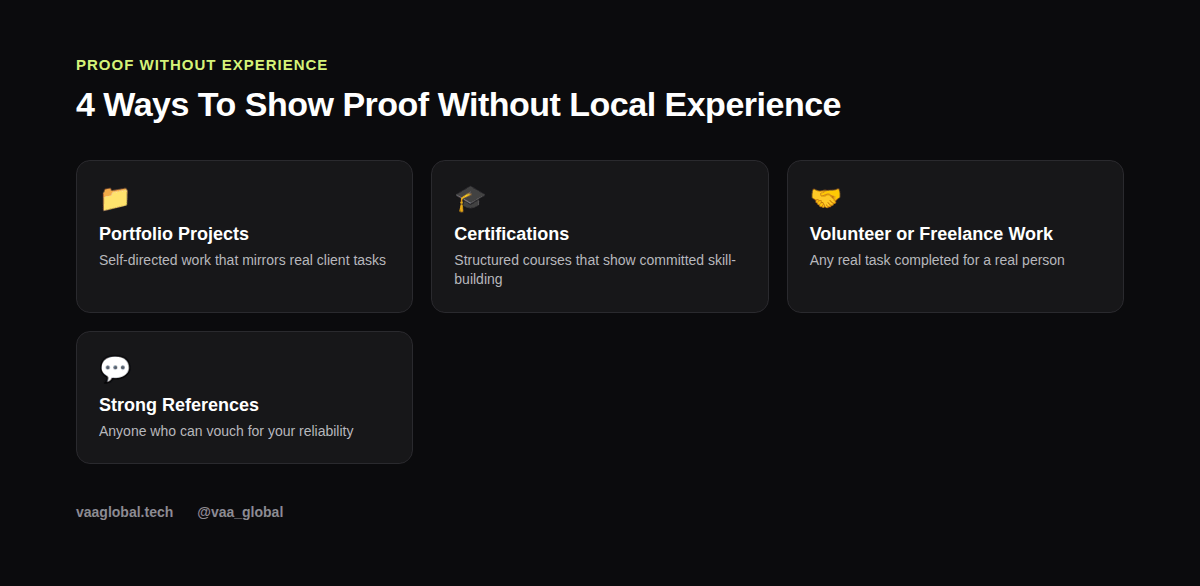
More than you'd think. School projects, volunteer work, helping a family member's small business, managing a community group's social media, or completing structured online coursework all count as real experience when framed correctly. The key is describing what you actually did and the outcome, not just where it happened — “managed weekly content posting and grew engagement for a local business page” is a legitimate bullet point even without a formal job title attached.
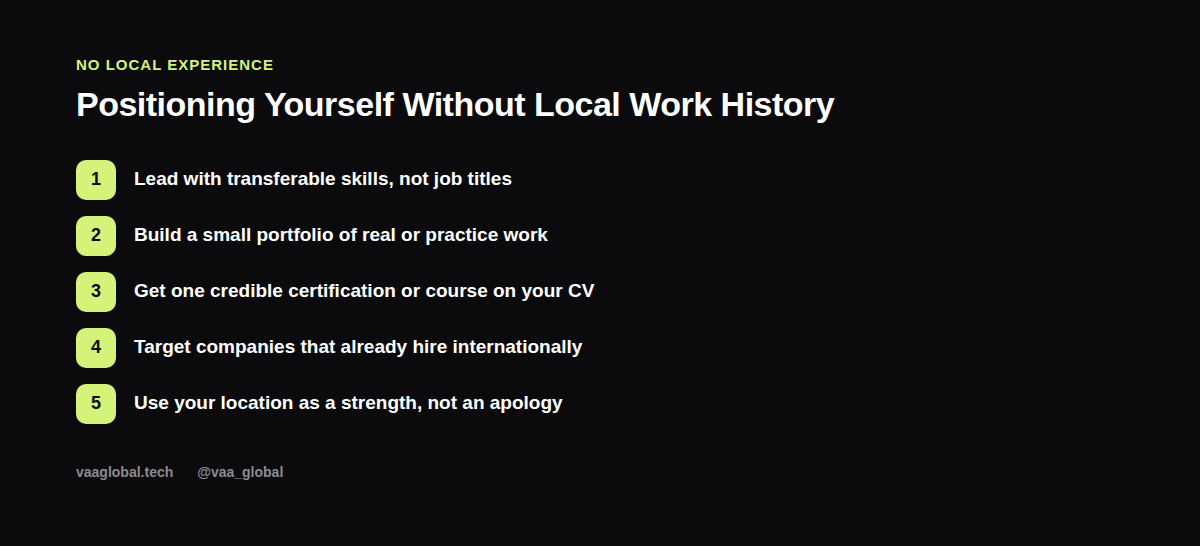
Leading With Transferable Skills Instead of Job Titles
Rather than organizing your CV strictly by job history (which may be thin), organize it around skills: communication, organization, specific software proficiency, writing, customer service. Under each skill, list the concrete evidence, whether from school, volunteering, or self-directed projects. This structure works especially well for no corporate experience candidates because it shifts the focus to capability rather than tenure.
Do International Companies Hire People With No Local Experience?
Many do, particularly startups, agencies, and companies built around distributed teams from the start. These employers are often less fixated on traditional local work history and more interested in whether you can do the specific tasks the role requires. Targeting these international remote jobs specifically, rather than applying broadly to every posting, improves your odds meaningfully.
How Do I Prove My Skills Without a Job History?
Build a small portfolio. For writing, that's a few sample pieces. For design, a handful of mock projects. For virtual assistance, you might document a mock inbox-management or scheduling workflow. This kind of proof does the talking your resume can't, and it's exactly what tools like the VAA Global Portfolio Builder are designed to help with for certified students.
The Value of a Relevant Certification
A completed, credible certification signals genuine commitment and gives you concrete, recent material to discuss in an interview. It doesn't need to be from a prestigious institution — what matters is that it's relevant to the role and that you can speak specifically about what you learned and applied, not just that you finished it.
Using Your Location as a Strength
Don't frame being based outside the employer's country as a limitation to apologize for. Many companies specifically value distributed teams for cost-effective, round-the-clock coverage, diverse perspectives, or access to skilled talent they can't find locally. Present your availability, time zone overlap, and reliability confidently, the same way you'd present any other genuine strength.
Getting References Without a Formal Job History
Teachers, mentors, course instructors, clients from small freelance gigs, or community leaders can all serve as references if they can speak honestly to your reliability and skills. A strong, specific reference from someone who knows your actual work ethic often carries more weight than a lukewarm reference from a forgettable past employer.
Avoiding Common Resume Mistakes That Undercut You
Even strong transferable skills and portfolio work can get undermined by a poorly built resume. Review common resume mistakes remote job seekers make before you start applying broadly, since fixing structural issues upfront saves you from losing good opportunities to easily avoidable errors.
Learning From Others Who've Done It
Plenty of people have built remote careers from Nigeria and other countries without a traditional corporate resume, and their paths are worth studying. For instance, our breakdown of top remote jobs for Nigerians in 2026 covers roles that are genuinely accessible without years of local work history. Likewise, guidance from FlexJobs on entry-level remote work confirms that skills-based hiring is becoming more common across remote-friendly industries generally, not just within any single company's practice.
Starting Small and Building Proof Over Time
You don't need to solve this all in one application cycle. Start with one portfolio piece, one certification, and one strong reference, then build from there as you gain more real feedback and experience. Each small piece of proof compounds, and before long you'll have a genuinely solid case, even without a conventional job history behind it.
The Bottom Line
Learning how to apply for remote jobs with no local experience comes down to building real, visible proof of your abilities through portfolios, certifications, and clearly framed transferable skills, then targeting companies genuinely open to hiring internationally. The lack of a traditional job history doesn't have to be a wall — treat it as a reason to show your capability in other, equally convincing ways.