Common resume mistakes remote job seekers make often come from reusing the same resume format and content meant for in-office roles. Remote employers specifically screen for things an office-based resume doesn't need to highlight, like independent work habits, clear written communication, and evidence you can be trusted without someone checking in on you every hour.
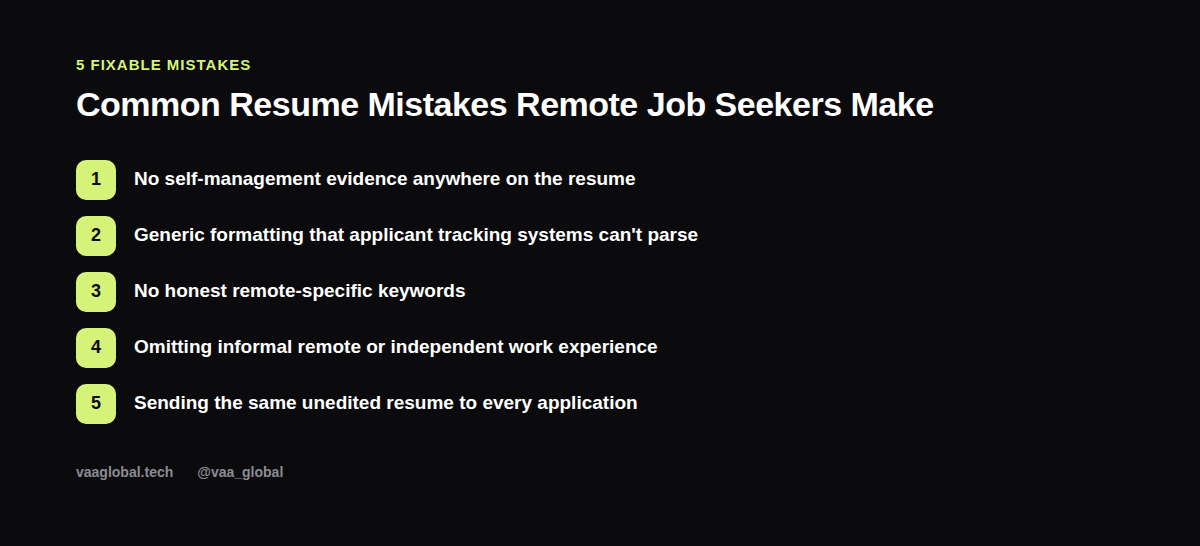
Mistake 1: No Self-Management Evidence
A resume that lists only tasks and responsibilities, without any example of working independently or managing your own deadlines, misses a signal remote employers specifically look for when screening candidates.
After: "Independently managed 40+ daily customer inquiries with no direct supervision, maintaining a same-day response rate while meeting all processing deadlines unsupervised."
Mistake 2: Generic, Non-Optimized Formatting
Overly creative formatting, images, tables, or text boxes, or missing keywords from the job description, can cause applicant tracking systems to filter out a resume before a human ever reviews it, regardless of actual qualification.
After: A clean, single-column format with standard section headings ("Experience," "Skills," "Education") that both a tracking system and a human reviewer can read without friction.
Mistake 3: No Remote-Specific Keywords
Terms like "remote," "distributed team," or "asynchronous collaboration" signal direct relevance to remote hiring managers and tracking systems alike, if your actual experience genuinely supports using them honestly.
After: "Collaborated asynchronously with a distributed team across three time zones using Slack and Notion to keep projects on schedule without real-time meetings."
A Short ATS Keyword List for Remote Roles
Beyond job-specific skills, these general terms consistently appear in remote job postings and tracking-system scans, worth including wherever your real experience genuinely supports them: remote, distributed team, asynchronous communication, self-directed, independently managed, cross-time-zone collaboration, virtual meetings, digital collaboration tools, remote onboarding, and results-driven.
Don't force keywords that don't reflect real experience, a tracking system might let a stuffed resume through, but the interview that follows won't.
Mistake 4: Omitting Any Remote or Independent Work
Even informal remote or independent experience, like a freelance project, volunteer coordination done remotely, or managing a personal side project with real deadlines, is worth including if it demonstrates the self-management skills remote employers are screening for.
After: "Freelance virtual assistant (remote, 2023-2024): managed scheduling and email correspondence for two small-business clients across different time zones."
Mistake 5: Not Tailoring for Each Application
Sending the same generic resume to every posting, without adjusting which experiences are highlighted, misses the chance to directly match what each specific listing is actually asking for.
After: A core resume with a swappable top third, re-ordering or lightly rewording 2-3 bullet points per application to mirror the specific language used in that job posting.
What Remote Employers Look for on a Resume Beyond the Basics
What do remote employers look for on a resume that a generic job seeker might not expect? Mostly, proof rather than claims. Remote resume tips consistently come back to the same point: evidence beats adjectives. Writing "strong communicator" convinces no one, but a bullet point describing an actual async handoff you managed does. If you're wondering how to write a resume for remote jobs from scratch, start by listing every instance of independent, unsupervised work you've done, however small, before worrying about formatting at all.
Building a Stronger Application
A strong resume is one part of the picture. Our guide on why remote job applications get ignored covers the broader application process this resume feeds into, and our dedicated piece on building a remote job CV in Nigeria goes deeper into formatting specifics. Once your resume is in good shape, preparing for the interview itself is the natural next step.
Should a Remote Resume Look Different From a Regular One?
Yes, somewhat. The underlying structure stays similar, but which experiences get emphasized changes. Remote job resume keywords and self-management evidence move from optional extras to central content, since they're specifically what a remote hiring manager is scanning for first.
A Quick Resume Self-Check
Read through your resume and ask: does it mention anywhere that you've worked independently, met deadlines without supervision, or communicated clearly in writing? If not, these gaps are worth filling before applying further. The U.S. Department of Labor's CareerOneStop Resume Guide offers a free, detailed walkthrough of resume structure and content if you want a second, independent reference beyond this checklist.
Having someone else review it also helps, ideally someone who has hired for or worked in remote roles themselves. They often spot gaps that are invisible to the person who wrote the resume. If rejections keep coming despite a solid resume, our guide on handling rejection during a remote job search covers how to keep momentum without losing confidence.
What Happens Once You Land the Interview
A fixed resume gets you further in the process, but the work doesn't stop there. Knowing what mistakes to avoid once you've started a new remote role matters just as much. Our guide on avoiding common first-week mistakes picks up exactly where a successful resume and interview leave off.
The Bottom Line
These resume gaps are specific and fixable: add self-management evidence, clean up formatting for applicant tracking systems, work in honest remote-specific keywords, include any informal remote experience, and tailor each application instead of sending one static resume everywhere. VAA Global's course catalogue builds the real, demonstrable skills that make a remote resume genuinely credible, not just better worded.