Learning to use AI tools to improve your job search has become almost standard practice now, but there's a real gap between using AI well and using it as a shortcut that backfires. The honest truth is that AI is genuinely useful for speeding up drafts, catching awkward phrasing, and generating practice questions — but it cannot replace the actual thinking, self-knowledge, and preparation that make a candidate stand out.
Can AI Write My Resume for Me?
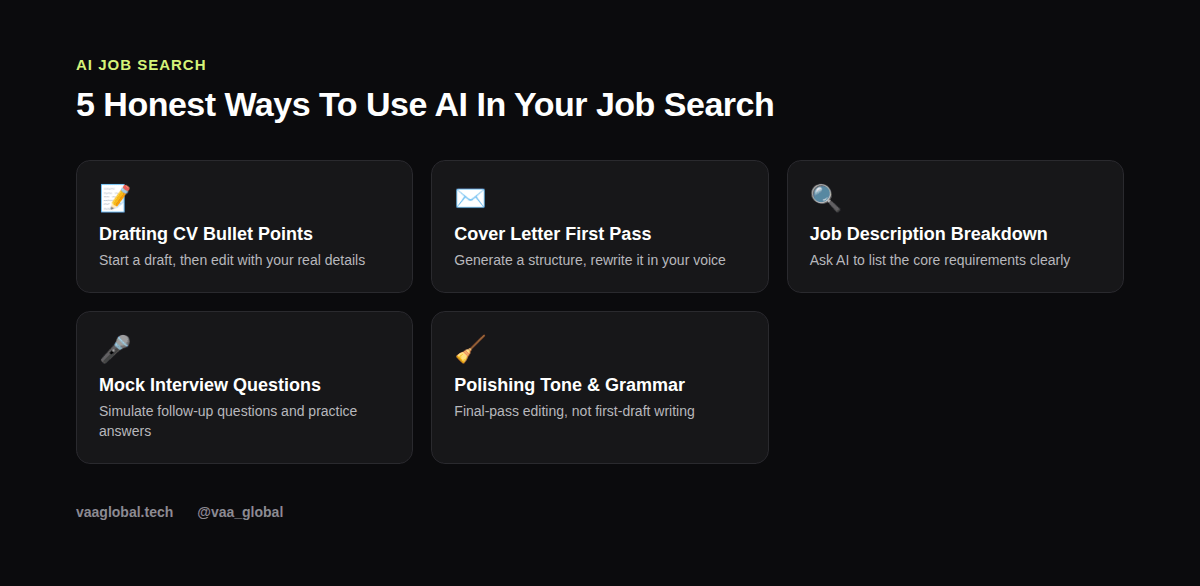
Not entirely, and you shouldn't want it to. An AI resume help tool can turn a messy list of your tasks into clean, action-oriented bullet points, but it doesn't know the specific details of what you actually did — the numbers, the tools, the outcomes. If you ask AI to write your resume from scratch with no input, you'll get generic language that could describe almost anyone, which is the opposite of what makes a resume memorable.
Using AI for a Cover Letter the Right Way
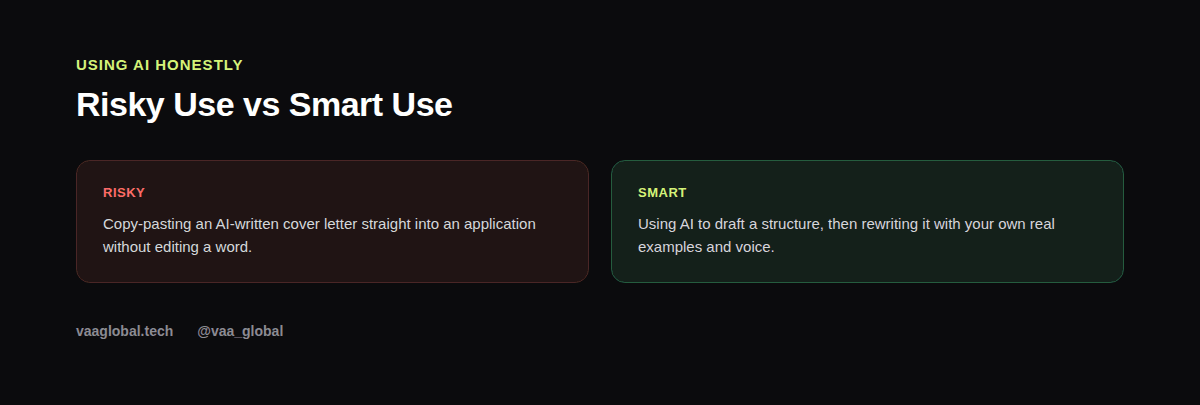
An AI cover letter draft is a reasonable starting point for structure: opening hook, why this role, relevant experience, closing. But feed it your real details first — the actual job description, your actual background, the specific thing that drew you to this company. Then rewrite the output so it sounds like you, not like a template. This matters because hiring managers read hundreds of cover letters and generic AI phrasing is often easy to spot.
Is It Cheating to Use AI for a Cover Letter?
No, as long as the final version reflects real thought and genuine information about you. Using AI as a drafting or editing tool is no different from using spell-check or asking a friend to review your writing — both are long-accepted practices. What crosses the line is submitting AI-generated content with fabricated achievements or claims you can't back up in an interview.
Breaking Down Job Descriptions With AI
Long, jargon-heavy job postings can be confusing, especially for beginners exploring a new field. Paste the posting into a ChatGPT job search session and ask it to list the core requirements in plain language, or to explain any unfamiliar terms. This is a legitimate, low-risk use case that saves time without touching the authenticity of your actual application materials.
How Do I Use ChatGPT to Prepare for an Interview?
AI interview practice works well as a supplement to real rehearsal. Ask it to role-play as an interviewer for a specific role, throw follow-up questions at your answers, or generate a list of likely behavioral questions based on a job description. This pairs naturally with mock interview practice you do alone, since the AI adds unpredictability that a self-written question list doesn't.
Using AI to Polish, Not to Write From Scratch
The safest and most defensible use of AI across your job search is final-pass editing: fixing awkward sentences, tightening wordy paragraphs, checking grammar, and making sure your tone is consistent. This is fundamentally different from asking AI to generate the content itself, and it's the use case least likely to produce generic or inaccurate output, since you're only refining something you already wrote.
Will Employers Know I Used AI?
Sometimes, yes. AI detection tools exist, but more commonly, it's the generic, overly polished, slightly impersonal tone of unedited AI writing that gives it away to an experienced recruiter who reads applications all day. The fix isn't avoiding AI entirely — it's always personalizing the output with your real voice, specific details, and genuine examples before you submit anything.
Understanding AI vs Just Using It
There's a meaningful difference between knowing how to prompt a chatbot and actually understanding what makes an answer good or bad. If you can't tell whether an AI-generated paragraph is actually strong, you're more likely to submit something weak without realizing it. This distinction is explored further in the difference between using AI tools and understanding AI, which is worth a read if you're relying on AI heavily in your search.
Where AI Can't Help
AI can't interview for you, build your actual professional relationships, or know how you genuinely feel about a role. It also can't fix a fundamentally weak application strategy — if your targeting is off or your resume has deeper structural mistakes, no amount of AI polish will solve that. Treat it as a tool that speeds up execution, not a substitute for strategy or self-reflection.
AI Tools Worth Knowing
Beyond general chatbots, there are AI job search tools built specifically for this purpose: resume checkers that flag formatting issues, browser extensions that auto-fill applications, and job-matching tools that surface roles based on your profile. General-purpose assistants like ChatGPT remain the most flexible option for most people, since they can handle drafting, breakdown, and practice all in one place rather than juggling several specialized apps. Start with one tool you're comfortable with rather than trying to adopt five at once.
The Bottom Line
Learning to use AI tools to improve your job search comes down to one principle: let it help you move faster, never let it think for you. Use it to draft, break down, practice, and polish, then make sure every word that goes out the door genuinely reflects who you are and what you've actually done.