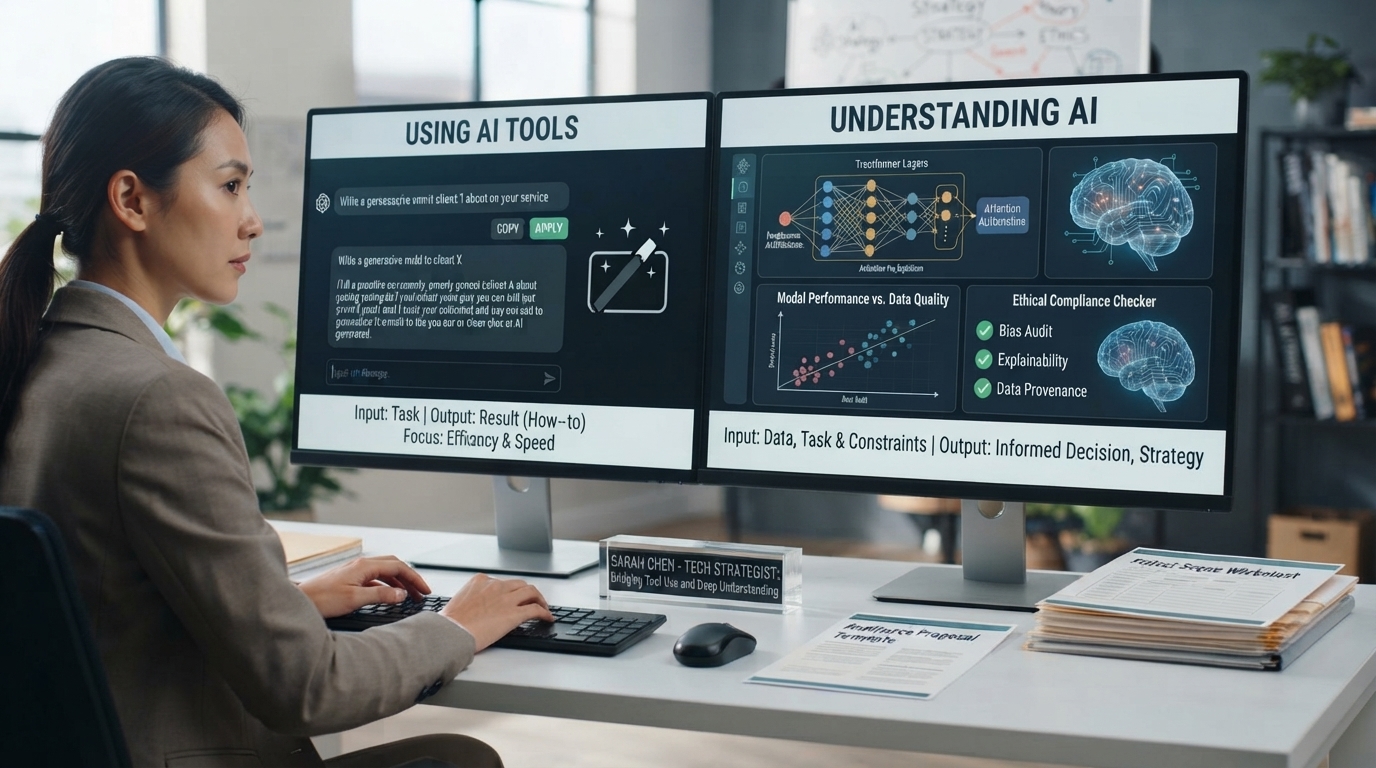
As AI tools have become genuinely mainstream in workplaces, a common source of anxiety for beginners is assuming they need to deeply understand how these systems actually work internally before they can use them professionally, when the reality is considerably more accessible than that.
Two Genuinely Different Skills, Often Confused
Understanding AI deeply, the underlying mathematics, model architectures, and training processes, is a specialized, research-level discipline that typically requires advanced study in computer science or a closely related field. Using AI tools effectively, on the other hand, is a practical, applied skill much closer to being genuinely good with Excel or a CRM system than to being a software engineer.
This distinction matters enormously because most job postings that mention AI are genuinely asking for the second skill, practical, confident use, not the first, deep technical understanding, even when the language in the posting sounds intimidatingly technical at first glance.
What Effective AI Use Actually Looks Like in Practice
It means knowing how to structure a request clearly enough to get genuinely useful output, understanding a specific tool's strengths and limitations well enough to know when to trust its output and when to double-check it carefully, and knowing how to weave these tools into an existing workflow so they genuinely save time rather than creating new problems to manage.
None of this requires understanding the mathematics behind how a language model actually generates its response, it requires the same kind of practical, hands-on fluency you'd build with any new professional tool, through structured practice and real application, not academic study.
Why This Distinction Should Actually Ease Your Anxiety
If AI has felt intimidating because it seems deeply technical, understanding that the professionally valuable skill is genuinely learnable through practical training, not years of specialized study, should be genuinely reassuring. This is precisely the kind of skill gap that's closed through structured, hands-on practice, not one that requires a fundamentally different educational background than what you already have.
Employers hiring for roles that involve AI tools are overwhelmingly looking for candidates who can demonstrate practical, applied comfort with these tools, not candidates who can explain the underlying architecture of a large language model in technical detail.
How VAA Global's AI Course Focuses on the Right Skill
VAA Global's Artificial Intelligence course runs 10 weeks and deliberately focuses on applied, practical skill, prompt engineering, model evaluation, workflow automation, using tools like ChatGPT, Python, and Zapier, rather than theoretical AI research.
This means you graduate genuinely job-ready for the roles that actually exist and are actively hiring right now, not prepared for a specialized research career that requires a fundamentally different, much longer academic path. The course includes a 2-month internship, 2 certificates, and job placement assistance.
Common Mistakes Beginners Make Here
A common mistake is either avoiding AI-related learning entirely out of intimidation, or conversely trying to learn deep technical AI theory when practical application would actually serve their career goals far better and far faster. Being clear-eyed about which skill you genuinely need for your specific career goals saves considerable wasted time and unnecessary anxiety.
Common Mistakes Beginners Make Here
A common mistake is either avoiding AI-related learning entirely out of intimidation about the underlying technology, or conversely spending excessive time studying deep AI theory when practical, applied skill would serve career goals far better and considerably faster. Being genuinely clear-eyed about which specific skill actually matters for your goals saves real time and unnecessary anxiety.
Another common mistake is assuming AI tools work identically regardless of how you use them, when in reality, the quality of your prompting and your judgment in evaluating output genuinely determines how useful these tools actually are in practice, this is precisely the skill worth deliberately building.
Recognizing this distinction early genuinely saves considerable wasted effort chasing the wrong kind of preparation for your actual career goals.
It also removes a genuine, common source of self-doubt for career changers who assume a technical background is a prerequisite for any AI-adjacent role.
Still deciding whether this is genuinely the right fit? VAA Global's free Career Compass quiz at vaaglobal.tech/career-compass can help clarify that before you commit real time to it.
VAA Global Talent at talent.vaaglobal.tech exists specifically to close this gap, connecting graduates directly with employers who are actively hiring.
Before you start applying, it's worth running your CV through VAA Global's free review tool at vaaglobal.tech/cv-review to make sure it actually reflects what you've built.
According to National Association of Colleges and Employers (NACE), this trend has held steady across multiple years of tracking, not just a short-lived shift.
U.S. Bureau of Labor Statistics has published research specifically on this, and it lines up closely with what's described here.
Research from LinkedIn Hiring Insights backs this up, consistently finding that this pattern holds across the wider remote job market, not just as an isolated trend.
Building the Skill That Actually Matters
If AI has felt like an intimidating, overly technical field to break into, the practical, professionally valuable version of this skill is genuinely more accessible than that. You can apply to VAA Global's Artificial Intelligence course to build it properly.