Is GRC a good career in 2026? For most people who enjoy structured, documentation-heavy work with real organizational stakes, yes, and the demand drivers behind that answer are stronger now than they were five years ago. That said, the honest answer also depends heavily on your own temperament, since GRC work rewards patience and precision far more than it rewards fast-paced variety.
The GRC Job Outlook for 2026, Honestly
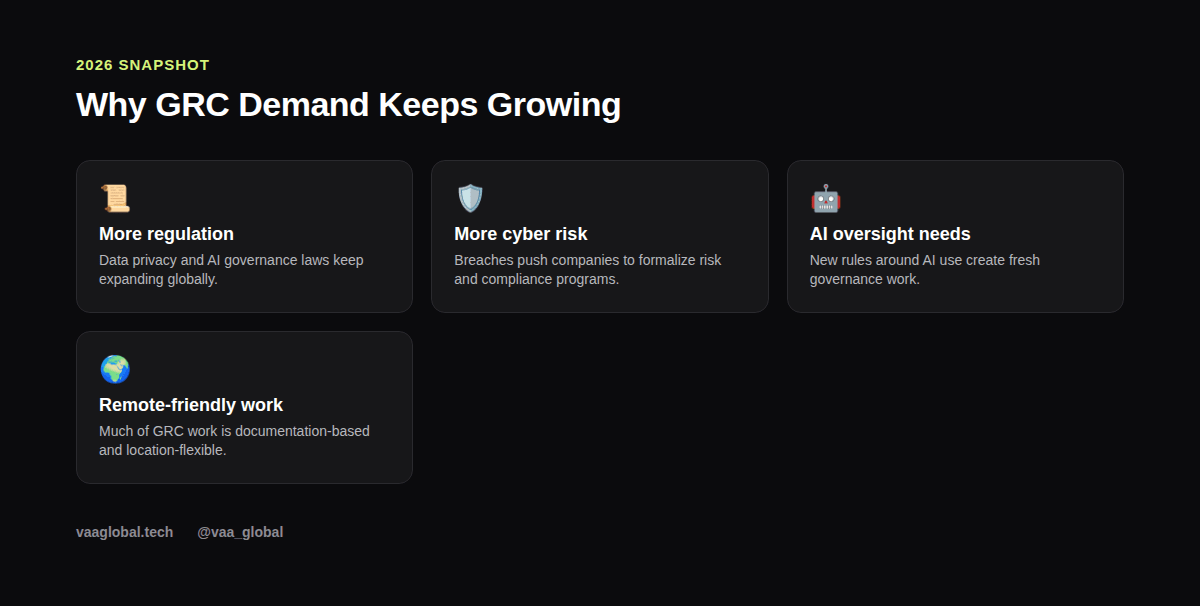
The GRC job outlook 2026 looks solid mainly because the forces that create GRC work keep multiplying rather than shrinking. Data privacy laws continue expanding into new jurisdictions and industries. Cybersecurity incidents keep pushing companies to formalize risk programs rather than handle problems reactively. And a newer driver, AI governance, is creating entirely fresh categories of risk and compliance work as companies try to figure out how to deploy AI systems responsibly and within emerging regulation.
Is Compliance a Stable Career Choice?
Is compliance a stable career choice compared to other fields? Generally yes, because compliance obligations rarely disappear during economic downturns the way discretionary spending does; if anything, regulators tend to scrutinize companies more closely during stressful economic periods, not less. This does not mean GRC roles are immune to layoffs, since any department can be cut, but the underlying demand for the work itself tends to persist even when individual companies cut staff.
Is GRC a Good Career for Introverts?
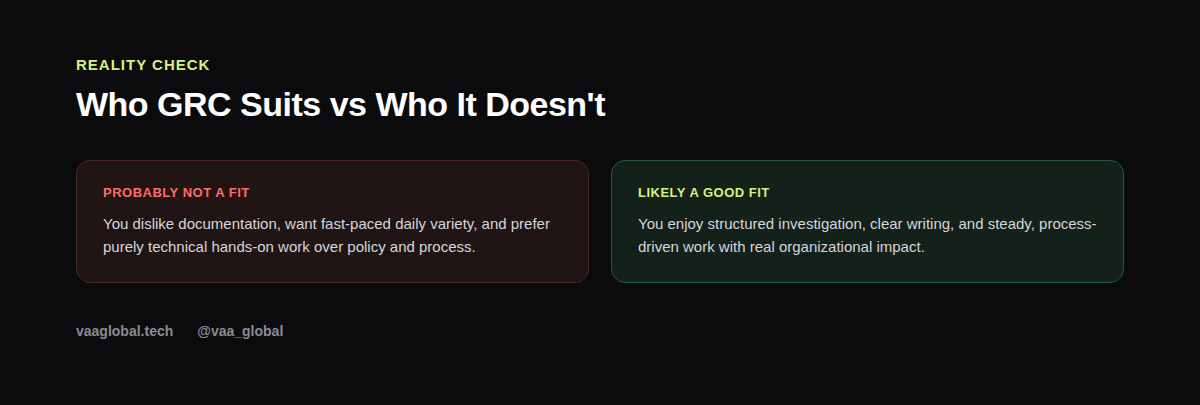
Is GRC a good career for introverts specifically? In many ways, yes, more than people expect. While the role does require interviewing stakeholders and writing clear reports, much of the actual work, like testing evidence and maintaining documentation, happens independently with minimal real-time social pressure. Compare this to sales or fast-paced customer support roles that require constant live interaction, and GRC's rhythm of focused independent work punctuated by scheduled conversations tends to suit people who prefer depth over constant stimulation.
Is GRC a Dying Field? Addressing the Myth
Is GRC a dying field, as some online commentary occasionally suggests, perhaps due to automation concerns? The honest answer is no, though the nature of the work is shifting. Routine, repetitive evidence-gathering tasks are increasingly assisted by software, which is true across many fields. However, judgment calls about risk severity, stakeholder communication, and interpreting ambiguous regulation still require a human in the loop, and those are precisely the skills that matter most for career growth in this field anyway.
Risk Management Career Growth: What the Trajectory Looks Like
Risk management career growth tends to be steadier than flashier fields, without the dramatic swings of, say, a volatile startup market. Most professionals who stay in the field for five or more years see consistent progression from analyst to senior roles, as outlined in our detailed breakdown of the GRC career path from analyst to director. This steadiness is itself part of the appeal for people who value predictability over high-variance upside.
The Real Downsides Worth Knowing Before You Commit
Pros and cons of GRC should include the genuine downsides, not just the upside. The work can feel bureaucratic in organizations that treat compliance as a box-ticking exercise rather than a genuine priority. Breaking in as a beginner is competitive, as covered in our guide on breaking into GRC with no experience. And the job can involve being the person who delivers unwelcome findings to people who outrank you, which requires a certain amount of professional confidence that takes time to build.
How Stable Is a Career in Compliance Long Term?
How stable is a career in compliance over a full career span, not just the next year or two? The International Organization for Standardization and professional bodies like ISACA continue to publish updated frameworks precisely because regulatory complexity keeps increasing rather than leveling off, which is a reasonable proxy for sustained demand. ISACA's own industry research and reports are worth reading directly if you want a source closer to the field itself rather than a secondhand summary.
Weighing Job Security Against Career Satisfaction
Job security and career satisfaction are not always the same thing, so it helps to separate them honestly when thinking about the future of GRC careers overall. Because regulatory change rarely slows down, job security in GRC tends to be reasonably strong, even accounting for normal layoff risk at any individual employer. Career satisfaction, however, depends more on whether your specific employer treats compliance as a genuine priority or as a checkbox exercise; the same job title can feel completely different depending on that organizational culture. If you are weighing GRC against other remote-friendly fields before committing, it is worth comparing it honestly against options covered in top remote jobs for Nigerians in 2026, and reviewing realistic entry timelines in what a realistic timeline from training to a remote job actually looks like, since GRC follows a similar pattern of steady, not instant, progress.
The Bottom Line
Is GRC a good career in 2026? For the right temperament, yes, and the underlying demand drivers, growing regulation, cybersecurity risk and new AI governance requirements, all point toward continued relevance rather than decline. It suits people who like structured, evidence-based work more than people chasing constant variety, and like any field, it rewards honest self-assessment before you commit years to building skills in it.