If you want to break into GRC with no experience, the honest news is that it is possible, but it rarely happens by applying to generic job postings and hoping for the best. Most people who land their first governance, risk and compliance role get there through a deliberate mix of self-study, a foundational certification, and targeting the right entry points rather than the flashiest job titles.

Start With the Vocabulary, Not the Job Boards
Before you touch a single job application, spend real time learning how GRC professionals actually talk. Terms like controls, risk register, audit trail, remediation and control owner show up constantly in job descriptions and interviews. Because this vocabulary is specific, hiring managers can usually tell within thirty seconds of conversation whether a candidate has actually studied the field or is guessing. Free resources from ISACA and the Institute of Internal Auditors are a solid place to absorb this language properly.
Pick One Foundational Certification and Finish It
You do not need five certifications to get started; you need one, finished, and listed confidently on your resume. Entry-level options that beginners commonly use include an introductory ISO 27001 course, a basic risk management certificate, or a compliance fundamentals course offered by a recognized provider. The goal is not the certificate itself but what it proves: that you can commit to structured learning and actually understand the material, since many interviewers will ask a basic question from the syllabus to check.
Build a Small, Real Portfolio Project
Because entry-level GRC candidates rarely have work samples, building one yourself is a strong differentiator. For example, pick a fictional small company and write a one-page risk register listing five realistic risks, their likelihood, their impact, and a proposed control for each. Or draft a simple access-control policy for a remote team. This kind of project gives you something concrete to discuss in an interview instead of only repeating definitions from a textbook.
Target Adjacent Roles, Not Just GRC Analyst Titles
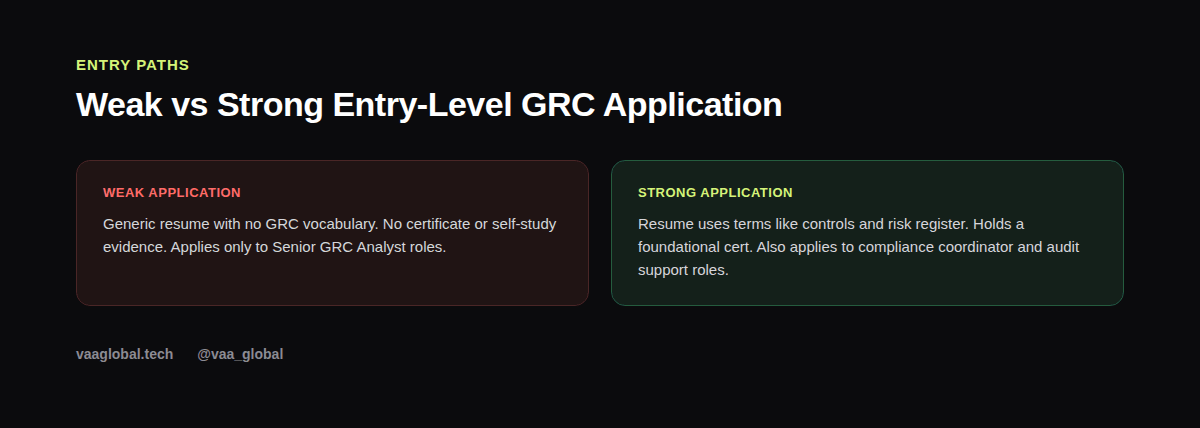
Entry level GRC jobs are genuinely competitive, so widen your search to roles that feed into GRC: compliance coordinator, audit assistant, risk coordinator, quality assurance analyst, or even a general operations role at a company with a strong compliance culture. These roles still involve reading policies, checking evidence and talking to stakeholders, which builds the exact skill set a GRC analyst no experience candidate needs to eventually move sideways into a dedicated GRC title within twelve to eighteen months.
Lean on Transferable Skills From Other Fields
If you have worked in customer service, banking operations, project coordination, or even teaching, you likely already have transferable skills that matter here: attention to detail, following procedures accurately, and documenting things clearly. Frame your resume around these skills explicitly rather than assuming a hiring manager will connect the dots for you. For instance, “reconciled daily transaction logs against policy requirements” from a banking job translates directly into compliance-checking language.
Network Deliberately, Not Randomly
Reach out to two or three GRC professionals on LinkedIn each week and ask for a short informational chat, not a job. Most people are happy to explain how they got started, and these conversations often surface openings before they are publicly posted. If networking and interview prep feel unfamiliar, it is worth reading how other beginners handle rejection during a search in this guide on handling rejection during a remote job search, since GRC hiring timelines can be slow and discouraging if you are not prepared for it.
Be Realistic About the Timeline
Most beginners underestimate how long this takes. A realistic path is three to six months of focused study and certification work, followed by another one to three months of active applications before landing a first role, often in an adjacent title rather than a pure GRC Analyst position. This is not a fast track, and anyone promising a guaranteed GRC job in a few weeks is overselling it.
Where a Related Course Can Help
If part of your path into GRC runs through cybersecurity-adjacent risk work, VAA Global's Cybersecurity course covers vulnerability management and incident response, both of which are commonly tested in GRC interviews for risk-focused roles, even though it is not a dedicated GRC program. Likewise, if your interest leans toward process and documentation work, the Business Analysis course covers requirements elicitation and process improvement, both useful when documenting controls. Also take a look at how to avoid common resume mistakes remote job seekers make before you send your first application.
Common Questions From People Starting Out
A lot of people typing “how do I get into GRC with no background” into a search bar are really asking two separate things: what certifications do I need for GRC, and can I get a GRC job without a degree. On the first question, start with one foundational certificate rather than chasing every acronym you see listed in job ads; employers want to see depth, not a wall of logos. On the second, yes, plenty of working GRC professionals have no specific degree in the field; they have relevant certificates, a portfolio project, and clear communication skills instead. For a broader view of how career fields like this are evaluated, ISACA's credentialing and career resources are worth reviewing directly, since they are maintained by the professional body most GRC hiring managers reference.
The Bottom Line
You can break into GRC with no experience, but it takes a plan: learn the vocabulary, finish one real certification, build a small portfolio project, target adjacent entry points, and give yourself a realistic four-to-nine-month runway. Treat it as a project with milestones rather than a single application you send and wait on, and your odds improve dramatically.