

A job search without structure feels endless, because there's no way to tell if you're actually making progress or just staying busy. Setting weekly job search goals fixes this by breaking an overwhelming, open-ended process into something you can measure every seven days. Instead of asking “am I doing enough,” you get a clear answer: did I hit this week's targets or not.
Why Vague Goals Don't Work
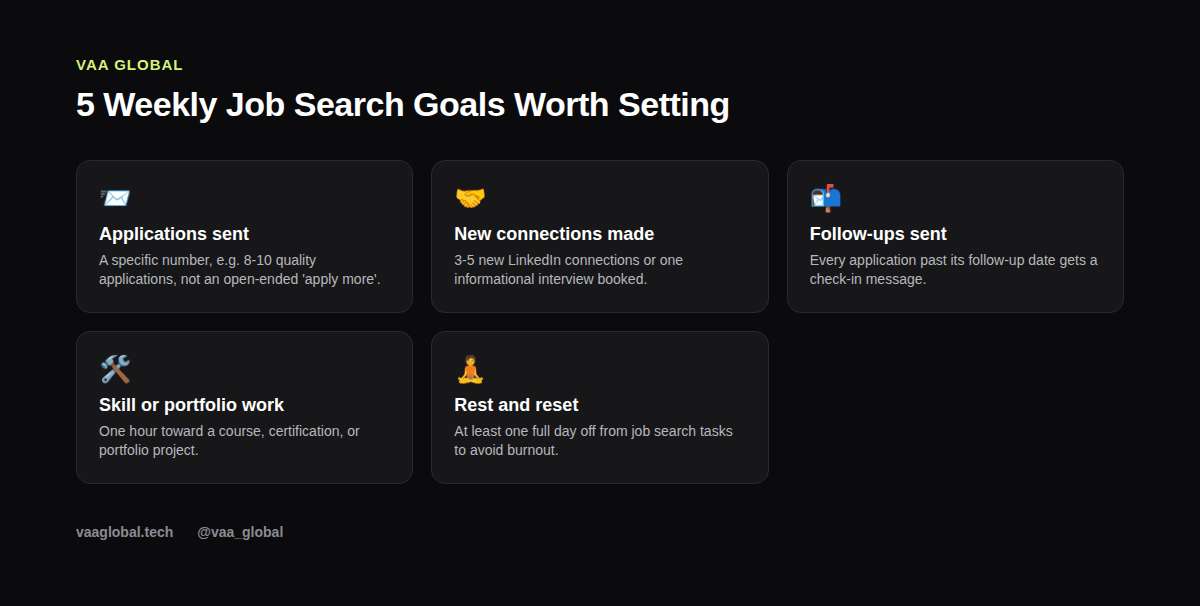
“Apply to more jobs this week” isn't a goal — it's a vague wish with no way to check whether you succeeded. The fix is specificity: instead of “apply more,” try “send eight quality applications by Friday.” Specific numbers give you something to actually track, and they stop the nagging feeling that you should always be doing more, because once you hit the number, you're done for the day.
How Many Jobs Should You Apply to Each Week?
There's no universal number, but a useful range for most people is five to twelve well-targeted applications a week, depending on how much time you have and how tailored each application is. Ten rushed, generic applications usually perform worse than five carefully matched ones, so weigh quality against quantity rather than chasing a big number for its own sake.
Add a Networking Target, Not Just an Application Target
Applications alone rarely carry a job search. Add a weekly networking goal — three to five new LinkedIn connections, or one informational interview booked — because referrals and warm introductions consistently outperform cold applications. This keeps your job search routine from becoming just a numbers game of blind submissions.
Build Follow-Ups Into the Goal, Not as an Afterthought
A goal to “send applications” without a matching goal to follow up on old ones means conversations quietly die. Set a rule: every application or message past its follow-up date this week gets a check-in. This is where a job search tracker spreadsheet becomes essential — it tells you exactly who's due for a follow-up without relying on memory.
Protect One Hour for Skill-Building
Job hunting shouldn't crowd out everything else. Setting aside even one hour a week to finish a course module, polish a portfolio piece, or practice a skill keeps you improving while you search, and gives you something concrete to add to applications and interviews as the weeks go on.
Schedule Rest as a Goal, Not a Luxury
This is the one people skip, and it's the one that keeps a search sustainable. Treat at least one full day off from job search tasks as a non-negotiable weekly goal, the same as your application target. Searching seven days a week without a break is a fast route to job search burnout, and burnout slows you down far more than one rest day ever would.
Review Every Sunday and Adjust
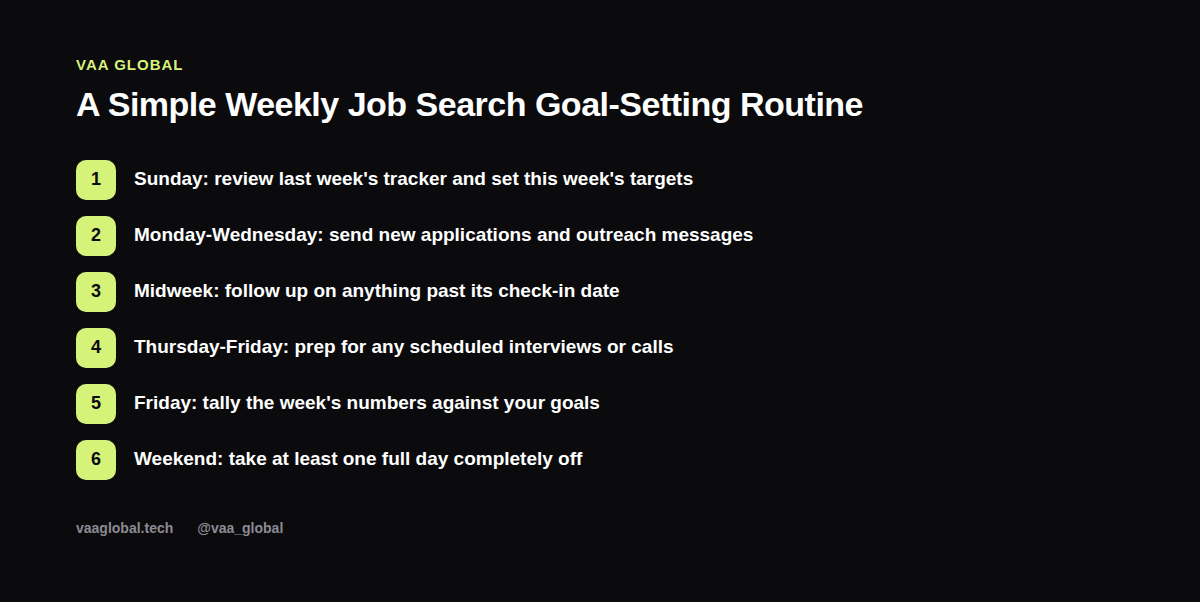
Set aside fifteen minutes every Sunday to look at what you actually did versus what you planned. If you consistently fall short of your application target, the number might be unrealistic given your schedule — lower it rather than feeling like you're failing every week. If you're consistently hitting every target with room to spare, raise the bar slightly. This is also how to stay consistent during a job search without relying purely on willpower: you adjust the plan to match your actual capacity.
Write Your Goals Down Somewhere Visible
A goal that lives only in your head is easy to quietly drop. Write this week's targets at the top of your tracker spreadsheet or on a sticky note by your laptop. Seeing the numbers daily — three more applications to go, two follow-ups due — keeps the goal active instead of becoming an abstract intention you forget by Wednesday.
What Should Your Weekly Targets Actually Be?
If you're wondering what your weekly job search targets should be, start by working backward from how much time you realistically have. Someone searching full-time might manage ten applications, five networking touches, and daily follow-ups. Someone searching around a current job might realistically manage four applications and two networking touches a week — and that's fine, as long as the numbers match your actual available hours rather than an idealized version of your week. Good job search planning means setting targets you can sustain for months, not just for one ambitious week before you burn out and quietly stop.
Keep the Goals Separate From Your Mood
Some weeks will feel discouraging regardless of how many applications you send — a rejection lands, a promising lead goes quiet, or an interview you were excited about doesn't move forward. This is exactly when sticking to the plan matters most. Hit your numbers for the week even when you don't feel like it, and save the emotional processing for a separate moment rather than letting a bad day erase the week's progress.
The Bottom Line
Weekly job search goals turn an overwhelming, open-ended process into something concrete you can measure and adjust every seven days. Pick specific numbers for applications, networking, and follow-ups, protect time for skill-building and rest, and review honestly every Sunday. A framework like the SMART goals method pairs well with this approach if you want more structure around how you phrase each target.