
Learning how to quantify achievements on a resume with no corporate experience is the single biggest confidence jump most beginners can make. You don't need a job title or an office to produce numbers worth writing down; you need to look harder at what you've actually done and translate it into resume numbers no experience or not. Coursework, volunteering, and personal projects all generate measurable results if you know what to track.
Why Numbers Matter Even Without A Job History
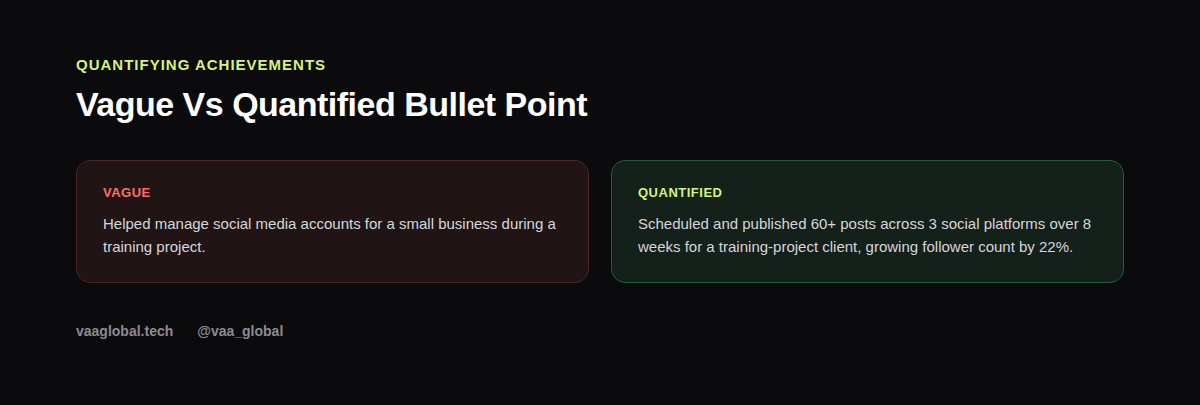
Hiring managers skim for proof, and a number is proof shorthand. "Managed social media" tells them nothing about scale or outcome; "posted 3x a week across 2 platforms for 10 weeks" tells them exactly what you did and for how long. Quantifiable resume achievements aren't reserved for people with years of corporate titles behind them, they're available to anyone who tracked what they actually did, however small the setting.
Can Volunteer Work Be Quantified On A Resume
Can volunteer work be quantified on a resume is a question a lot of beginners don't think to ask, and the answer is almost always yes. If you organized an event, count the attendees or the budget you managed. If you tutored or mentored, count the hours or the number of people. If you ran a social media page for a community group, count the posts, the follower growth, or the engagement. Volunteer work often produces some of the clearest numbers available to someone without paid experience.
What Counts As An Achievement With No Work Experience
What counts as an achievement with no work experience is broader than most people assume. A finished course project with a deadline you hit counts. A spreadsheet you built to track a family budget counts. A small freelance task, even unpaid or for a friend, counts. The test isn't whether someone paid you, it's whether you produced something, solved something, or improved something measurable.
4 Places To Find Numbers When You Have No Job History
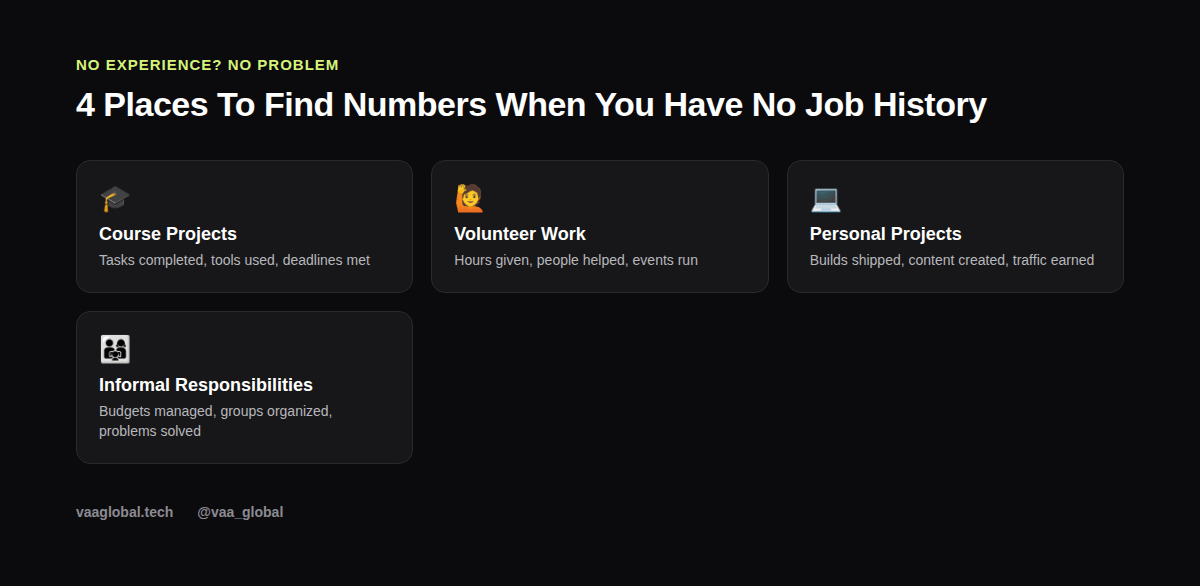
Course projects give you tasks completed, tools used, and deadlines met. Volunteer work gives you hours given, people helped, and events run. Personal projects give you builds shipped, content created, and traffic or engagement earned. Informal responsibilities, like managing a family budget or organizing a group trip, give you budgets managed, groups organized, and problems solved. Go through each category and write down every number you can honestly attach to something you did.
How Do I Add Numbers To My Resume If I Never Had A Job
How do I add numbers to my resume if I never had a job comes down to a simple habit: before you write a bullet point, ask "how much," "how many," or "how often." Instead of "completed a virtual assistant training course," write "completed a 6-week virtual assistant training covering 4 scheduling tools and 2 CRM platforms, plus a live client simulation handling 30+ email replies." The second version uses measurable resume bullet points instead of a flat description.
Before And After: More Examples
Before: "Participated in a customer service training program."
After: "Completed 40 hours of customer service training, handled 15 simulated support tickets, and maintained a 95% accuracy rate on response scripts."
Before: "Built a personal website as a hobby project."
After: "Designed and launched a 5-page portfolio website, optimized load time to under 2 seconds, and attracted 200+ visitors in the first month."
What To Do When There's Genuinely No Number Available
Sometimes there isn't a clean number, and that's fine. In those cases, quantify effort or scope instead of outcome: how long something took, how many steps were involved, or how many people were affected. "Organized a 3-day community event for 50 attendees" still reads as entry-level resume metrics even if you can't measure the event's success in dollars.
Turning This Into A Full Resume
Once you've gathered your numbers, string the strongest ones into your resume summary first; our guide on how to write a resume summary that gets read shows exactly how to lead with them. Then make sure the formatting around those bullet points won't get lost in a parsing error, using our ATS-friendly resume formatting checklist. If you want a broader list of what to avoid while you're at it, check our post on common resume mistakes remote job seekers make.
Backing It Up With A Portfolio
Numbers on a resume are stronger when there's something a recruiter can actually look at. If your course or project work produced anything visual or shareable, a simple portfolio adds credibility; see do virtual assistants need a portfolio website for a practical take on when that's worth building. VAA Global students completing an eligible course also get access to the VAA Global Portfolio Builder, which can help turn course projects into a shareable work sample alongside your resume. For general guidance on presenting early-career work, LinkedIn's help center also has resources on profile and experience sections.
The Bottom Line
You can quantify achievements on a resume with no corporate experience by treating your training, volunteer work, and personal projects as real sources of proof, not placeholders until you get a "real" job. Go through each one, pull the honest numbers out, and let those numbers do the talking your job title can't yet.