A resume summary that gets read is short, specific, and front-loaded with proof instead of adjectives. It sits right under your name and contact details, and in most cases it's the only part of your resume a recruiter reads before deciding whether to keep scrolling. If it's vague, you've lost them in under ten seconds, no matter how good the rest of your resume is.
Why Most Resume Summaries Get Skipped
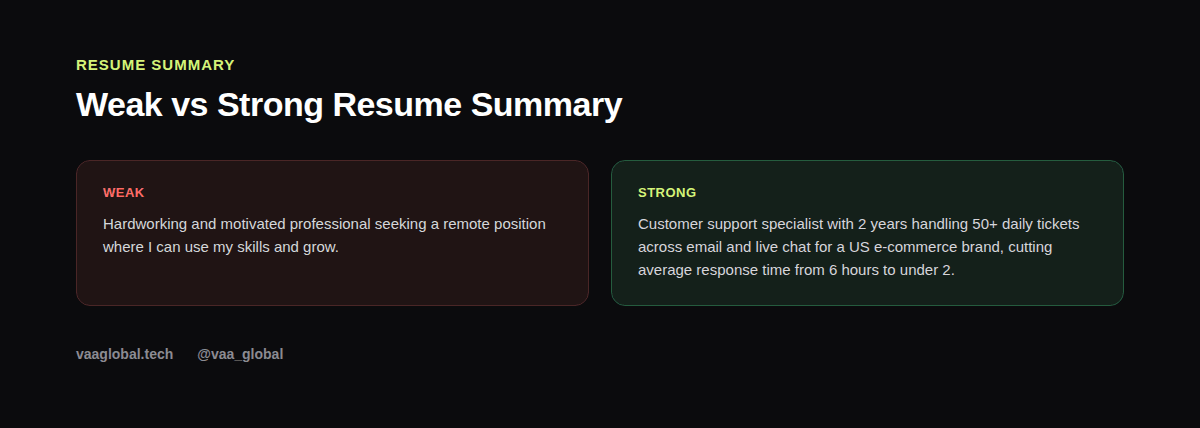
Recruiters and hiring managers read dozens, sometimes hundreds, of resumes for a single remote opening. A resume summary for remote jobs that opens with "motivated self-starter looking for an opportunity to grow" tells them nothing they can't already guess. It doesn't say what you do, how well you do it, or why you'd be useful on day one. Because of that, it gets skimmed past rather than read, and the rest of your resume never gets a fair look. If you're also cleaning up the rest of your document, it helps to first check your resume against a list of common resume mistakes remote job seekers make, since a weak summary is rarely the only issue.
What A Resume Summary Should Actually Include
If you're wondering what should a resume summary include, the answer is four things: your current role or focus area, one number or outcome that proves you can do the job, a tool or skill specific to the role you want, and a line that shows you understand what remote work requires. You don't need all four in every sentence, but each one should show up somewhere in those 2-4 lines.
The Formula, Step By Step
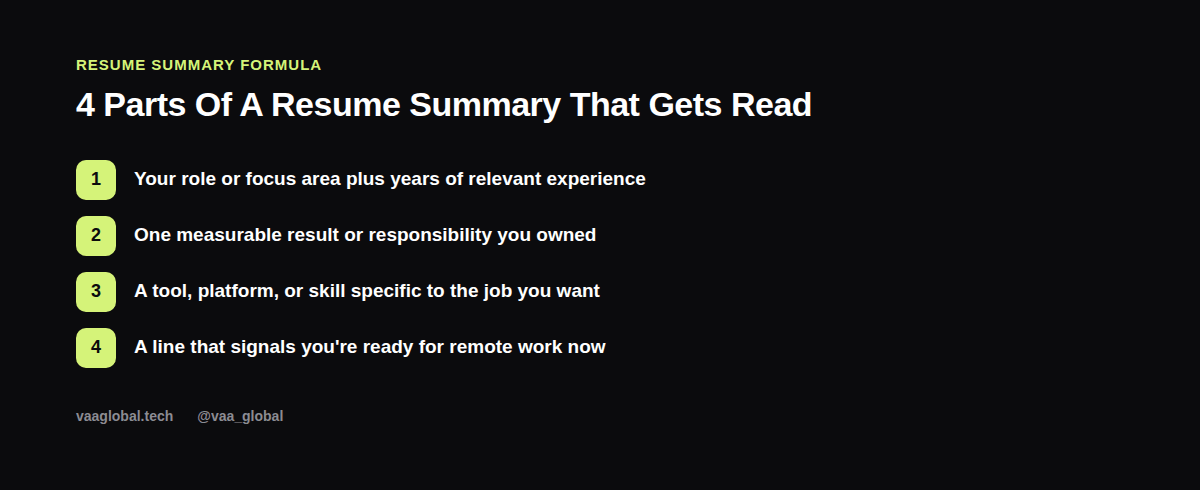
Start with your title or target role, add your years of experience if you have them, then move straight into a result. Instead of "responsible for customer service," write what that responsibility produced. Then name a specific tool, platform, or process you're fluent in, since that's often what an applicant tracking system (ATS) is scanning for. Finish with a short line connecting your experience to the job description in front of you.
How Long Should A Resume Summary Be
How long should a resume summary be is one of the most common questions beginners ask, and the honest answer is short: 2-4 sentences, roughly 40-60 words. Anything longer starts to read like a cover letter, and anything shorter reads like a filler line. If you're struggling to cut it down, draft the long version first, then remove every word that doesn't add a fact.
Resume Summary Examples: Before And After
Here are two more resume summary examples so you can see the pattern repeated across different roles.
Before (weak): "Detail-oriented individual with strong communication skills seeking a remote administrative role."
After (strong): "Virtual assistant with 1 year supporting a US-based real estate agent, managing a 200-contact CRM, scheduling 15+ weekly appointments, and reducing missed follow-ups to zero."
Before (weak): "Passionate about data and eager to contribute to a growing company."
After (strong): "Entry-level data analyst trained in Excel and SQL, built three dashboards tracking sales trends for a mock retail dataset, and comfortable translating raw numbers into plain-language recommendations."
How Do I Write A Resume Summary With No Experience
How do I write a resume summary with no experience is the question most beginners actually need answered. If you don't have paid work history yet, lean on training, projects, and transferable skills instead of inventing a job title you've never held. Mention the course or certification you completed, a project you built, and a skill you can prove, such as a tool you used or a volume of work you handled during practice exercises. If you need a deeper walkthrough on turning projects and training into measurable resume lines, our guide on how to quantify achievements on a resume with no corporate experience covers that in more detail.
Matching Your Summary To The Job Description
A generic summary works against you because recruiters and ATS software are both looking for overlap with the specific posting. Before you submit, reread the job description and check whether your summary uses at least one or two of the same keywords the employer used, whether that's a tool name, a certification, or an industry term. This is especially important if the role involves an ATS filter, which is covered in detail in our ATS-friendly resume formatting checklist.
Common Resume Summary Mistakes To Avoid
The biggest mistake is writing a career objective instead of a summary: talking about what you want rather than what you offer. Other common slip-ups include stacking adjectives with no evidence behind them, repeating your job title word-for-word instead of showing range, and writing the summary last without tailoring it to the specific job. Once your resume summary is solid, it's worth applying the same before-and-after thinking to your LinkedIn profile, since recruiters often check both.
Where This Fits In Your Job Search
A strong summary is one part of a bigger job search system. Pair it with a clean, ATS-friendly resume format, a tailored cover letter (see our guide on how to write a cover letter for a remote job), and interview prep once you land a call, using our notes on how to prepare for a remote job interview. VAA Global students who've completed a course can also run their resume through the VAA Global CV and LinkedIn Review Tool for a second set of eyes before applying.
The Bottom Line
A resume summary that gets read doesn't need clever language or a long list of soft skills. It needs a role, a result, a tool, and a reason you fit the job in front of you, all in 2-4 tight sentences. For more on writing a professional summary resume that holds up across different roles, LinkedIn's own career resource center has further formatting guidance worth a look. Write it last, tailor it every time you apply, keep resume bullet points under it just as specific, and treat the whole thing as proof, not a pitch.