Most people never figure out how to ask for a LinkedIn recommendation, so their profile sits with zero of them even after years of solid work. A recommendation is one of the few pieces of social proof on LinkedIn that comes from someone else's voice, not your own, which makes it more convincing to a recruiter than almost anything you could write about yourself.
Why LinkedIn Recommendations Matter More Than You'd Think
A LinkedIn recommendation request, when it comes back, puts someone else's words next to your name. It describes what it was actually like to work with you, in their voice, not yours. Because of that, it carries weight a self-written About section can't match, especially for someone early in their career with limited work history to point to. Even two or three solid recommendations can meaningfully change how a profile reads to a recruiter, since they shift the story from "here's what I say about myself" to "here's what someone else says about me."
Who Should I Ask For A LinkedIn Recommendation
Who should I ask for a LinkedIn recommendation is the first decision to get right. Prioritize people who directly saw your work: a manager, a client, a mentor, a trainer, or even a peer who collaborated with you closely on a specific project. A LinkedIn reference from someone who barely knows your day-to-day output reads as vague and generic, and recruiters can usually tell.
5 Steps To Asking For A LinkedIn Recommendation
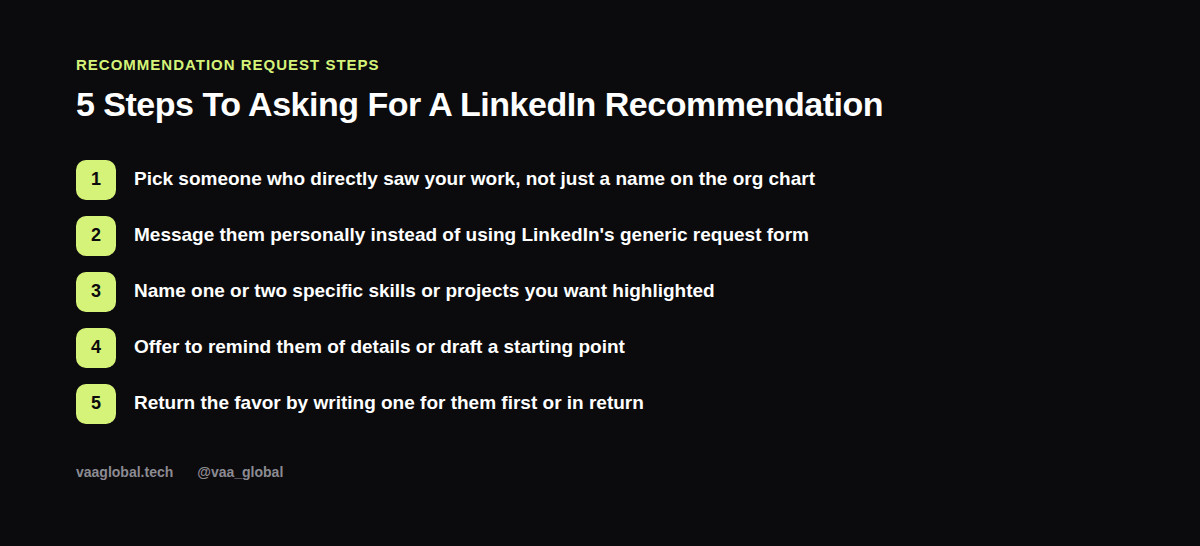
Pick someone who genuinely saw your work up close. Message them directly and personally rather than using LinkedIn's generic one-click request form, which feels impersonal and is easy to ignore. Name one or two specific skills or projects you'd like highlighted, since a targeted ask produces a far more useful LinkedIn recommendation message than "can you write me something." Offer to remind them of details or send a few bullet points as a starting draft. And where it fits, offer to write one for them too, either first or in return.
What Should I Say When Asking For A LinkedIn Recommendation
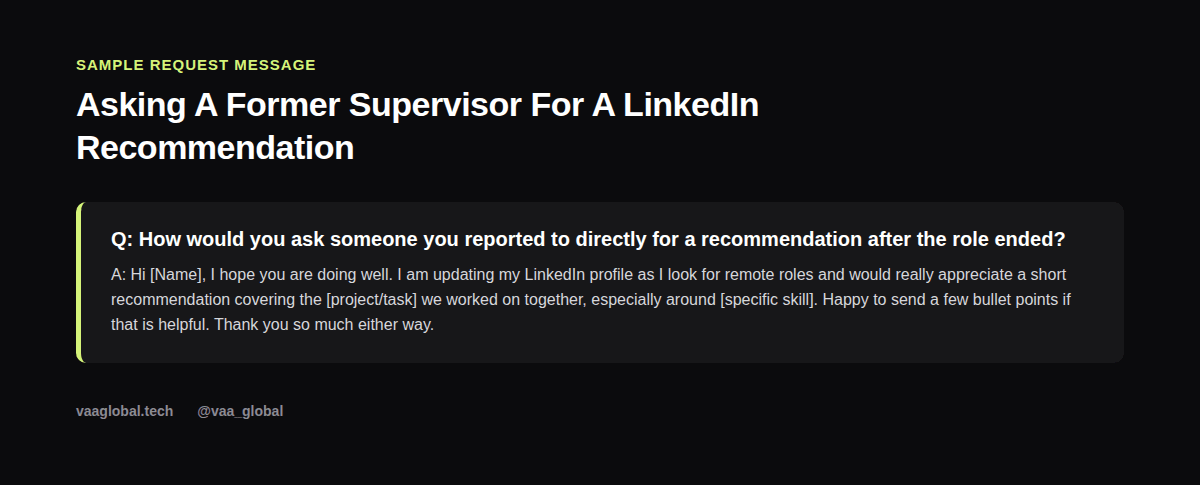
What should I say when asking for a LinkedIn recommendation comes down to being specific and low-pressure. Here's a template you can adapt: "Hi [Name], I hope you are doing well. I am updating my LinkedIn profile as I look for remote roles and would really appreciate a short recommendation covering the [project/task] we worked on together, especially around [specific skill]. Happy to send a few bullet points if that is helpful. Thank you so much either way." The brackets make it easy to personalize for a manager, a client, or a training partner.
A Second Template For A Client Or Freelance Relationship
If you're asking a former client rather than a boss: "Hi [Name], it was great working with you on [project]. I am building out my LinkedIn profile and would love a short recommendation on your experience working with me, particularly around [turnaround time, communication, quality, etc.]. No pressure at all, and thank you either way." Clients often respond well to a request tied to a specific, finished piece of work rather than a general one.
How Many LinkedIn Recommendations Do I Need
How many LinkedIn recommendations do I need isn't a fixed number, but 3-5 genuine ones from different relationships (a manager, a peer, a client) is a reasonable early goal. Quality and specificity matter far more than quantity; two detailed recommendations that mention real skills beat ten generic ones that could apply to anyone.
What If You Don't Have Traditional Work Experience Yet
If you're newer to the workforce, ask a course instructor, a training supervisor, a group project partner, or someone you volunteered alongside. A recommendation describing how you handled a specific training project or simulation is still a credible signal, especially paired with the kind of quantified detail covered in our guide on quantifying achievements with no corporate experience.
When To Ask, And How To Follow Up Politely
Ask soon after a project wraps or a role ends. At that point, the details are still fresh for the other person, and it's easier for them to write something specific instead of something vague. If a couple of weeks pass with no response, one light, polite follow-up is fine, since LinkedIn requests are easy to forget and are not usually ignored on purpose. Avoid asking more than once or twice, however, and never pressure someone who's clearly busy or who has already declined.
Where This Fits Into The Rest Of Your Profile
Recommendations work best alongside a sharp LinkedIn headline and a specific About section that converts, since recommendations only add credibility to a profile that's already saying something clear. If you're building out proof of your work more broadly, see how to build a personal brand as a remote professional, and check LinkedIn's help center for the exact steps to send and manage recommendation requests on the platform.
The Bottom Line
Figuring out how to ask for a LinkedIn recommendation is mostly about being specific and personal instead of generic. Pick the right person, name the exact skill or project you want highlighted, make it easy for them to say yes, and offer something back. A handful of real, detailed recommendations will do more for your profile than almost anything you write yourself.