Access control reviews are one of the first practical GRC tasks a lot of beginners get handed, and for good reason — they're concrete, they happen on a regular schedule, and they teach you how access, risk, and accountability connect in a real organization. At their core, access control reviews are simply the periodic process of checking who has access to what, and confirming each person still genuinely needs it.
What Is an Access Control Review?
What is an access control review, exactly? It's a scheduled check of who has access to a given system, application, or dataset, done to confirm that access still matches each person's current role and job needs. The underlying principle is called least privilege — give people only the access they actually need, nothing more — and access reviews exist to catch the drift that naturally happens as people change roles, take on temporary projects, or leave the company entirely.
Why Access Reviews Are So Common in Audits
For deeper background on how access management fits into a broader controls framework, the Institute of Internal Auditors publishes solid guidance worth reading.
Stale access is one of the most common findings in almost any audit, internal or external, because access tends to accumulate and rarely gets cleaned up on its own. Someone gets temporary access for a project, the project ends, and nobody remembers to remove it. A role-based access change happens, but the old permissions never get revoked alongside the new ones being granted. Regular access reviews are the mechanism that catches this drift before it becomes a real security or compliance problem.
The Review Process, Step by Step
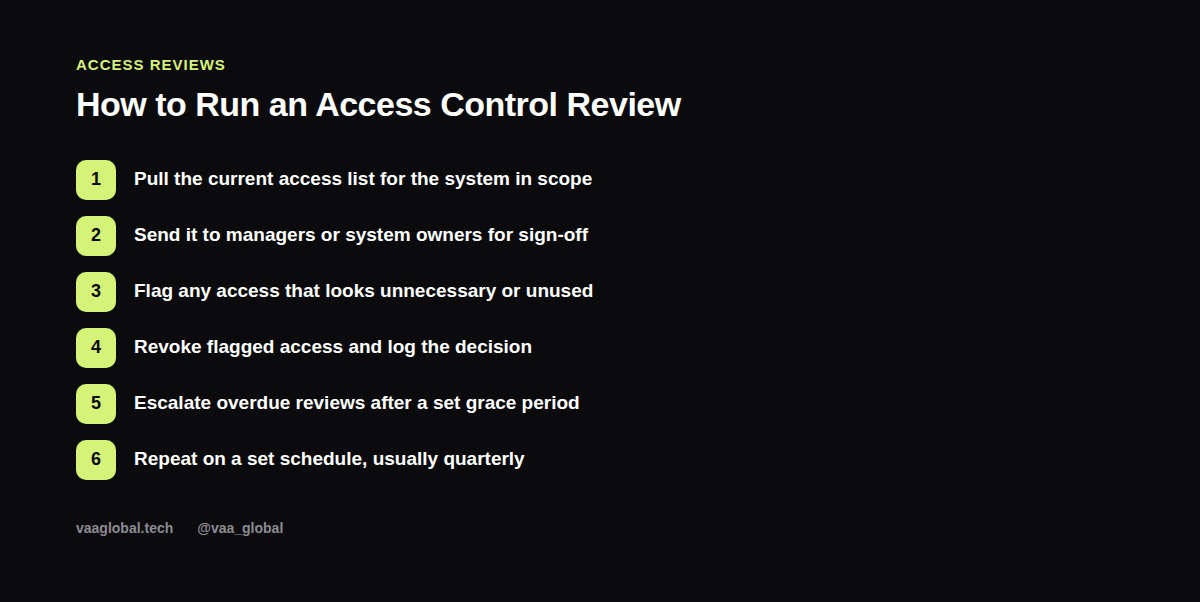
A typical review follows six steps. First, pull the current access list for the system in scope — this needs to be complete and accurate, or the whole review is built on bad data. Second, send that list to the relevant managers or system owners for sign-off, since they're the ones who actually know whether someone still needs that access. Third, flag anything that looks unnecessary, unused, or mismatched with the person's current role. Fourth, revoke the flagged access and log exactly what was removed and when. Fifth, escalate any reviews that go overdue past a set grace period, rather than letting them slip indefinitely. Sixth, repeat the entire cycle on a set schedule — quarterly is the most common cadence for higher-risk systems.
How Often Should Access Reviews Happen?
How often should access reviews happen depends on the system's risk level. Systems holding sensitive customer data, financial records, or production infrastructure access often get reviewed quarterly, sometimes even monthly for the highest-risk roles. Lower-risk systems, like an internal wiki with no sensitive data, might only need an annual review. Matching review frequency to actual risk, rather than reviewing everything on the same calendar, is what keeps the process sustainable instead of an overwhelming, box-checking chore.
A Worked Example: Sample Access Review Checklist
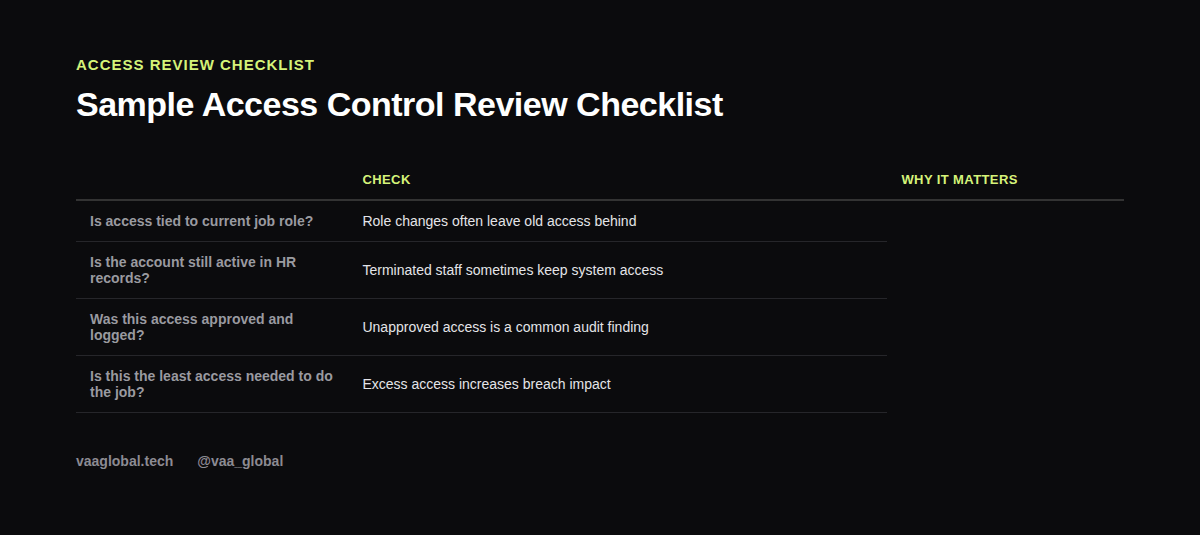
A manager reviewing a user access review list for their team might run through a checklist like this, line by line for each person: Is this access tied to the person's current job role, or left over from an old one? Is the account still active in HR records, or did this person leave the company? Was this access originally approved and logged somewhere, or does it exist with no documented history? And finally, is this the least access needed to do the job, or could a more limited role-based access level work just as well? Any "no" or "not sure" answer should trigger a flag for follow-up, not a quiet pass.
Who Approves Access Reviews?
Who approves access reviews is usually the person's direct manager, since they're closest to what the role actually requires day to day. For especially sensitive systems, a second approver — like a system owner or security lead — sometimes needs to sign off too, adding a layer of accountability beyond a single manager's judgment.
What Happens If Access Reviews Are Skipped?
What happens if access reviews are skipped, even just once or twice? Access quietly accumulates, and the gap between who should have access and who actually has access widens every cycle you miss. This is exactly the kind of gap that shows up as a finding in common GRC audit findings and how to fix them, and it's also a real security risk — every unnecessary active account is one more potential entry point if credentials are ever compromised.
Access Reviews and Incident Response
This process connects directly to incident response planning, since weak or stale access is a frequent root cause of security incidents. A compromised account with excessive, unreviewed access can do far more damage than one limited strictly to what the role requires. This is part of why access reviews and incident response planning basics are often taught together in security-focused training. If you're building these skills, VAA Global's Cybersecurity course covers the foundational concepts behind access management as part of its broader curriculum, and common cybersecurity tools beginners should learn is a useful next read.
The Bottom Line
Access control reviews, at their core, boil down to a simple, repeatable habit: regularly check who has access to what, confirm it's still needed, and revoke what isn't — then log the whole thing as proof it happened. It's one of the most concrete, learnable GRC tasks out there, and getting comfortable with it early sets up a strong foundation for almost everything else in the field.