Once you've sat through a few audits, you start noticing the same GRC audit findings showing up again and again across completely different companies and industries. That's actually good news for beginners, because it means you can learn to recognize and fix these patterns well before you ever sit in your first real audit.
What Are the Most Common Audit Findings?
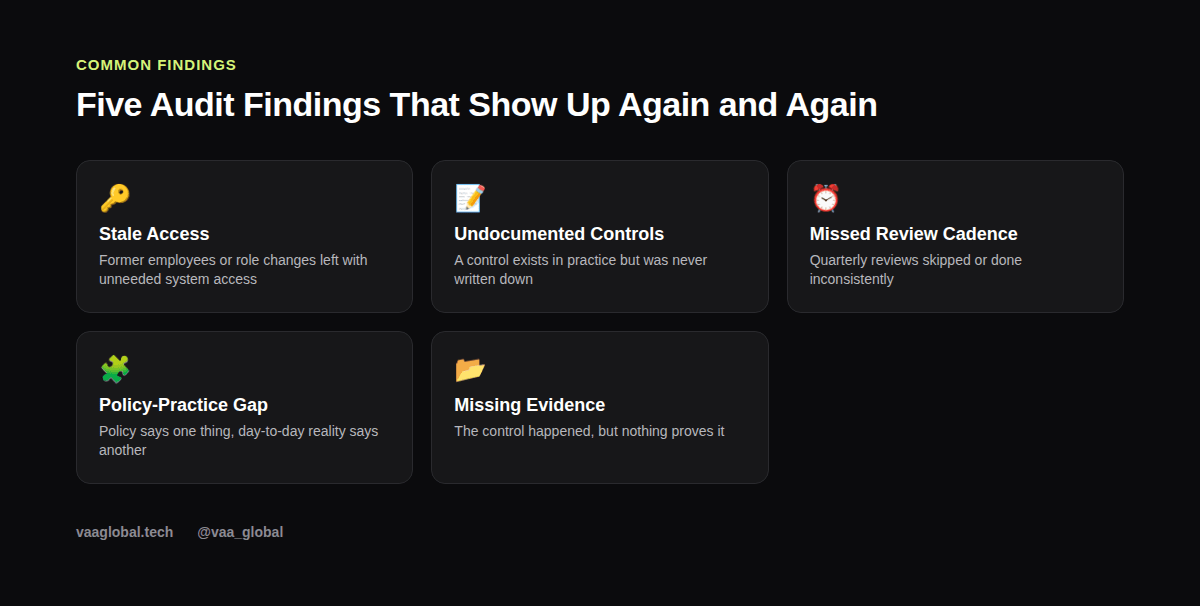
What are the most common audit findings a beginner is likely to encounter? Five patterns cover the vast majority: stale access that was never revoked, controls that exist in practice but were never written down, review cadences that get skipped or done inconsistently, a gap between what the policy says and what people actually do, and evidence that's simply missing even though the control did happen. Learning to spot these quickly is one of the fastest ways to build real audit instincts.
Finding One: Stale Access
Why do access reviews fail audits so often? Usually because offboarding and role-change processes aren't tightly connected to IT provisioning. An employee leaves or switches teams, and their old access just sits there, unused but still technically active. The fix isn't just revoking the specific access found during the audit — it's building an automated trigger between HR systems and IT provisioning so access changes happen the moment HR records change, not whenever someone happens to notice.
Finding Two: Undocumented Controls
Sometimes a control genuinely works — the team really does check something every week — but nothing was ever written down describing it. This is a surprisingly common finding, because teams often build good habits informally and never think to formalize them. The fix is straightforward: document the control as it actually operates, assign an owner, and fold it into the regular policy management cycle so it doesn't quietly disappear when that person eventually moves on.
Finding Three: Missed Review Cadence
A policy says quarterly reviews happen. The evidence shows the last one was seven months ago. This finding usually isn't a sign of bad intentions — it's almost always a sign nobody owns the reminder. The fix combines two things: assign a named, accountable owner, and add an automated calendar or ticketing reminder with an escalation path if the deadline passes unaddressed.
Finding Four: Policy-Practice Gaps
This is one of the trickiest findings to fix well, because there are two possible directions. Either the practice needs to change to match the policy, or the policy was unrealistic and needs to change to match how work actually happens. A good auditor — and a good GRC analyst responding to the finding — asks which direction makes more sense before jumping to a fix. If the policy was simply unrealistic from the start, forcing practice to match it creates a worse problem than the one you started with.
Finding Five: Missing Evidence
Sometimes the control genuinely happened, but there's no record proving it. An auditor can't give credit for a control they can't verify, no matter how confident the team is that it occurred. The fix is building evidence capture directly into the workflow — a checkbox in a ticketing system, an automatic log entry, a signed approval — so proof is generated as a natural byproduct of doing the work, not as a separate task people forget.
A Worked Example: Finding-to-Fix Pairs
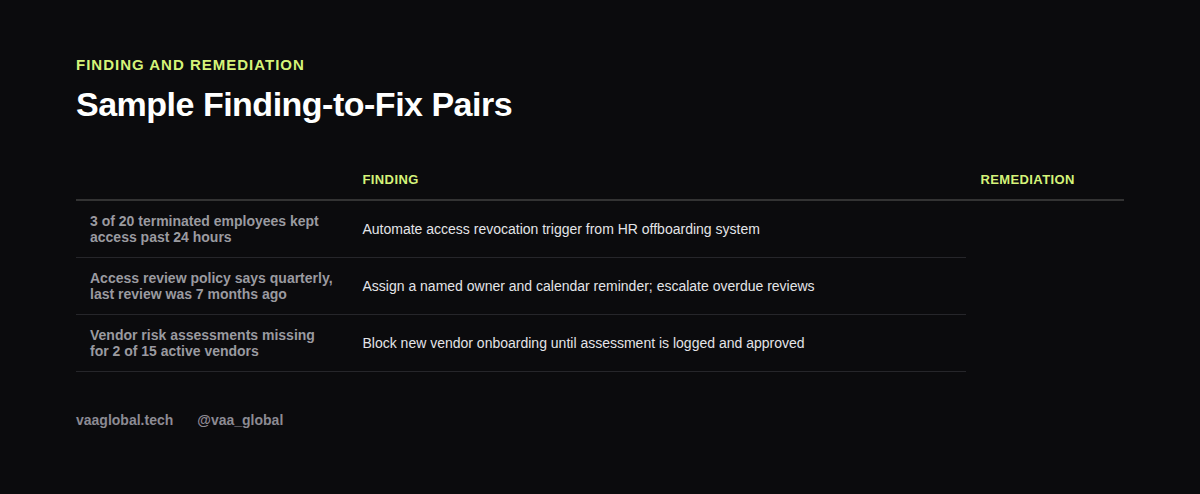
Here are three sample finding-and-remediation pairs modeled on real patterns: Finding — 3 of 20 sampled terminated employees kept system access for more than 24 hours after termination. Remediation — automate the access revocation trigger directly from the HR offboarding workflow, removing the manual step that was failing. Finding — the access review policy requires quarterly reviews, but the last completed review was seven months ago. Remediation — assign a named review owner with a calendar reminder, and set an automatic escalation to their manager if the review isn't completed within 10 days of the deadline. Finding — vendor risk assessments are missing for 2 of 15 active vendors. Remediation — block new vendor onboarding in the procurement workflow until a completed risk assessment is logged and approved.
How Do You Write an Audit Remediation Plan?
How do you write an audit remediation plan that actually gets taken seriously? Keep it specific: name the exact fix, the person responsible, and a realistic deadline. Vague remediation language like "will improve the process" tends to get flagged again at the next audit, because there's nothing concrete to check. A strong remediation plan reads almost like a mini policy statement — specific enough that someone unfamiliar with the finding could verify whether it's been completed.
How Do You Close an Audit Finding?
How do you close an audit finding properly, rather than just marking it done? The remediation needs to be verified, not just claimed. This usually means the original auditor, or a designated reviewer, checks real evidence that the fix was implemented — not just a status update saying it's handled. This follow-up step is exactly what separates a credible internal audit function from one that just collects promises nobody checks on.
Getting Comfortable With Findings as a Beginner
If you're new to this work, practice by reviewing any policy you follow in daily life — a workplace expense policy, a subscription cancellation process — and look for a gap between what's written and what actually happens. This habit builds the same muscle used in real GRC work, and it's a great talking point in interviews, the same way cybersecurity interview questions for beginners often ask candidates to walk through a real-world example rather than recite definitions.
Connecting Findings Back to Internal Audit
Common audit findings and their fixes are really a continuation of internal audit basics — the finding is just the output of the testing phase, and the fix is what internal audit expects to see confirmed at follow-up. If you're building toward this field, the Institute of Internal Auditors publishes solid guidance on writing and tracking findings, and how to write a guest experience audit shows the same finding-and-fix logic applied in a smaller, operational setting. Each finding should also carry a risk rating so leadership can prioritize corrective action by severity rather than treating every item the same, and a hotel night audit checklist is a good small-scale example of risk rating in practice.
The Bottom Line
Most GRC audit findings fall into a handful of recognizable patterns — stale access, undocumented controls, missed reviews, policy-practice gaps, and missing evidence. Learning to spot them quickly, write specific remediation plans, and verify fixes before closing them out is what turns audit findings from a stressful surprise into a routine, manageable part of the job.