Covering incident response planning basics early is one of the smartest moves any GRC or security beginner can make, because when a real incident hits, there's no time to figure out the plan from scratch. Incident response planning is the work of deciding, ahead of time, who does what when something goes wrong — a breach, an outage, a ransomware attempt — so the actual response is fast and organized instead of chaotic.
What Is an Incident Response Plan?
So what is an incident response plan, exactly? It's a written document that spells out how an organization detects, responds to, and recovers from security incidents. A good incident response plan names specific roles, defines what counts as an incident worth escalating, lists communication steps, and includes templates so people aren't writing things from scratch under pressure. Without one, even a skilled team wastes critical time just figuring out who's in charge.
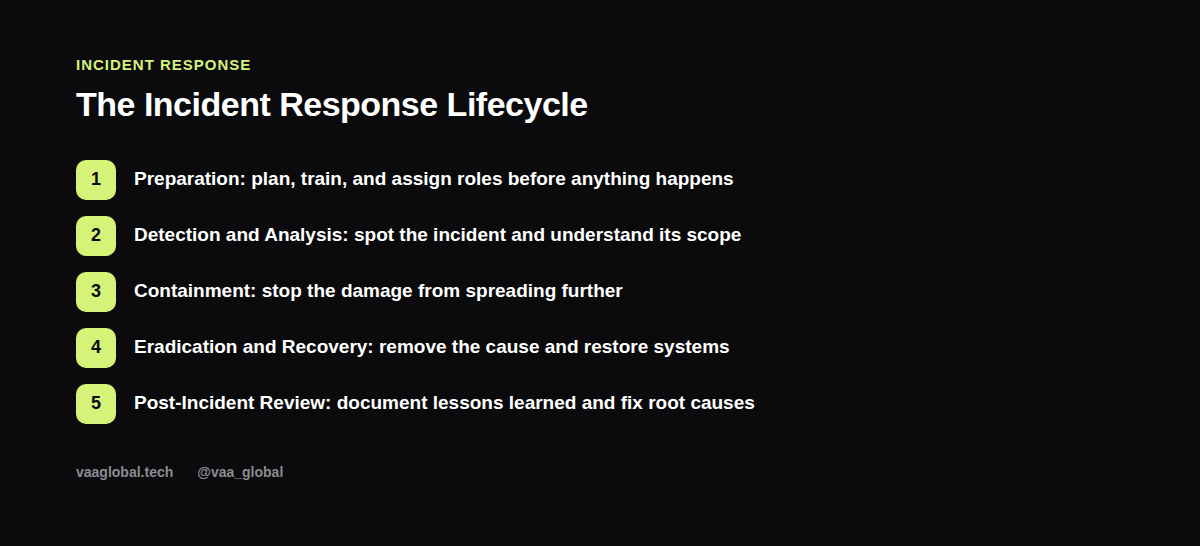
The Five-Phase Incident Response Lifecycle
Most incident response frameworks, including guidance from the National Institute of Standards and Technology, describe a similar lifecycle. Preparation comes first — this is where the plan, training, and tooling get built before anything goes wrong. Detection and analysis is spotting that something has happened and figuring out its scope. Containment is about stopping the damage from spreading, even before the root cause is fully understood. Eradication and recovery means removing the actual cause and restoring normal operations. Finally, post-incident review captures lessons learned and drives fixes to whatever let the incident happen in the first place.
Who Should Be on an Incident Response Team?
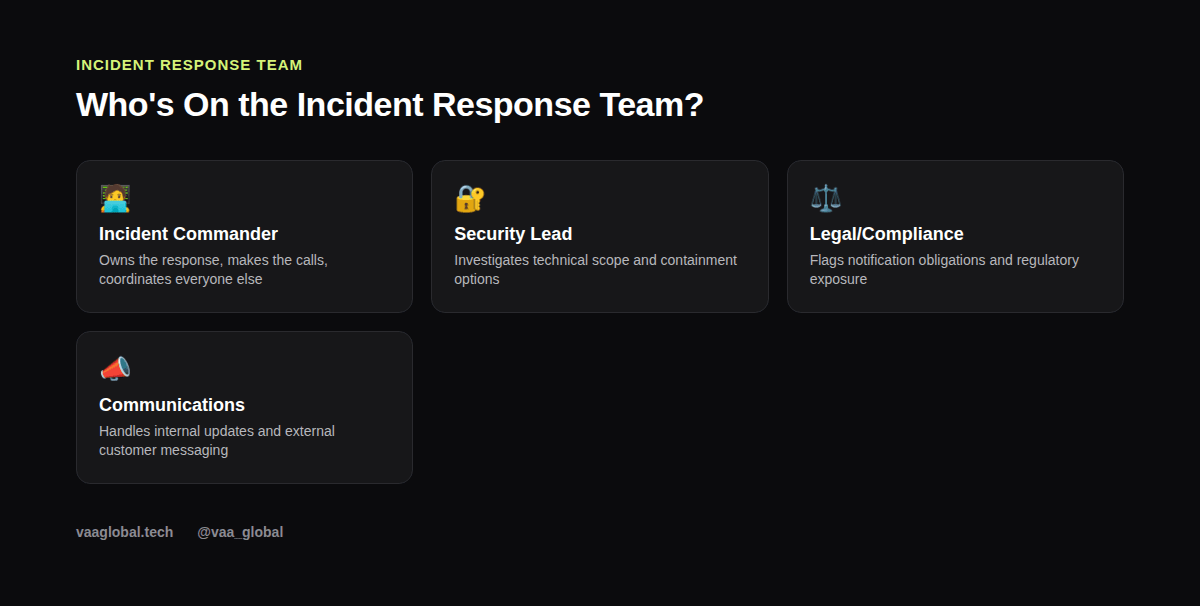
Who should be on an incident response team depends on company size, but a few roles show up almost everywhere. An incident commander owns the response and makes final calls under pressure. A security lead investigates technical scope and containment options. Someone from legal or compliance flags notification obligations, since many incidents trigger regulatory reporting requirements. And a communications owner handles both internal updates and, when needed, external customer or public messaging. Smaller companies often combine several of these roles into one or two people — what matters is that every role is assigned to someone specific, not left as an assumption.
Containment and Recovery in Practice
Containment and recovery is where plans either hold up or fall apart under real pressure. Containment might mean isolating an affected server from the network, disabling a compromised account, or temporarily taking a feature offline. The goal is limiting damage fast, even if it's not yet clear exactly what caused the problem. Recovery comes after the cause is understood and removed — restoring from clean backups, rotating credentials, and verifying systems are genuinely clean before bringing them back online.
How Do You Test an Incident Response Plan?
How do you test an incident response plan without waiting for a real crisis? The standard answer is a tabletop exercise: gather the response team, walk through a realistic scenario out loud, and have each person describe what they'd actually do at each step. This surfaces gaps — maybe nobody actually knows the escalation phone number, or two people think they're the incident commander — in a low-stakes setting rather than during a genuine emergency. Running a tabletop exercise at least once or twice a year is a widely recommended baseline.
A Worked Example: Simple Incident Response Plan Outline
A lean, functional incident response plan typically includes:
- Incident classification: What counts as low, medium, or high severity, with examples for each.
- Escalation contacts: Names, roles, and backup contacts for every team member, kept current.
- Communication templates: Pre-written drafts for internal updates and customer notifications, ready to adapt quickly.
- Containment playbooks: Specific steps for common scenarios, like a compromised account or a suspected data exposure.
- Post-incident review template: A standard set of questions — what happened, how was it caught, what will change — completed after every incident, big or small.
What Happens After a Security Incident?
What happens after a security incident matters just as much as the response itself. A thorough post-incident review documents the timeline, root cause, and what worked or didn't. This review should produce real action items — a new monitoring alert, an updated access control review process, a revised policy — not just a report that gets filed away. Skipping this step means the organization is likely to face the same type of incident again, having learned nothing from the first one.
Incident Response and the Wider GRC Picture
Incident response planning connects tightly to compliance monitoring and access control reviews, since weak access controls are a common root cause of security incidents. If you're building toward a GRC or security analyst role, VAA Global's Cybersecurity course covers incident response and vulnerability management as part of its 10-week curriculum, and pairs well with the documentation and process skills covered in how to become a business analyst in 2026. For deeper, authoritative incident response guidance, see NIST, whose incident handling frameworks are widely adopted across industries.
Starting Small if You're New
If your team doesn't have a formal plan yet, don't try to build the perfect document on day one. Start with a one-page version covering classification, contacts, and basic containment steps, then expand it after your first tabletop exercise reveals what's actually missing. Even a rough plan beats no plan at all, since the exploring-under-pressure scenario is exactly what planning exists to prevent — the same logic behind why knowing what to do after a HIPAA mistake matters before a mistake ever happens, not after.
The Bottom Line
Incident response planning basics are really about removing guesswork from the worst moments. Build the five-phase lifecycle into a real document, assign specific roles to specific people, rehearse it with tabletop exercises, and always close the loop with a post-incident review. Teams that do this consistently respond faster and recover cleaner than teams improvising in the moment.