This SOC 2 compliance explained for beginners guide exists because almost everyone who starts exploring GRC or works near a SaaS company runs into the term within their first week, usually with zero context. By the end of this article you'll understand what SOC 2 actually is, who needs it, and what a SOC 2 report says.
What SOC 2 Actually Is
SOC 2 stands for System and Organization Controls 2, a framework developed by the AICPA (American Institute of Certified Public Accountants). Unlike ISO 27001, which results in a certification, SOC 2 results in an attestation report written by an independent CPA firm. That report describes the service organization's systems and controls and gives the auditor's opinion on whether those controls meet the relevant criteria.
The Trust Services Criteria
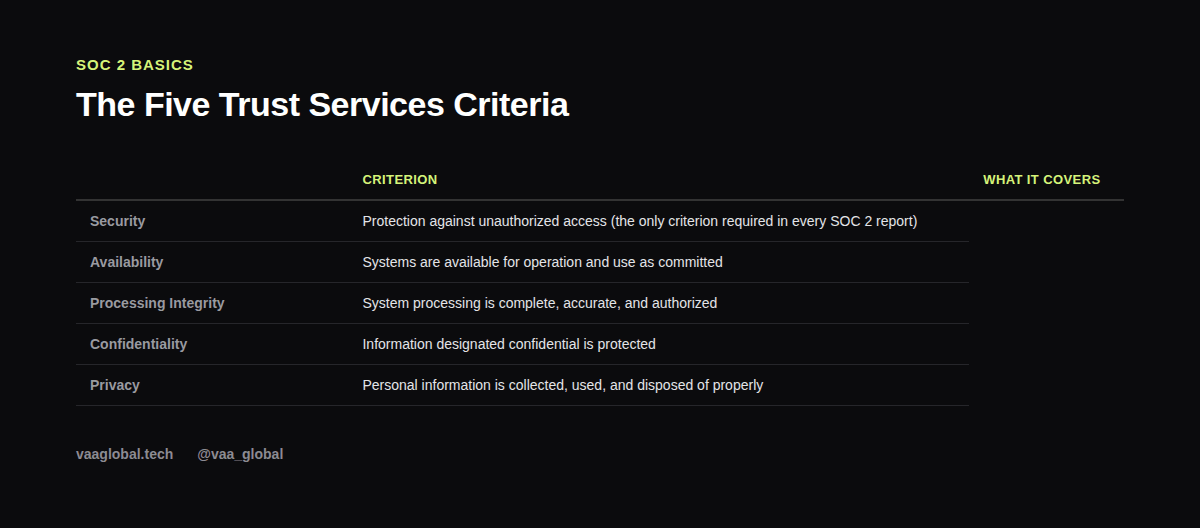
Every SOC 2 report is built around the Trust Services Criteria. Security is mandatory in every SOC 2 engagement — it covers protection against unauthorized access. The other four criteria (availability, processing integrity, confidentiality, and privacy) are optional and chosen based on what a company's customers actually care about. A cloud storage provider might include confidentiality and availability, for instance, while a payments company might add processing integrity.
Who Actually Needs a SOC 2 Report
SOC 2 is most common among US-based SaaS and technology service companies, because their enterprise customers routinely ask for a SOC 2 report during vendor due diligence before signing a contract. If you've read our piece on third-party vendor risk management basics, this is exactly the kind of evidence a procurement or security team would request from a vendor as part of that process.
Type I vs. Type II: A Critical Distinction
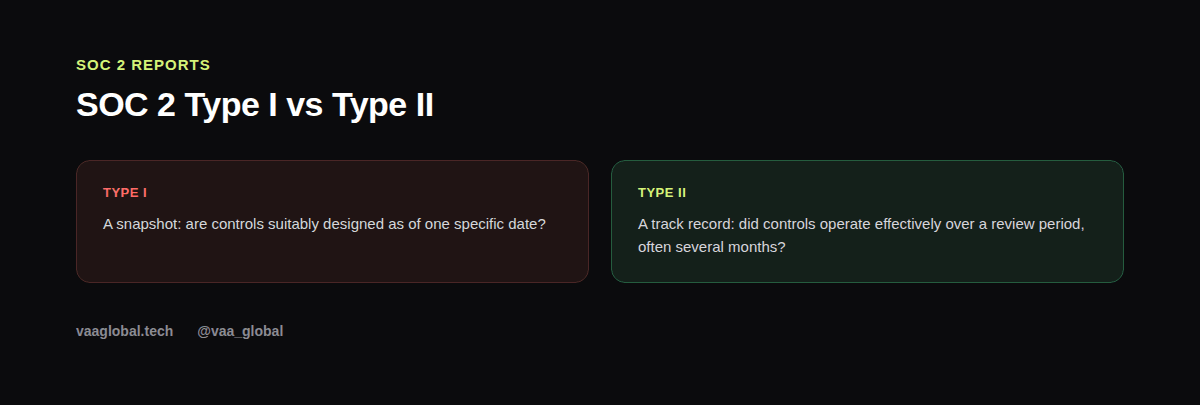
One of the most confusing parts of SOC 2 for newcomers is the difference between a Type I and a Type II report. A Type I report is a snapshot — it evaluates whether controls are suitably designed at one point in time. A Type II report goes further, evaluating whether those controls actually operated effectively over a review period, often several months. Most enterprise buyers eventually want to see a Type II report, since it demonstrates sustained performance rather than a single good day.
What Happens During a SOC 2 Audit
A SOC 2 audit involves an independent CPA firm reviewing documented policies, testing whether controls are actually followed, and interviewing staff responsible for those controls. For a Type II report, the auditor samples evidence across the entire review period rather than just checking a single point in time. This is one reason organizations often build out a risk register and clear control ownership well before the audit even starts — scrambling to produce evidence at the last minute rarely goes well.
SOC 2 and the Rest of the GRC World
SOC 2 doesn't exist in isolation. Many companies maintain both a SOC 2 report and ISO 27001 certification because different customers, especially international ones, ask for different proof. If you're new to this comparison, our article on ISO 27001 explained for beginners walks through how that international standard differs from SOC 2's attestation-based approach, and understanding both gives you a much stronger foundation for any entry-level GRC or compliance role.
Common Questions Beginners Ask
People often ask what is SOC 2 compliance in simple terms — it's proof, backed by an independent auditor, that a company's security and operational controls meet a recognized bar. Another frequent question is the difference between SOC 2 Type 1 and Type 2, which, as covered above, comes down to a point-in-time check versus a sustained-performance check. People also ask who needs a SOC 2 report: typically any service organization that stores or processes customer data and sells into enterprise or regulated markets. And on how long does SOC 2 take, there's no universal number — a Type II review period alone is often several months, on top of however long it takes to build the control environment beforehand, so it's worth checking current guidance on the AICPA's own site rather than relying on a fixed timeline.
A Simple Example: Mapping One Control
Imagine a company chooses security and availability as its two criteria. One control might require multi-factor authentication for all employee access to production systems. During the audit, the auditor doesn't just read the policy; they check configuration settings, pull login logs, and, for a Type II report, sample multiple months to confirm the control was actually enforced consistently, not just written down somewhere. That gap between a policy on paper and a control that truly operates is exactly what Type II testing is designed to catch, and it's why evidence collection becomes such a central part of audit preparation.
Breaking Into This Work
You don't need a CPA license to work around SOC 2 — GRC analysts, compliance associates, and security coordinators regularly manage evidence collection, track control owners, and liaise with auditors without being the auditor themselves. If you're exploring this path alongside technical security skills, VAA Global's Cybersecurity course covers vulnerability management and incident response fundamentals that often show up as SOC 2 controls in practice. It's also worth reading up on cybersecurity interview questions for beginners and common cybersecurity tools beginners should learn to round out your understanding before interviewing.
The Bottom Line
SOC 2 compliance explained for beginners really comes down to this: it's an independent attestation, built around the Trust Services Criteria, that tells a company's customers whether its controls can be trusted — and whether that trust has been proven over time (Type II) or just verified once (Type I). Learn the vocabulary, understand the audit process, and you'll be ahead of most people walking into their first compliance interview.