With this NIST Cybersecurity Framework explained guide, you'll walk away understanding why it's one of the most referenced resources in GRC and security circles, without needing to read the full government publication first. It's less a strict rulebook and more a shared vocabulary for talking about cybersecurity risk.
Where NIST CSF Comes From
The framework is published by the National Institute of Standards and Technology (NIST), a US government agency. It was originally built for critical infrastructure operators, but its usefulness for managing cybersecurity risk means organizations well outside that original scope — small businesses, nonprofits, schools — now use it too.
The Six Core Functions
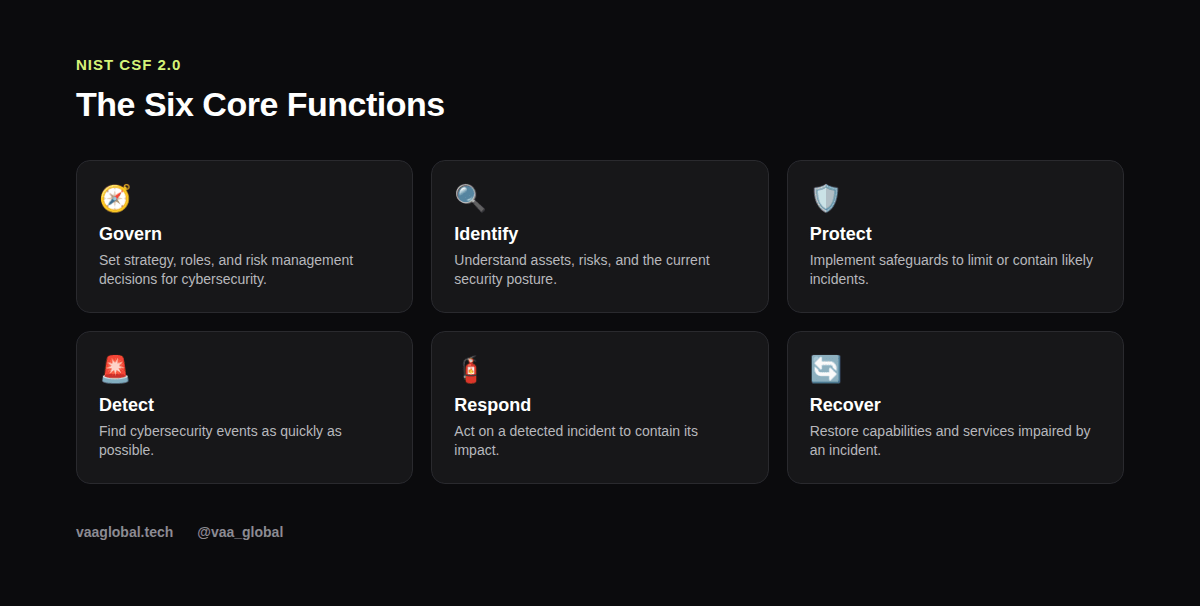
NIST CSF 2.0 organizes everything into six functions, shown in the graphic above. Govern sets the strategy and decision-making structure. Identify is about understanding what assets and risks actually exist. Protect covers the safeguards that limit or contain an incident. Detect is about noticing something has gone wrong. Respond covers containing and managing an active incident. Recover focuses on restoring normal operations afterward. Together, these cover the entire lifecycle of a cybersecurity risk, not just prevention.
Why 'Voluntary' Doesn't Mean 'Optional in Practice'
NIST CSF is explicitly a voluntary framework — there's no legal requirement to adopt it. That said, many contracts, insurance applications, and industry expectations now reference it informally, so in practice a lot of organizations treat it as close to mandatory even though it technically isn't. If you need a definitive answer on any specific regulatory obligation, that's a question for legal counsel or the relevant regulator, not a blog post.
Profiles and Tiers: How Organizations Actually Use It
Two concepts make NIST CSF practical rather than purely theoretical. A Profile describes which outcomes an organization is currently achieving versus which ones it wants to achieve (a target profile). Tiers describe how mature and integrated an organization's cybersecurity risk management practices are, from ad hoc to adaptive. Comparing a current profile against a target profile is how teams figure out exactly where their gaps are.
A Simple Example
Picture a small e-commerce company reviewing itself against the Identify function. They realize they've never actually inventoried which third-party services have access to customer payment data. That gap becomes a priority action item, closed by building an asset and vendor inventory — which then feeds directly into their broader approach to third-party vendor risk management and entry-level cybersecurity work more generally. In other words, a single overlooked gap in Identify can cascade into real exposure elsewhere.
How NIST CSF Relates to ISO 27001 and SOC 2
A common beginner question is how NIST CSF is different from ISO 27001. ISO 27001 is a certifiable management-system standard, while NIST CSF is a flexible reference framework without a certification process attached to it directly. Some organizations map their NIST CSF work into an ISO 27001-aligned ISMS, or use it alongside SOC 2 preparation, since the underlying risk concepts (identify, protect, detect, respond) overlap heavily across frameworks even when the vocabulary differs.
Common Questions Beginners Ask
People frequently ask what is the NIST cybersecurity framework used for — mainly for structuring and communicating about cybersecurity risk management in a consistent way across a whole organization. Others ask is NIST CSF mandatory, and the honest answer is no, not generally, though specific contracts or sector rules might reference it. On how is NIST CSF different from ISO 27001, remember that one is a flexible US-origin framework and the other is a certifiable international standard. And when people ask what are the NIST CSF functions, the answer is the six core functions covered above: Govern, Identify, Protect, Detect, Respond, and Recover.
A Note on Risk Tiers
Beyond profiles, NIST CSF also describes four risk tiers that describe how mature an organization's overall approach is: Partial, Risk Informed, Repeatable, and Adaptive. For instance, a Tier 1 (Partial) organization typically manages cybersecurity risk in an ad hoc way with little coordination across teams, whereas a Tier 4 (Adaptive) organization continuously adapts its practices based on lessons learned and shifts in the threat landscape. Most organizations starting out land somewhere in the middle, and that's perfectly normal; the tiers exist to show a direction of travel, not a score you're expected to hit on day one. Mapping your own organization, or a client's, onto a tier is a useful exercise even before you touch the six functions in detail.
Building a Career Around This Knowledge
Understanding NIST CSF is valuable whether you're aiming for a GRC analyst role, a security operations position, or just want to speak the same language as the security team you support. If you're building foundational cybersecurity skills alongside this framework knowledge, VAA Global's Cybersecurity course covers networking, vulnerability management, and incident response, all of which map neatly onto the Protect, Detect, and Respond functions. For more on breaking into the field, see how to start a career in cybersecurity from scratch and cybersecurity certifications for beginners in Nigeria.
The Bottom Line
With the NIST Cybersecurity Framework explained in plain terms, the takeaway is simple: it gives any organization a shared language and structure for managing cybersecurity risk, from governance all the way through recovery. Learn the six functions, understand profiles and tiers, and you'll be able to hold your own in almost any cybersecurity or GRC conversation.