

A medical virtual assistant medical terminology crash course doesn't need to feel like memorizing a dictionary, because most medical words are actually built from a small, reusable set of word parts once you learn to recognize the pattern. Instead of trying to memorize thousands of isolated terms, you can learn roughly 50 to 60 common prefixes, suffixes, and root words and suddenly decode a huge share of what you'll encounter in charts, referrals, and provider notes.
How Medical Words Are Built
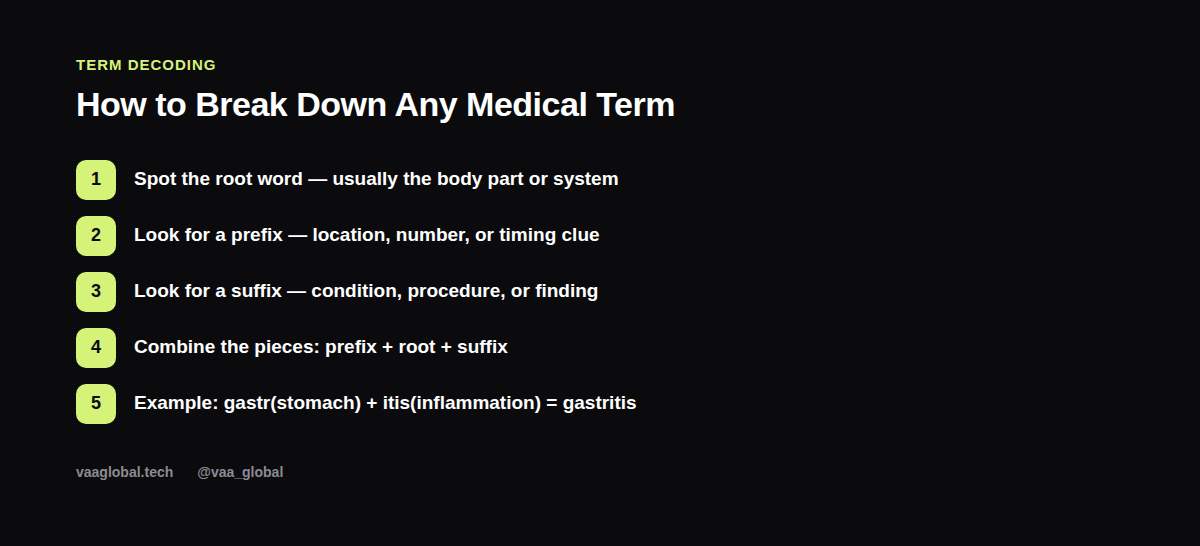
Most clinical terms follow a predictable structure: prefix + root + suffix. The root word usually refers to a body part or system (for example, "cardi" relates to the heart, "derm" relates to skin, "gastro" relates to the stomach). The prefix often adds information about location, number, or timing ("hypo-" means below or under, "hyper-" means above or excessive, "peri-" means around). The suffix usually describes a condition, procedure, or finding ("-itis" means inflammation, "-ectomy" means surgical removal, "-ology" means the study of). Put them together and "gastritis" breaks down simply: stomach inflammation.
A Short List of Root Words Worth Knowing First
Some of the most frequently seen roots include: cardi (heart), derm (skin), gastro (stomach), hepat (liver), nephro (kidney), neuro (nerve), osteo (bone), and pulmo (lung). You'll see these constantly across specialties, which is exactly why learning this short list pays off disproportionately compared to the time it takes to memorize.
Prefixes and Suffixes That Show Up Everywhere
On the prefix side: hypo- (below normal), hyper- (above normal), brady- (slow), tachy- (fast), and anti- (against). On the suffix side: -itis (inflammation), -ectomy (surgical removal), -otomy (cutting into), -oma (tumor or mass), -algia (pain), and -pathy (disease). Once these feel familiar, a term like "tachycardia" stops being a scary word and starts reading as simply "fast heart."
What Medical Abbreviations Should a Medical VA Know?
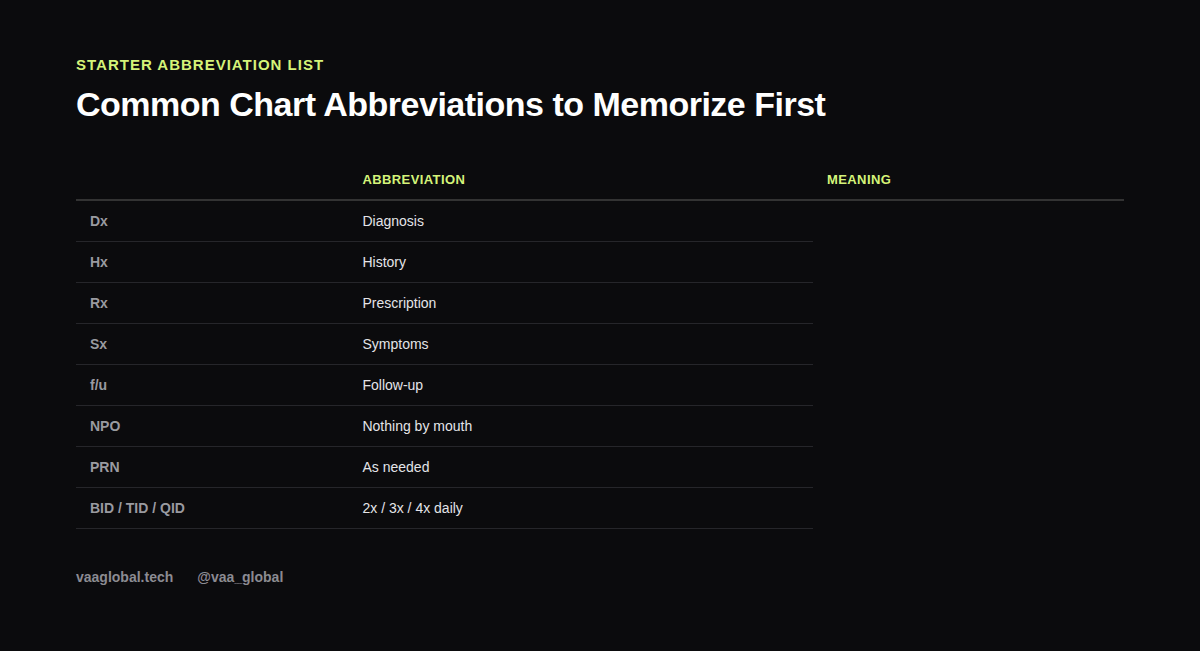
Beyond full words, charts are packed with shorthand. A short starter list: Dx (diagnosis), Hx (history), Rx (prescription), Sx (symptoms), f/u (follow-up), NPO (nothing by mouth), PRN (as needed), and BID/TID/QID (twice/three times/four times daily). These abbreviations appear constantly in SOAP notes and scheduling instructions, so recognizing them quickly saves real time and prevents misreading a patient's record.
How Do I Learn Medical Terminology Fast?
The fastest approach is spaced, applied repetition rather than passive memorization. Make flashcards for roots, prefixes, and suffixes separately, then practice breaking apart real (even sample) terms you encounter during training. Reading actual chart notes or sample templates, even before you fully understand every term, builds pattern recognition faster than a vocabulary list alone. Most learners find that after a few weeks of consistent, short daily practice, the patterns start clicking faster than expected.
Do I Need a Medical Degree to Learn Medical Terms?
No. This is one of the most common misconceptions that keeps capable people from pursuing medical VA work. Medical terminology is a language-pattern skill, not a clinical judgment skill, and plenty of people with zero healthcare background become comfortable with it within weeks of focused practice. The goal for a medical VA isn't diagnosing anything; it's reading, typing, and routing information accurately.
Common Mistakes Beginners Make
New learners often confuse similar-sounding roots (like "hepat" for liver versus "hepar" variants you might see in different contexts), or they guess at an abbreviation's meaning instead of confirming it, which can introduce real errors into a chart. Another common mistake is relying only on memorization without understanding the prefix-root-suffix pattern, which means every new term feels like starting from zero instead of building on what you already know.
How This Knowledge Shows Up Across the Job
This vocabulary foundation underpins nearly everything else in the role, from supporting medical billing tasks to understanding CPT and ICD-10 basics to communicating clearly during telehealth visits. For a comprehensive, authoritative medical dictionary reference, the National Library of Medicine's MedlinePlus is a free, trustworthy resource worth bookmarking. VA Global's Medical Virtual Assistant Training course builds medical terminology directly into its six beginner-level modules, so learners with no prior medical background get structured practice from day one.
The Bottom Line
A medical virtual assistant medical terminology crash course works best when you focus on patterns, not isolated words. Learn the common roots, prefixes, and suffixes, practice applying them to real examples, and you'll decode most of what crosses your desk within your first few weeks on the job.
A Quick Practice Drill You Can Do Today
Try this simple drill: take any unfamiliar medical word you come across, split it visually into prefix, root, and suffix, and guess the meaning before checking a dictionary. For example, "hepatomegaly" splits into hepat (liver) and -megaly (enlargement), so the whole word simply means an enlarged liver. Similarly, "neuropathy" splits into neuro (nerve) and -pathy (disease), meaning nerve disease. Doing this drill for just ten minutes a day, consistently, builds real fluency far faster than trying to cram a long list in one sitting. Because the same small set of pieces repeats across thousands of terms, your decoding speed improves quickly once the core patterns feel automatic rather than effortful.



