
If you're training to become a medical virtual assistant, SOAP notes are one of the first clinical documents you will encounter, because nearly every patient visit gets recorded in this format somewhere in the chart. A medical virtual assistant SOAP notes workflow usually does not mean writing the clinical note itself (that is a licensed provider's job), but it does mean you will see SOAP notes constantly, help organize the information that feeds into them, and sometimes assist with formatting, transcription cleanup, or data entry around them. So what is a SOAP note in healthcare, exactly, and how do medical virtual assistants help with SOAP notes day to day? Below we break down what SOAP stands for in medical notes, with a worked example.
What SOAP Actually Stands For
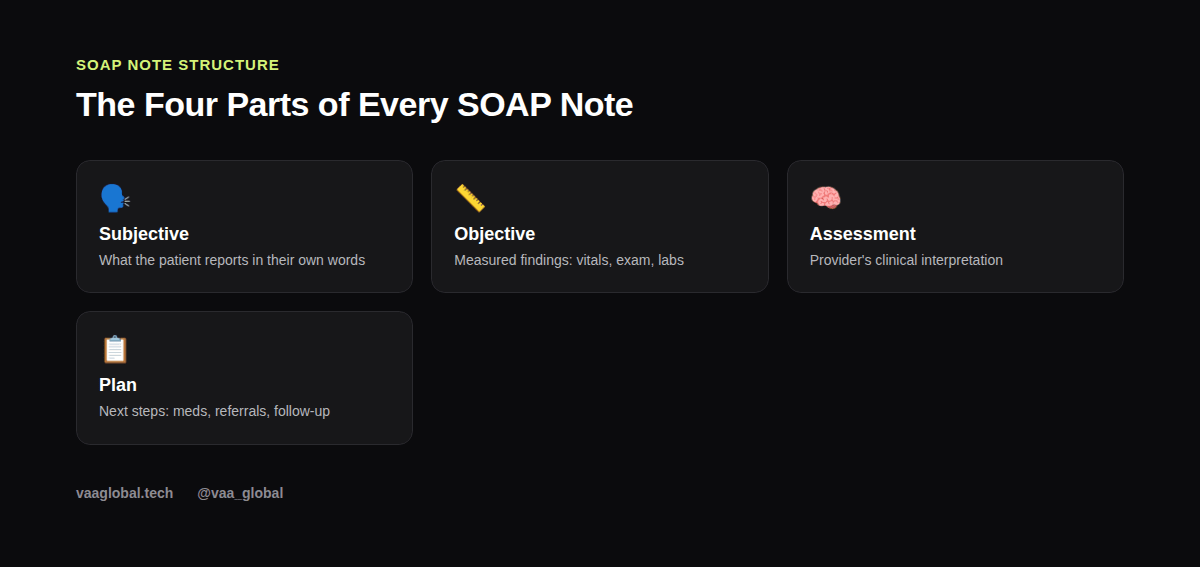
Every SOAP note follows the same four-part skeleton. Subjective is what the patient reports in their own words. Think symptoms, pain level, or how long something has lasted. Objective is what the provider or staff actually measures. This includes vital signs, exam findings, and lab results. Assessment is the provider's clinical interpretation or working diagnosis. Plan is what happens next. That usually means medications, referrals, follow-up instructions, or further testing. Because Subjective and Objective are built from information patients and staff provide, a medical VA often touches those two sections indirectly. You will rarely, if ever, write the Assessment or Plan yourself.
A Worked Example (For Learning Purposes Only)
Here is a simplified, fictional example so you can see the structure in action. This is a training illustration, not a real patient record:
S: "Patient reports a dry cough for five days, worse at night, no fever."
O: "Temp 98.4°F, lungs clear on auscultation, no wheezing noted."
A: "Likely viral upper respiratory infection."
P: "Recommend rest, fluids, OTC cough suppressant; follow up in 7 days if symptoms persist."
As a medical VA, you might be the one who took the initial intake call and typed the patient's reported symptoms into a pre-visit note, which then becomes the raw material for the Subjective line above. You might also be the one who files or formats the completed note into the patient's chart after the provider signs off.
Where Medical Virtual Assistants Fit In
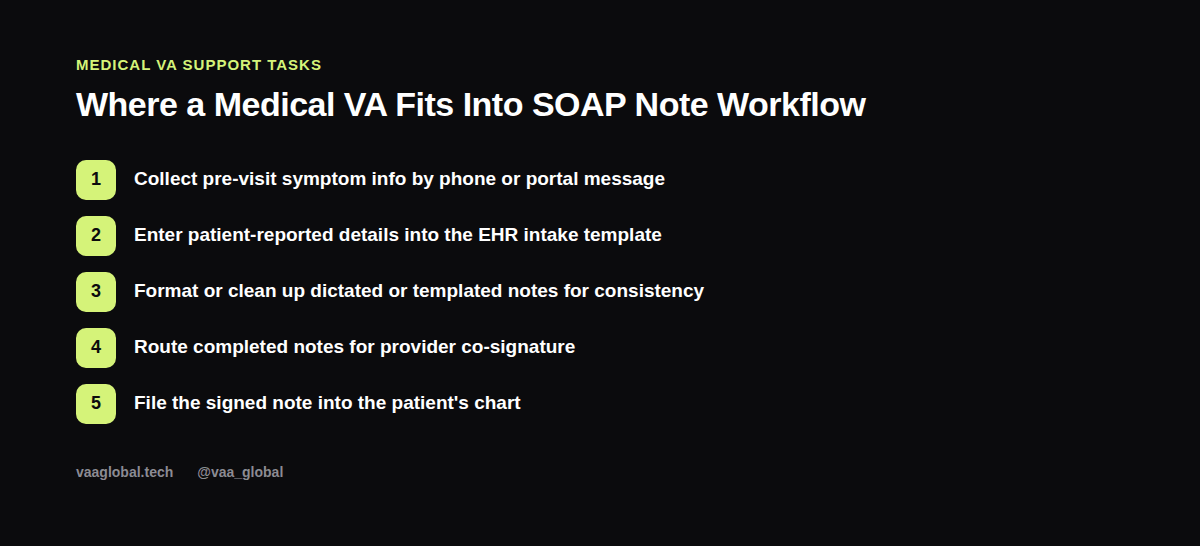
Your role around SOAP notes typically includes: collecting pre-visit information by phone or patient portal message, entering patient-reported symptoms into the EHR template before the visit, formatting or cleaning up dictated or templated notes for consistency, and routing completed notes for provider co-signature when a workflow requires it. You are not making the clinical call — you're keeping the documentation pipeline moving so providers spend less time on data entry and more time with patients. This overlaps with general medical VA daily tasks, but SOAP note support is one of the more clinically-adjacent pieces of that job.
Common Formatting Mistakes to Avoid
New medical VAs often blur the line between Subjective and Objective. For example, writing "patient seems anxious" in the Objective section is a judgment call, not a measurement — that belongs in Subjective or is the provider's assessment language, not yours to add. Similarly, never summarize or paraphrase a patient's reported symptoms in a way that changes their meaning; type what they said as closely as possible, because that becomes part of the legal medical record. If you're unsure whether something belongs in a note at all, flag it for the provider rather than guessing.
Why This Matters for Billing and Coding
SOAP notes are also the backbone of medical billing, because the Assessment section often determines which diagnosis code gets billed and the Plan section supports the procedure or service code. If you move into tasks that touch medical billing tasks or need to understand CPT and ICD-10 basics, a clean SOAP note is what makes accurate coding possible in the first place. A sloppy or incomplete note downstream often causes claim denials, which is why formatting accuracy matters even for support staff who never touch the clinical content.
SOAP Notes vs. Other Chart Documentation
Not every entry in a patient's chart is a SOAP note. Nursing flow sheets, telephone encounter logs, and brief progress notes between visits often use simpler formats than a full SOAP write-up. SOAP still remains the dominant structure for office visit documentation across most EHR systems, though. Because of that, it's worth learning the format well even if your specific employer customizes its template slightly. Every SOAP note also documents a single patient encounter from start to finish, which is part of why providers and auditors rely on it so heavily. For official guidance on how patient records must be protected and handled, the U.S. Department of Health and Human Services HIPAA guidance is the authoritative source. If you later support telehealth visits, you'll notice the same SOAP skeleton gets used there too, just captured through a video visit instead of an in-person exam.
How to Get Comfortable With SOAP Notes Before Your First Job
Because you won't be writing clinical content, your goal is pattern recognition: learn to scan a note and instantly know which section you're looking at, learn the common abbreviations (Dx for diagnosis, Hx for history, Rx for prescription), and practice typing accurately and quickly since speed and accuracy are what clients actually pay for. Reviewing sample templates in whatever EHR your training covers is far more useful than memorizing medical theory. VA Global's Medical Virtual Assistant Training course covers electronic health records and medical terminology across its six modules, which gives beginners with no prior medical background a structured way to build this comfort before applying for roles.
The Bottom Line
Medical virtual assistant SOAP notes work is less about clinical writing and more about accurate, careful support around a format providers rely on every day. Once you know what Subjective, Objective, Assessment, and Plan each mean — and where your responsibilities start and stop — you'll move faster, make fewer errors, and become genuinely useful to a busy practice from your very first week.



