
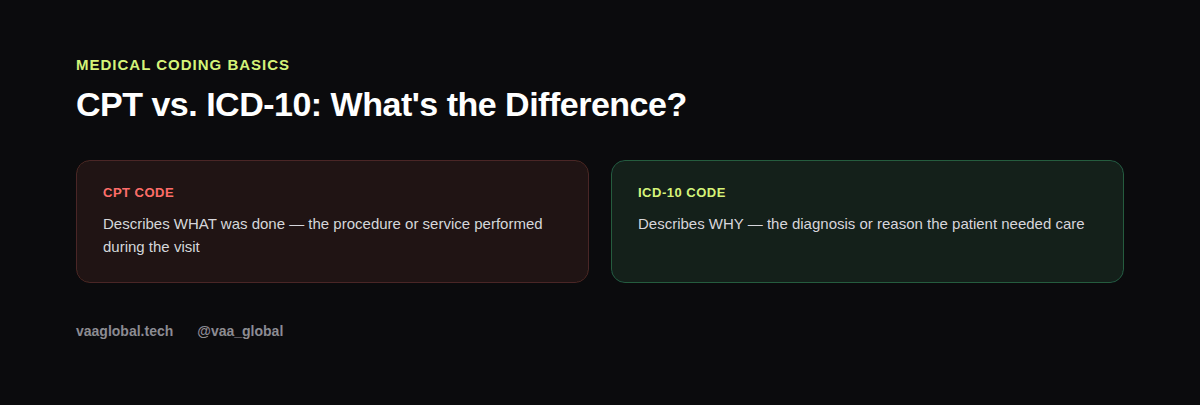
Every medical virtual assistant CPT ICD-10 conversation starts with the same confusion: the two code sets sound similar but do completely different jobs. CPT codes describe what a provider did during a visit, while ICD-10 codes describe why the patient needed that visit in the first place, and if you can keep that one distinction straight, most of the rest of medical coding starts to make sense.
This article covers the medical coding basics in plain language: CPT codes explained simply, ICD-10 diagnosis codes broken down the same way, and a clear look at procedure vs diagnosis codes so you stop mixing them up. We'll also cover how medical codes are used in billing, how a claim form ties everything together, and why a certified medical coder, not a medical VA, usually has final say over which code gets used.
CPT Codes: The "What Was Done"
CPT stands for Current Procedural Terminology, a code set maintained by the American Medical Association. Every office visit, lab test, vaccination, or procedure has a corresponding CPT code that tells the insurer exactly what service was billed. For example, a standard office visit of a certain complexity level has its own distinct code, separate from a code for a more involved visit with an established patient. The exact numeric codes change periodically and should always be looked up in a current reference rather than memorized from an old source, which is why we won't print specific numbers here.
ICD-10 Codes: The "Why"
ICD-10 stands for the International Classification of Diseases, 10th revision, and it's the code set used to describe diagnoses and reasons for care. A patient coming in for a sprained ankle gets a different ICD-10 code than a patient coming in for seasonal allergies, even if both visits used the identical CPT procedure code for an office visit. Insurers use the ICD-10 code to judge whether the service billed (the CPT code) was medically necessary for that diagnosis, which is exactly why mismatched pairs are such a common cause of claim denials.
A Simple Way to Remember the Difference
Think of ICD-10 as the reason and CPT as the action. If a friend asked "why did you go to the doctor?" your answer maps to an ICD-10-style diagnosis. If they asked "what did the doctor actually do?" your answer maps to a CPT-style procedure. A visit for a diabetes check-up (reason) might involve bloodwork and an office visit (actions) — one diagnosis code, potentially two or more procedure codes.
Where Medical Virtual Assistants Actually Use This Knowledge
You will rarely be the person selecting final billing codes, especially as a beginner; that's typically a certified medical coder's job. However, you will regularly see these codes while supporting medical billing tasks, preparing a superbill, or helping sort out a denied claim during denial management. This is also exactly why VA Global's existing guide on medical coding boundaries is worth reading alongside this one: it covers what you should never do with codes, while this article covers what the codes actually mean.
Red Flags Worth Noticing (Without Fixing Them Yourself)
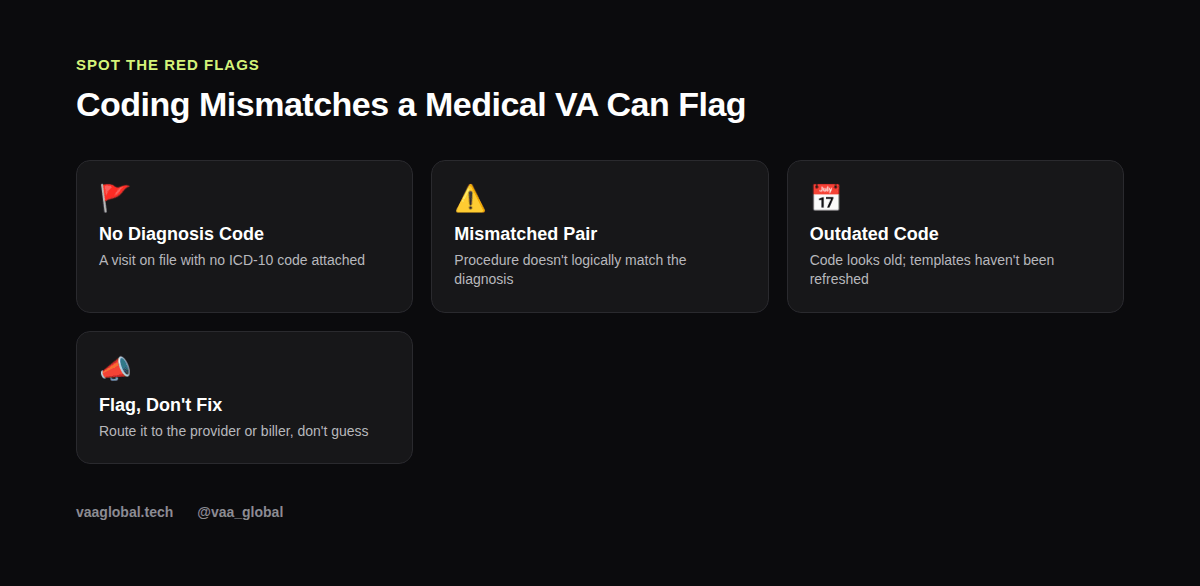
Even without coding authority, a sharp-eyed medical VA can flag likely problems before they become denials: a procedure code for a service type that doesn't match the diagnosis on file, a visit with no diagnosis code attached at all, or a code that looks obviously outdated because the practice hasn't updated its templates in years. Flagging these to the provider or biller, rather than silently fixing them, keeps you safely within your role while still adding real value.
Why Code Sets Get Updated
ICD-10 codes are revised and expanded periodically to reflect new diagnoses, and CPT codes are updated annually by the AMA to reflect new procedures and retire outdated ones. Because of this, relying on outdated training materials or an old cheat sheet taped to a desk is a real risk. For current, authoritative code lookups and guidance, the American Academy of Professional Coders (AAPC) and the American Health Information Management Association are the standard references medical coders use, and pointing a practice toward them is safer than guessing yourself.
How This Connects to Everyday VA Tasks
Lab orders, referral letters, and even prior authorization requests all reference these same code sets behind the scenes, so the pattern-recognition skill you build here pays off across many other medical VA tasks, not just billing. Insurance verification calls also often require you to read a diagnosis code back to a representative, so being comfortable with the format, not the memorization, saves real time on the phone. People new to this often ask what is the difference between CPT and ICD-10 codes on the phone with a payer rep, and knowing the answer cold builds instant credibility. Reimbursement itself depends on that pairing being correct, which is the whole reason insurers scrutinize it so closely.
Building This Skill Without a Coding Certification
You do not need a professional coding certificate to work as a medical VA, and you shouldn't claim coding authority you don't have. What helps most is simply getting comfortable with the shape and purpose of each code type through repetition. VA Global's Medical Virtual Assistant Training course introduces medical billing and coding fundamentals as part of its six beginner-level modules, which is enough grounding for support-level tasks without requiring a prior medical background.
The Bottom Line
Medical virtual assistant CPT ICD-10 knowledge doesn't require memorizing numeric codes. It requires understanding that CPT answers "what was done" and ICD-10 answers "why," and knowing when something looks off enough to flag for someone with coding authority. Get that distinction solid, and you'll navigate billing-adjacent tasks with far more confidence.



