
Medical virtual assistant denial management work starts the moment a claim comes back from an insurer marked "denied" instead of "paid," and learning to handle that moment calmly and systematically is one of the most valuable skills you can bring to a billing-focused practice. A denied claim is not necessarily lost money; it's usually a solvable problem, and knowing how to solve it is what separates a reactive admin assistant from a genuinely useful one.
What Causes a Medical Claim to Be Denied?
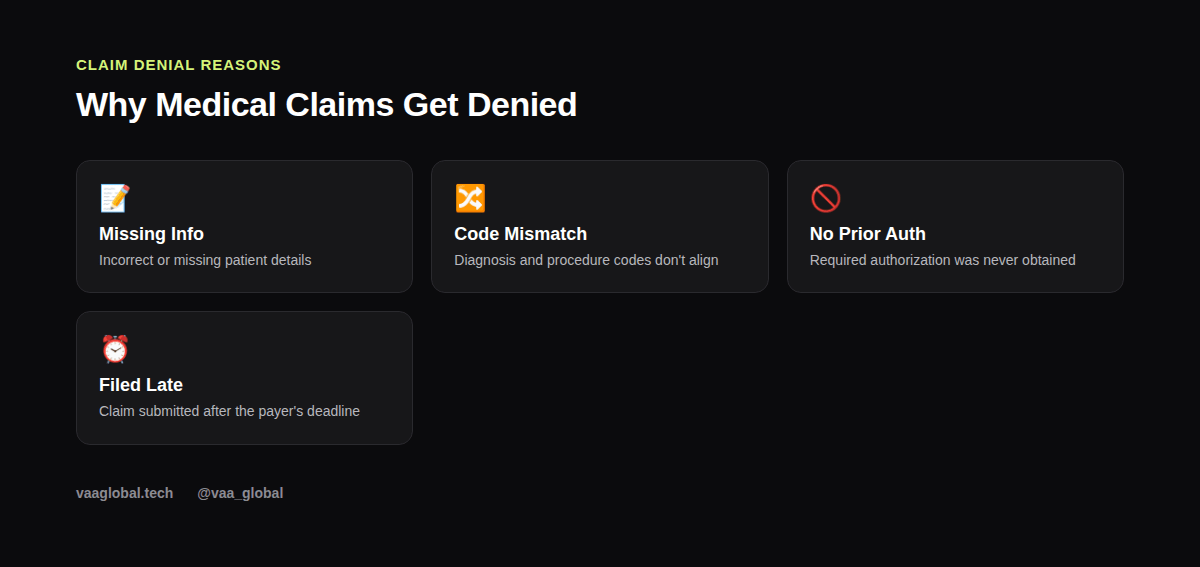
Denials generally fall into a handful of recurring buckets: missing or incorrect patient information, a mismatched diagnosis and procedure code pairing, a missing prior authorization, a service the payer considers not medically necessary, a claim filed after the payer's deadline, or duplicate billing. Most denials are not fraud or dishonesty; they're clerical. That's actually good news, because clerical problems are usually fixable once you know exactly what went wrong.
Reading the Denial Code
Every denial comes with a reason code on the explanation of benefits (EOB) or remittance advice, and your first job is translating that code into plain English. For example, a code indicating the service wasn't covered under the patient's plan requires a very different fix than a code indicating the claim was filed late. Before doing anything else, read the denial reason carefully, because resubmitting the exact same claim without addressing the actual problem just produces a second denial and wastes everyone's time.
Step-by-Step: A Basic Denial Management Workflow
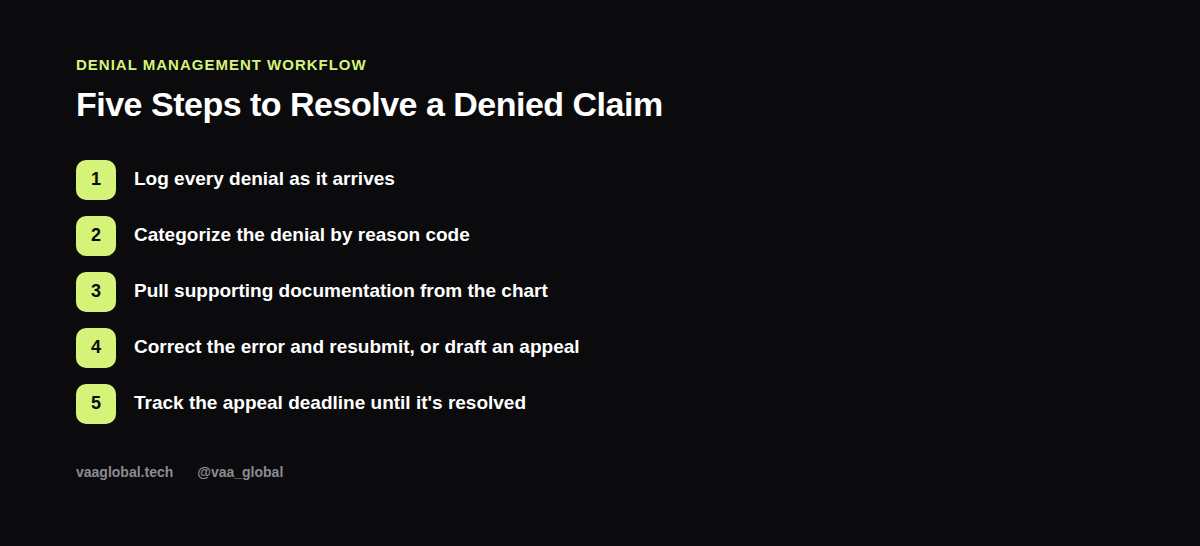
A typical process looks like this: first, log every denial as it arrives so nothing slips through; second, categorize the denial by reason code; third, pull the original documentation (chart notes, prior authorization records, or SOAP notes) needed to support a correction; fourth, correct the error and resubmit, or draft an appeal letter if the claim requires one; and fifth, track the resubmission against the payer's appeal deadline so nothing expires unresolved. Because deadlines vary by payer and sometimes by state, missing one can mean the practice loses the ability to collect that money at all.
Writing a Basic Appeal (Simplified Example)
Here's a fictional, simplified appeal letter structure for training purposes only: "We are appealing the denial of claim #[number] for patient [name], dated [service date]. The claim was denied for [reason stated on EOB]. Attached is documentation showing [supporting evidence, such as medical necessity notes or corrected billing information]. We request reconsideration and prompt reprocessing of this claim." A real appeal letter would include specific clinical documentation a provider supplies, and a medical VA's role is usually to assemble and format that letter, not to write the clinical justification themselves.
Denial Management vs. Claim Rejection: Are They the Same?
Not quite. A rejection usually means the claim never entered the payer's processing system at all, often due to a formatting or data-entry error, and can typically be corrected and resubmitted quickly. A denial means the claim was processed and the payer made an actual coverage decision, which often requires a formal appeal rather than a simple resubmission. Knowing which one you're dealing with changes your whole approach, so always check the payer's language carefully before choosing resubmission versus appeal.
How This Connects to Other Medical VA Tasks
Strong denial management leans heavily on skills covered elsewhere in a medical VA's toolkit: understanding CPT and ICD-10 basics helps you spot a coding mismatch instantly, familiarity with the insurance verification process helps you catch eligibility issues before they ever cause a denial, and knowing the prior authorization process prevents one of the most common denial reasons altogether.
Staying Within Scope While Managing Denials
You can gather documentation, format appeal letters, track deadlines, and communicate with the payer's representative on the phone. However, decisions about clinical medical necessity still belong to the provider, and formal interpretations of coverage policy are the payer's call, not yours. For authoritative guidance on claims and appeals processes under federal healthcare programs, the Centers for Medicare & Medicaid Services publishes detailed appeal procedures worth referencing when a practice's own policy is unclear.
How Long Does Denial Management Usually Take?
Timelines vary a lot by payer, but here is a general sense of what to expect. A simple corrected resubmission might reprocess within two to four weeks. A formal appeal with supporting documentation often takes longer, sometimes a month or more, because the payer has to route it to a reviewer. As a result, patience and consistent follow-up matter as much as the initial paperwork. Many practices keep a simple spreadsheet or tracker noting the claim number, the denial reason, the date the appeal was sent, and the follow-up date, so nothing quietly falls through the cracks while everyone waits for the payer to respond. This is also a good moment to ask what causes a medical claim to be denied a second time, since repeat denials on the same claim usually point to a step that was skipped the first time around.
Building This Skill as a New Medical VA
Denial management is rarely a day-one task, but it's a natural next step after you're comfortable with billing basics and documentation workflows. VA Global's Medical Virtual Assistant Training course covers medical billing fundamentals across its six modules, giving beginners a foundation to build toward denial-focused roles over time, even without a prior healthcare background.
The Bottom Line
Medical virtual assistant denial management comes down to a simple habit: read the reason carefully, fix the actual problem, document everything, and track every deadline. Master that loop and you become one of the people a practice trusts to keep its revenue moving instead of stuck in a drawer of denied claims.



