Billing gets noticeably more particular once a government payer is involved, which is exactly why medical virtual assistant Medicare Medicaid billing basics deserve their own closer look. Medicare and Medicaid are both US government health insurance programs, but they serve different populations and follow their own specific rules for how claims get submitted and processed. As an MVA, you won't need to master every regulation, but understanding the general shape of how these programs work helps you support billing staff accurately and avoid easy mistakes.
Medicare and Medicaid Are Not the Same Thing
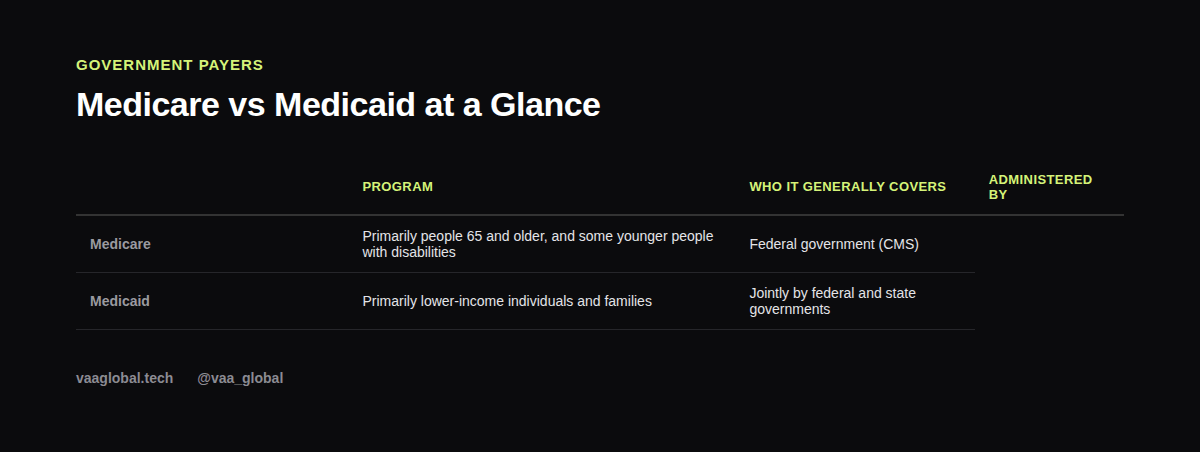
Medicare generally covers people 65 and older, along with some younger people with disabilities, and it's administered federally. Medicaid, on the other hand, generally covers lower-income individuals and families, and it's run jointly by federal and state governments, which means rules can vary somewhat by state. Confusing the two can lead to real billing mistakes, so knowing which program a patient is covered under matters from the very first intake step.
What Is the Difference Between Medicare and Medicaid, Really?
So, what is the difference between Medicare and Medicaid beyond the basic age and income framing? Medicare eligibility is mostly tied to age or disability status, and it's consistent nationwide since the federal government runs it directly. Medicaid, by contrast, is a joint federal-state program, so specific eligibility rules and covered services can vary from one state to another, which adds a layer of complexity an MVA should at least be aware of.
Why Government Payer Rules Differ From Private Insurance
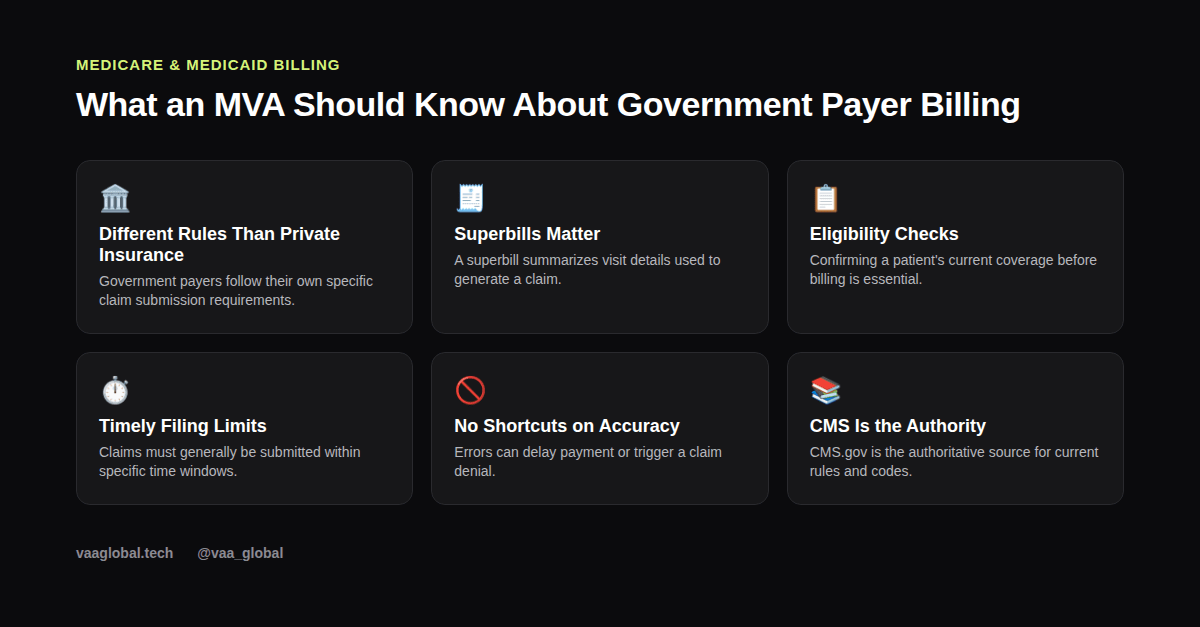
Private insurers set their own claim requirements, but government payers like Medicare and Medicaid follow federal and state regulations that tend to be more rigid and detailed. That means less flexibility around documentation and timing, and a stronger emphasis on getting the details right the first time rather than correcting them after a denial.
What Is a Superbill Used For?
So, what is a superbill used for exactly? It's essentially a detailed summary of a patient visit, including services provided and relevant diagnosis information, which becomes the basis for a claim submitted to the insurer. An MVA might help prepare or organize this information before it reaches a biller or coder, even without directly assigning billing codes themselves. Our overview of medical billing tasks covers where this kind of support typically fits.
Eligibility Verification Comes First
Before any claim gets submitted, someone needs to confirm the patient's coverage is active and matches what's on file. This step prevents a lot of downstream billing headaches. Our guide on the insurance verification process walks through this in more detail, and the same general logic applies whether the payer is private, Medicare, or Medicaid.
Timely Filing and Why Deadlines Matter
Government payers generally require claims to be submitted within a specific window after a visit, often referred to as a timely filing limit. Missing that window can mean the claim gets denied entirely, with no payment recovered, regardless of how legitimate the original service was. This is one more reason accurate, prompt documentation matters so much in this part of the job.
Where Prior Authorization Fits In
Some services require approval from the payer before they happen, a process known as prior authorization. This applies to certain Medicare and Medicaid services just as it does with private insurance. Our piece on the prior authorization process explains how an MVA typically supports this step without making the actual approval decision.
Why Do Government Payers Have Strict Billing Rules?
It's worth asking directly: why do government payers have such strict billing rules compared to many private insurers? Largely because these programs are funded by taxpayers and administered under federal and state law, so accountability and documentation standards tend to be tighter. That accountability is exactly why precision matters so much in this corner of healthcare administration.
Can an MVA Submit Medicare Claims?
A fair question many beginners ask is whether an MVA can submit Medicare claims directly. Generally, no, not independently. Claim submission typically goes through a certified biller or coder, while an MVA supports the surrounding steps, like confirming eligibility and organizing visit documentation, that make an accurate submission possible in the first place.
Why You Shouldn't Memorize Specific Codes or Rates
Billing codes and reimbursement rates change periodically, and getting them wrong from memory is riskier than not knowing them at all. Instead of memorizing specific numbers, focus on understanding the general process. When exact current details matter, the authoritative source is always CMS.gov, the federal agency that actually runs these programs.
How This Shows Up in a Typical MVA Role
In practice, you're more likely to support the surrounding administrative work, confirming eligibility, organizing visit documentation, tracking claim status, and flagging anything unusual, than to personally code or submit a Medicare or Medicaid claim. That division of labor protects both you and the practice from costly errors.
The Bottom Line
Medical virtual assistant Medicare Medicaid billing basics really come down to understanding that government payers follow stricter, more specific rules than private insurance, and that your role usually sits in the supportive administrative layer around that process, not inside the coding itself. VAA Global's Medical Virtual Assistant Training is a 6-module, beginner-level course covering medical billing and coding basics, HIPAA compliance, and healthcare administration, with no prior medical background required, plus job assistance after graduation.