
If you're new to remote healthcare support work, this medical virtual assistant invoicing clients guide walks you through exactly how to bill, when to bill, and what to include so you get paid correctly and on time. Invoicing feels like a small administrative task until you get it wrong, and then it becomes the reason a client pays you three weeks late or disputes your hours.
Why Invoicing Properly Matters More In Healthcare Support Work
Medical practices tend to run billing through established systems like practice management software, and your invoice is often the odd one out that someone has to manually process. That means clarity matters. A vague invoice with just a total and no breakdown is more likely to sit in a queue while an office manager tries to figure out what it's for. A clean, itemized invoice gets approved faster because it answers the question before anyone has to ask it.
What To Put On Every Invoice
At minimum, your invoice should have: your name or business name and contact info, the client's name and practice, an invoice number and date, the billing period covered, an itemized list of tasks or hours, your rate, subtotal, any discounts, and the final total. If you're tracking billable hours across tasks like scheduling, insurance verification, or EHR data entry, break each one out separately rather than lumping everything into one line. This also helps if a client ever questions a specific task.
A Sample Invoice Structure (Illustrative Numbers)
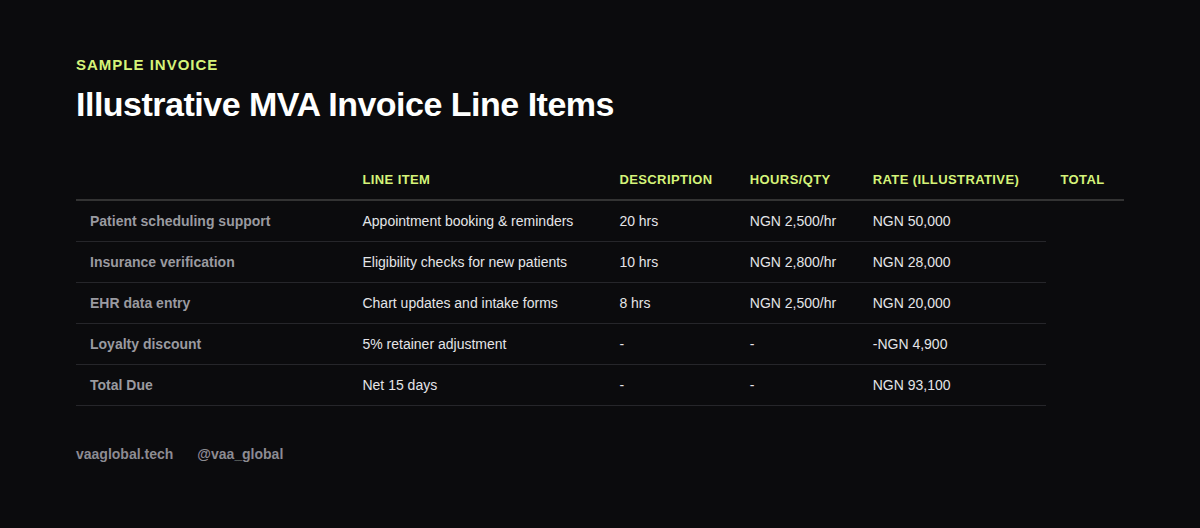
Here's a worked example using made-up, illustrative numbers only, not real market rates. Say you worked 20 hours on patient scheduling support at NGN 2,500/hr, 10 hours on insurance verification at NGN 2,800/hr, and 8 hours on EHR data entry at NGN 2,500/hr, with a 5% loyalty discount applied for a long-term client. The line items would look like this.
Setting Payment Terms That Actually Get Respected
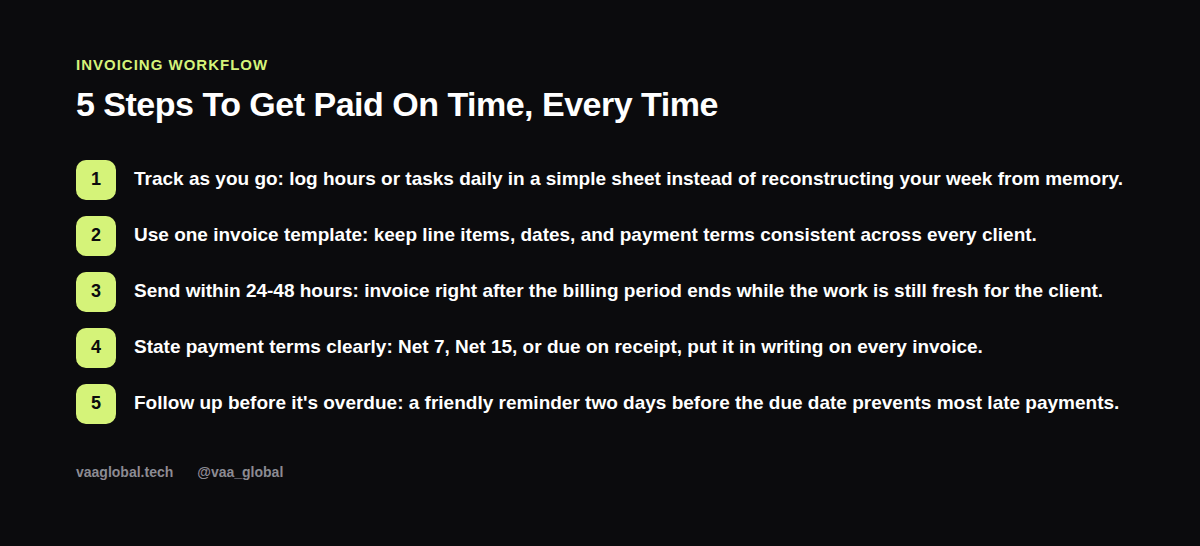
Payment terms for freelancers only work if you state them clearly and consistently. Net 15 means payment is due 15 days after the invoice date. Net 7 is tighter and works well for short-term or contract-based work. Due on receipt is reasonable for one-off tasks. Whatever you choose, put it in writing on the invoice itself, not just in a conversation, and repeat it when you first start working with a client so there's no confusion later.
Tracking Billable Hours Without Losing Your Mind
The easiest way to avoid invoicing stress is to track as you go. A simple spreadsheet with columns for date, task, time spent, and client name is enough when you're just starting out. Update it daily, not at the end of the month when you're guessing. If you're juggling more than one client, this habit is what keeps your work across multiple practices straight without double-billing hours or forgetting tasks entirely.
Handling Late Payments Without Burning The Relationship
Most late payments aren't malicious, they're just low priority for a busy office. Send a polite reminder a day or two before the due date, and another short follow-up the day it's due if nothing's landed. Keep the tone professional and assume good faith on the first miss. If a pattern develops with a specific client, that's a conversation about terms, not an accusation.
Invoicing Tools Worth Considering
You don't need expensive software to start. Google Sheets or a free invoice template can carry you for your first several clients. As you grow, tools like Wave, Invoicely, or PayPal's built-in invoicing feature add automation like due-date reminders and payment tracking. Whatever you pick, consistency matters more than the tool itself, since clients get used to how your invoices look and that familiarity speeds up approval.
How This Connects To Running Your Business Long-Term
Good invoicing habits are also the foundation for everything else in your career path after two years as an MVA, including eventually writing solid contract essentials and even building an agency if you choose to scale. For more general freelance invoicing mistakes to avoid, see our piece on common invoicing mistakes freelancers make, and for the basics of writing professional invoices as a Nigerian freelancer, check this guide. If you want to build these skills from the ground up, the Medical Virtual Assistant Training course is a 6-module, beginner-level program that requires no prior medical background and includes job assistance after graduation.
The IRS Of Your Own Business: Keep Records
Keep a copy of every invoice you send, along with proof of payment, for at least a year. This protects you if a client disputes a charge and makes tax season far less painful. The U.S. Small Business Administration has general guidance on recordkeeping that applies even if you're not US-based; see their recordkeeping guide for the basics that apply to any small business or freelancer.
The Bottom Line
This medical virtual assistant invoicing clients guide boils down to a few habits: track your hours as you go, use one consistent template, state your payment terms clearly, send invoices promptly, and follow up before things go overdue. Get these right early and invoicing stops being a source of stress and becomes just another routine part of running your remote healthcare support business.



